
The Future Of Mobile [DECK] 5 Trends Shaping the Mobile Market. Jeremy Lockhorn | February 7, 2012 | 1 Comment inShare81 Opportunities for marketers to connect with their audiences on mobile devices this year.
The explosive growth of smartphones and the resulting tectonic shifts in consumer behavior continue to demonstrate the need for big marketers to pay attention and find ways to connect with their audiences on mobile devices (as if you haven't heard that before). Loyal Users Generate 25% More In-App Purchases. In-app purchases are the lifeblood of many apps, and although it may seem like getting users to the sale proposition quickly is ideal, a new Localytics study finds that building relationships with app users and fostering long-term usage are more important.
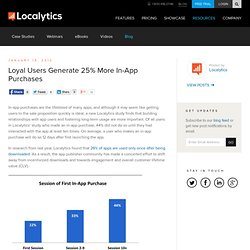
Of all users in Localytics’ study who made an in-app purchase, 44% did not do so until they had interacted with the app at least ten times. On average, a user who makes an in-app purchase will do so 12 days after first launching the app. In research from last year, Localytics found that 26% of apps are used only once after being downloaded. As a result, the app publisher community has made a concerted effort to shift away from incentivized downloads and towards engagement and overall customer lifetime value (CLV).
With this new data, that shift is shown to be even more important. Engagement leads to higher CLV Grow customer lifetime value Author. Massively Mobile: iPhone apps for your favorite MMOs part 2. Massively Mobile: iPhone apps for your favorite MMOs. Every two weeks, Massively Mobile brings you the latest news, guides and analysis about MMOs on mobile devices.
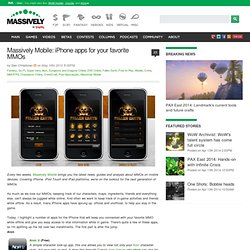
Covering iPhone, iPod Touch and iPad platforms, we're on the lookout for the next generation of MMOs. As much as we love our MMOs, keeping track of our characters, maps, ingredients, friends and everything else, can't always be juggled while online. And often we want to keep track of in-game activities and friends while offline. The Game Bakers – Money and the App Store: a few figures that might help an indie developer. Emeric Thoa is the creative director and co-founder of The Game Bakers, an independent game studio that recently released the turn-based action RPG SQUIDS on iOS.
Twitter: @emericthoa ; company twitter: @thegamebakers _ _ _ _ _ Eighteen months ago, when I left Ubisoft to start an independent game studio and focus on making my own games, I looked online a bit to get an idea of how much income I could expect to make as an indie. At Ubisoft I used to work on big AAA console games, and I had some figures in mind, but I knew they wouldn’t be relevant for my new life: $20M budgets, teams of 200 hundred people, 3 million sales at $70 per unit… I knew being an indie developer would be completely different, but I had very little information about how different it would be. Statistics from the mobile games forum. By Zoya Street on January 30, 2012 If you missed some of the best figures from the Mobile Games Forum, either because you weren’t there or because you were too busy networking, don’t worry.
GAMESbrief has you covered. Mixpanel-mobile-money-infographic-jpeg.jpg (Image JPEG, 740x4127 pixels) Mobile Ad Spending in BRIC Countries Set To Grow by 100% Smartphone Penetration Rates by Country! We Have Good Data (finally) Thank you Netsize Guide and Informa!

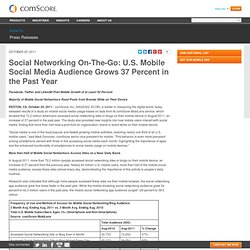
Thank you Google and Ipsos! We have finally some solid international data on smartphone penetration rates, broken down nationally. Not every country yet, but we can do a very solid analysis of 42 major countries, that cover 72% of the world's mobile phone subscriptions with countries included from all six inhabited continents. Social Networking On-The-Go: U.S. Mobile Social Media Audience Grows 37 Percent in the Past Year. October 20, 2011.
The 20 Most Advanced Countries in Mobile (Updated Listing for EOY 2011) I have been tabulating the listing for the most advanced countries in mobile and been showing it at various events and printing the latest chart in my TomiAhonen Almanac annually, etc.
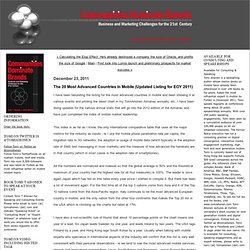
I have been doing updates for the various annual stats that will go into the 2012 edition of the Almanac and have just completed the index of mobile market leadership. This index is as far as I know, the only international comparative table that uses all the major metrics for the industry as inputs - ie I use the mobile phone penetration rate per capita, the migration rate to 3G networks, the adoption ie usage of mobile data (which typically is the adoption rate of SMS text messaging in most markets) and the measure of how advanced the handsets are in that country (which in most cases is the adoption rate of smartphones).
All the numbers are normalized and indexed so that the global average is 50% and the theoretical maximum (if your country had the highest rate for all four measures) is 100%. Or take 3G. Orange-exposure-2011.pdf (Objet application/pdf) Ethnicity Study. Announcements As gamers age, so does their propensity to buy mobile virtual goods BOSTON – December 20, 2011 – Today MocoSpace, the largest mobile gaming community in North America, is announcing results of a new study focused on virtual goods consumption and engagement by age.

The report found younger gamers (25-35) spend the most time playing social games, but gamers over 45 buy exponentially more virtual goods than their younger counterparts. The study, conducted over a three-month period between August and November, surveyed nearly 500,000 gamers on MocoSpace’s expansive network of 22 million users. Charted: Android Fragmentation.
Mobile + Cloud + Social. These are the three interdependent forces that power the biggest wave of growth, change, and destruction I’ve seen since I have been allowed to take part in the high-tech industry.
In the beginning (or mine, anyway), back in 1968 when I was, miraculously, offered a salary to be part of HP France there was the mainframe. IBM – “The Company” — reigned supreme, a dynasty that seemed unassailable. The IBMer wore a suit and tie when approaching the punch card feeder. Big Blue’s competitors, the BUNCH, were also called the Seven Dwarfs because their combined market share couldn’t compare to IBM’s dominance.
A few years later, the dress code relaxed a bit and Digital Equipment Corporation’s minicomputer displaced mainframes. Android Outpaces iPhone In 2011 U.S. Smartphone Sales. Android Outpaces iPhone In 2011 U.S. Smartphone Sales Google's Android operating system continues to lead U.S. smartphone sales and has increased its market share in recent months, according to research.