
Conectores Condicionales en Inglés. If you can't see the Babylon translation box, use this link for <a href=" or this one for <a href=" Descárgalo gratis aquí Son aquellos que indican condición para la realización de algo.
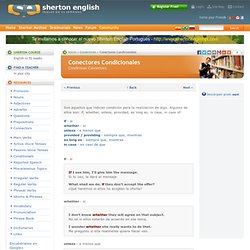
Algunos de ellos son: if, whether, unless, provided, as long as, in case, in case of. if - si whether - siunless - a menos queprovided / providing - siempre que, mientras as long as - siempre que, mientras in case - en caso de que if - si <object type="application/x-shockwave-flash" data="/audio/mediaplayer.swf" width="100" height="20"><param name="movie" value="/audio/mediaplayer.swf" /><param name="flashvars" value="file=/audio/resources/connectors/connectors-conditional.02.mp3" /></object> If I see him, I'll give him the message.
Whether - si unless - a menos que provided / providing - siempre que, mientras as long as - siempre que, mientras in case - en caso de que Want to learn English with other people? Results for smack - Longman English Dictionary Online. Listen, learn and teach English for elementary and pre-intermediate English learners. There are more vocabulary activities related to these podcasts on the 'extras' page. 125 Iceland: the land of fire and ice.
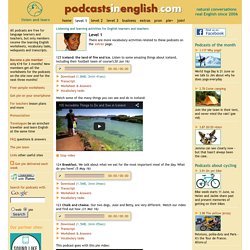
Listen to some amazing things about Iceland, including their football team of course! (30 Jun 16) ► Download (1.8MB, 3min 41sec) ► Transcript ► Worksheet & Answers► Vocabulary tasks Watch some of the many things you can see and do in Iceland: ◼ Stop video 124 Breakfast. . ► Download (1.5MB, 3min 04sec) ► Transcript ► Worksheet & Answers► Vocabulary tasks 123 Chalk and cheese. . ► Download (1.5MB, 3min 05sec) ► Transcript ► Worksheet & Answers► Vocabulary tasks This podcast goes with this pie video: 122 Chinese New Year. . ► Download (1.62MB, 3min 33sec) ► Transcript► Worksheet & Answers► Vocabulary tasks Chinese New Year in London's Chinatown (in the rain of course 121 Toys, toys, toys.
. ► Download (1.62MB, 3min 33sec) ► Transcript► Worksheet & Answers► Vocabulary tasks This is how to wrap your presents simply and beautifully: My Drive. Stative and Dynamic Verbs. Verbs in English can be classified into two categories: stative verbs and dynamic verbs.
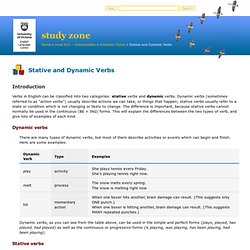
Dynamic verbs (sometimes referred to as "action verbs") usually describe actions we can take, or things that happen; stative verbs usually refer to a state or condition which is not changing or likely to change. The difference is important, because stative verbs cannot normally be used in the continuous (BE + ING) forms. This will explain the differences between the two types of verb, and give lots of examples of each kind.
Dynamic verbs There are many types of dynamic verbs, but most of them describe activities or events which can begin and finish. Dynamic verbs, as you can see from the table above, can be used in the simple and perfect forms (plays, played, has played, had played) as well as the continuous or progressive forms (is playing, was playing, has been playing, had been playing). Stative verbs Stative verbs usually refer to a state or condition which is quite static or unchanging. Code - Open Blog. Pre-intermediate. Incidental teaching. English to French, Italian, German & Spanish Dictionary. Longman English Dictionary Online. The Short Happy Life of Francis Macomber.docx.