
Economics. For a topical guide to this subject, see Outline of economics.
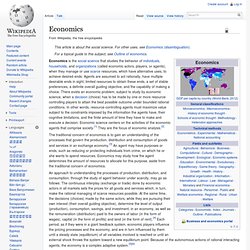
Economics is the social science that studies the behavior of individuals, households, and organizations (called economic actors, players, or agents), when they manage or use scarce resources, which have alternative uses, to achieve desired ends. Agents are assumed to act rationally, have multiple desirable ends in sight, limited resources to obtain these ends, a set of stable preferences, a definite overall guiding objective, and the capability of making a choice. Outline of economics. The following outline is provided as an overview of and topical guide to economics: Nature of economics[edit] Economics can be described as all of the following:
History of economic thought. The history of economic thought deals with different thinkers and theories in the subject that became political economy and economics from the ancient world to the present day.
It encompasses many disparate schools of economic thought. Ancient Greek writers such as the philosopher Aristotle examined ideas about the art of wealth acquisition, and questioned whether property is best left in private or public hands. In medieval times, scholastic scholars such as Thomas Aquinas argued that it was a moral obligation of businesses to sell goods at a just price.