
Bullyprevention_ES. New: 10 of the best Apple apps for education in 2012. New apps include student file sharing, special education, cyber bullying information By Meris Stansbury, Associate EditorRead more by Meris Stansbury April 21st, 2012 One app teaches young students about cyber bullying.
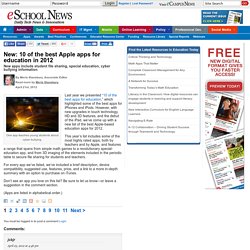
Last year we presented “10 of the best apps for education,” which highlighted some of the best apps for iPhones and iPods. However, with new upgrades in touch technology, HD and 3D features, and the debut of the iPad, we’ve come up with a new list of the best Apple-based education apps for 2012. This year’s list includes some of the most highly rated apps, both by teachers and by Apple, and features a range that spans from simple math games to a revolutionary special-education app, and from 3D imaging of the elements included in the periodic table to secure file sharing for students and teachers.
Don’t see an app you love on this list? (Apps are listed in alphabetical order.) Are We Wired For Mobile Learning? Because of the proliferation of new technologies, the younger generation today is outgrowing traditional forms of education – remember pencils, chalkboards, textbooks and graphing calculators?
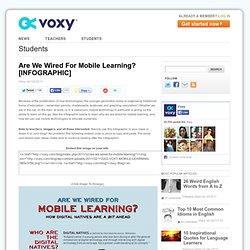
Whether we are in the car, on the train, at work, or in a classroom, mobile technology in particular is giving us the ability to learn on-the-go. See the infographic below to learn why we are wired for mobile learning, and how we can use mobile technologies to educate ourselves. Note to teachers, bloggers and all those interested: Want to use this infographic in your class or share it on your blog? No problem! The following embed code is yours to copy and paste. Embed this image on your site <a href=" src=" <a href=" Blog</a> (Click Image To Enlarge) Use This Infographic In Your Class We think that infographics are an awesome learning and teaching tool, so our creations will always be available for you to print out, use with your students and embed on your blog!
Bloom's Digital Taxonomy. Twitter Literacy (I refuse to make up a Twittery name for it) Post-Oprah and apres-Ashton, Twittermania is definitely sliding down the backlash slope of the hype cycle.
It’s not just the predictable wave of naysaying after the predictable waves of sliced-breadism and bandwagon-chasing. We’re beginning to see some data. Nielsen, the same people who do TV ratings, recently noted that more than 60% of new Twitter users fail to return the following month. To me, this represents a perfect example of a media literacy issue: Twitter is one of a growing breed of part-technological, part-social communication media that require some skills to use productively. Sure, Twitter is banal and trivial, full of self-promotion and outright spam. When I started requiring digital journalism students to learn how to use Twitter, I didn’t have the list of journalistic uses for Twitter that I have compiled by now. One of my students asked me online why I use Twitter. Immediacy – it is a rolling present. A way to meet new people – it happens every day. 30 Web 2.0 Tools for Teachers.
Pedagogy. Teaching resources. Elearning.