
10 Excellent iPad Applications for Teachers. With the iPad2 on the launching pad, it’s a great time to share this list of useful iPad apps for teachers from guest writer Paula Dierkens.
There’s no doubt that the iPad is an excellent device, and if you own this gadget, it makes sense to pick up the applications best suited to your lifestyle and profession. So if you’re a teacher, here are ten great iPad apps that you must try out: [Note to readers of this article! I conducted a survey in March of 2012 to update this list of iPad apps that educators like to use in their professional roles, so it is based on actual teacher input. The results are available in this post. 1. 2. 3. 4. 5. 6. 7. 8. 9. iPad – is it any good for the classroom or learning? Well, it’s here; the iPad has finally landed.
I had said on Twitter that I wouldn’t blog about it until I actually had one (and I’m still thinking about it) but I have read quite a bit over the weekend about and wanted to bring together the various threads of thoughts and ‘research’ already out there on whether it will be good for students, and the classroom, or not. I’ll start with my final words (!) And they are simply how can we be sure that the iPad will be any good if we’ve literally only just got it (not in the UK we haven’t!)? We may know how the theory fits in with technology and student fashion, but will it work, will the students buy one (or even can the afford one, given that they’ve already got a smartphone and high-end laptop?) 3 Best Practices for Generating Reliable QR Codes. The Time for Mobile is Now - 7 Ways to Make It Happen.
How Teachers Make Cell Phones Work in the Classroom. Culture Digital Tools Teaching Strategies Erin Scott A.P.
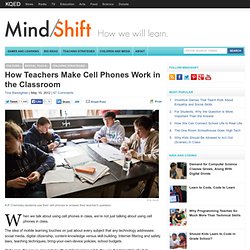
Chemistry students use their cell phones to answer their teacher's question. When we talk about using cell phones in class, we’re not just talking about using cell phones in class. The idea of mobile learning touches on just about every subject that any technology addresses: social media, digital citizenship, content-knowledge versus skill-building, Internet filtering and safety laws, teaching techniques, bring-your-own-device policies, school budgets. At its core, the issues associated with mobile learning get to the very fundamentals of what happens in class everyday. In the most ideal class settings, mobile devices disappear into the background, like markers and whiteboards, pencil and paper – not because they’re not being used, but because they’re simply tools, a means to an end.
Are You Ready for Mobile Learning? (EDUCAUSE Quarterly. Are You Ready for Mobile Learning?
Frequent use of mobile devices does not mean that students or instructors are ready for mobile learning and teaching By Joseph Rene Corbeil and Maria Elena Valdes-Corbeil Jason, a 19-year-old college freshman, woke up early Friday morning to download this week's U.S. History podcast to his iPod. As he got into his car for the one-hour commute to campus, he put on his earbuds and began to listen to his professor's test review session.
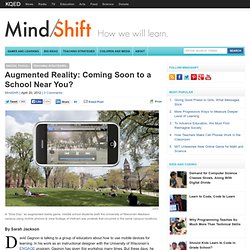
Before exiting the car, Jason received a text message on his smart phone from Paula, his study partner. Augmented Reality: Coming Soon to a School Near You? Digital Tools Teaching Strategies In “Dow Day,” an augmented reality game, middle school students walk the University of Wisconsin-Madison campus using mobile phones to view footage of Vietnam war protests that occurred in the same campus locations.
By Sarah Jackson. Instructional Design Challenges for Mobile Learning. Mobile learning is fast gaining pace as a popular medium of imparting knowledge amongst the new-age learners of today.
Most of us carry (or at least aspire to carry) a high-end mobile device – be it a Smartphone or a tablet. This proximity to the device, at all times, creates a huge opportunity to make learning material available to the learner – anywhere, anytime. This opportunity has been tapped for corporate learning and, according to a report, 50% of those who have implemented m-learning have already begun to see positive results*. *Source: E-learning Guild Report – Mobile Learning and Trends by Clark Quinn So, while that’s the good news, mobile learning comes with its own set of challenges,especially for instructional designers who lay the foundation of the learning content.
Small Screen – New Challenges The biggest challenge in mobile learning is, unarguably, the limited viewing space available. The Truth About Tablets: Educators are getting iPads and ereaders into students' hands—but it's not easy. Talk about a revolution.
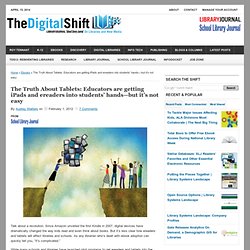
Since Amazon unveiled the first Kindle in 2007, digital devices have dramatically changed the way kids read and even think about books. But it’s less clear how ereaders and tablets will affect libraries and schools. Using an iPad in History teaching. Image by s. yume When the iPad first came out in April 2010 (was it really just over 18 months ago?)
I wasn’t blown away. Moodle Goes Mobile on iPhone. LMS | News Moodle Goes Mobile on iPhone The open source learning management system Moodle has a new mobile companion.
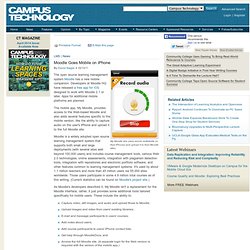
Developers at Moodle HQ have released a free app for iOS designed to work with Moodle 2.1 or later. Apps for additional mobile platforms are planned. The mobile app, My Moodle, provides access to the Web-based Moodle and also adds several features specific to the mobile version, like the ability to capture audio on the user's iPhone and upload it to the full Moodle site. Moodle is a widely adopted open source learning management system that supports both small and large deployments (with several sites well beyond 100,000 users) and includes course management tools, various Web 2.0 technologies, online assessments, integration with plagiarism detection tools, integration with repositories and electronic portfolio software, and other features common to learning management systems. My Moodle 1.0.1 is available as a free download from the iTunes App Store. Are You Ready for Mobile Learning? (EDUCAUSE Quarterly.