
Egypt's army 'involved in detentions and torture' The Egyptian military has secretly detained hundreds and possibly thousands of suspected government opponents since mass protests against President Hosni Mubarak began, and at least some of these detainees have been tortured, according to testimony gathered by the Guardian.
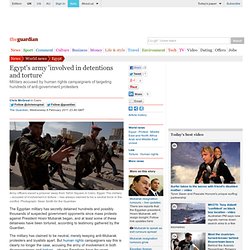
The military has claimed to be neutral, merely keeping anti-Mubarak protesters and loyalists apart. But human rights campaigners say this is clearly no longer the case, accusing the army of involvement in both disappearances and torture – abuses Egyptians have for years associated with the notorious state security intelligence (SSI) but not the army. The Guardian has spoken to detainees who say they have suffered extensive beatings and other abuses at the hands of the military in what appears to be an organised campaign of intimidation.
Human rights groups have documented the use of electric shocks on some of those held by the army. "I was on a sidestreet and a soldier stopped me and asked me where I was going. Egyptian army 'torturing' prisoners - Middle East. The Egyptian military has been secretly detaining and torturing those it suspects of being involved in pro-democracy protests, according to testimony gathered by the British newspaper the Guardian.
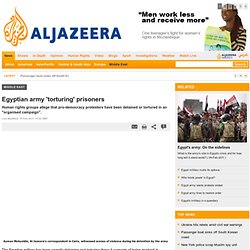
The newspaper, quoting human rights agencies, put the number of people detained at "hundreds, possibly thousands," since protests against Hosni Mubarak, the Egyptian president, began on January 25. While the military has said it is playing a neutral role in the political unrest, the newspaper quoted human rights campaigners as saying this was no longer the case, accusing the army of being involved in an organised campaign of disappearances, torture and intimidation. Egyptians have long associated such crimes with the country's much-feared intelligence and security services, but not with the army. "It's unusual and to the best of our knowledge it's also unprecedented for the army to be doing this.
" The country's army has denied the charges of illegal detention or torture. 'Foreign enemies' Suleiman: The CIA's man in Cairo. On January 29, Omar Suleiman, Egypt’s top spy chief, was anointed vice president by tottering dictator, Hosni Mubarak.

By appointing Suleiman, part of a shake-up of the cabinet in an attempt to appease the masses of protesters and retain his own grip on the presidency, Mubarak has once again shown his knack for devilish shrewdness. Suleiman has long been favoured by the US government for his ardent anti-Islamism, his willingness to talk and act tough on Iran - and he has long been the CIA’s main man in Cairo.
Mubarak knew that Suleiman would command an instant lobby of supporters at Langley and among 'Iran nexters' in Washington - not to mention among other authoritarian mukhabarat-dependent regimes in the region. Suleiman is a favourite of Israel too; he held the Israel dossier and directed Egypt’s efforts to crush Hamas by demolishing the tunnels that have functioned as a smuggling conduit for both weapons and foodstuffs into Gaza.
Realtime: Worrisome Economic Consequences from the Unrest in Egypt. The demonstrations and the more recent violent clashes between the pro and anti-Mubarak factions in Tahrir Square continue unabated despite President Mubarak’s announcement on February 1 that he would not seek reelection in September.
(It is also presumed that his son Gamal Mubarak will not run for the presidency.) The Mubarak concession may well have worked if it had come in the first week of the protests, but the dynamics of the movement to remove him have moved beyond that possibility. What will the instability in Egypt mean for the Middle East economies, and more generally for the world economy? It is always difficult to predict such matters with certainty.
But on the face of it, the direct costs of even a sharp decline in the Egyptian economy would not amount to much. On the financial side the effects are also small. The price of oil is the real issue. If Suez is not the cause, then what is pushing up oil prices? Oil prices could still rise further, on the other hand.