
Embedded.com - References vs. Pointers. C++ tutorial for C users. This text shows and highlights features and basic principles of C++.
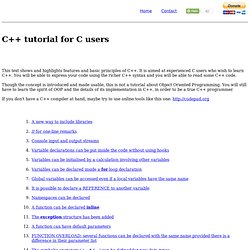
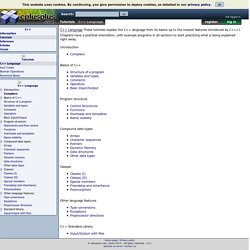
It is aimed at experienced C users who wish to learn C++. You will be able to express your code using the richer C++ syntax and you will be able to read some C++ code. C++ Language Tutorial. This website uses cookies.
By continuing, you give permission to deploy cookies, as detailed in our privacy policy. ok Search: Not logged in. Threads in C++ NextPreviousContents 18. Threads in C++ IBM pthread User Guide, Thread concepts, API reference and mirror site is at IBM main site QpThread Library for C++ provides object oriented framework in C++ for threads and Unix signals on top of system level threads (currently POSIX Threads) ThreadJack supports Java-like multi-thread programming model with platform independent C++ class library and here is the download-site APE is the "APE Portable Environment" and class libraries for writing portable threaded servers in C++, under UNIX (pthread) and Win32 API's.
APE provides portable class abstraction for threads, sockets, file handling, and synchronization objects. The goal of APE is to make writing threaded servers in C++ both practical and convient, even for small and simple projects, and hence simplicity and low runtime overhead are design goals Portabale Thread Lib Thread-Recyling in C++ Windows API Tutorial: Using Threads. Enter key boxEditor.