
Les nouveaux outils pour apprendre autrement. Twitter in the University Classroom: Live-Tweeting During Lectures « Educational Vignettes. My second blog post reflecting on teaching innovations of 2012 is dedicated to my use of Twitter during one undergraduate module in the year just passed.

My original intention, in embedding a Twitter widget within one of my Moodle pages, was merely to issue the occasional message to students to aid communication of, for instance, my progress with marking of their assessments. However, when I announced our ‘official’ Twitter hashtag to the students, to my surprise and delight, they started to use it not just for my module but to tweet about other areas of the programme as well. Untitled. Resources on e-portfolios. Virtuallythere - The Learning Theories. The actual practice of teaching is more complicated than we have so far suggested.

Pédagogie ouverte: autoformation et collaboration au cœur d’une formule éducative hybride - Le blogue de Luc R. Vendredi 9 mars 2012 5 09 / 03 / Mars / 2012 02:16 Note: Cet article est aussi diffusé sur Educavox.fr à l'adresse suivante: Quel genre de citoyens la société recherche-t-elle? Des personnes conformistes ou des maîtres de la créativité? Peer-to-Peer Learning Handbook. La présence en e-learning : modèle théorique et perspectives pour la recherche. Annie Jézégou VOL. 26, No. 1 L’auteure de cet article propose un modèle de la présence en e-learning.
Ce modèle comporte quelques similitudes avec le modèle de community of inquiry en e-learning (Garrison et Anderson, 2003) mais également des différences importantes. En effet, il aborde la notion de présence sous un autre angle, la caractérise et la décline différemment. L’auteure précise tout d’abord les référents épistémologiques du modèle proposé. The author of this article proposes a model of presence in e-learning. Dans un précédent article (Jézégou, 2010a), nous avons présenté une analyse critique et constructive du modèle de community of inquiry1 en e-learning (Garrison et Anderson, 2003; Garrison, Anderson et Archer, 2010; Garrison et Arbaugh, 2007). La fragilité de ce modèle porte principalement sur l’hypothèse selon laquelle la présence favorise les apprentissages en « profondeur ». The 10 Key Rules for Managing Time in Online Teaching. June 15th, 2008 By: Errol Craig Sull In my several years of teaching online I have developed a variety of time-management tools that have helped me to stay on top of my classes while making my efforts smoother and easier; hundreds of colleagues I’ve discussed this with over the years also have their favorite ways of managing time.
As you can imagine, this collective wisdom includes a multitude of approaches (in fact, nearly 300 so far!) , but what I present to you here is what I think are the best of the best. Use one, some, or all of these, and I assure you that you’ll have a much better time teaching online! The list: Get into a schedule. REMEMBER: Not managing your time effectively is like letting termites run amok–pretty soon your entire structure will come crashing down. Please let me hear from you, including sending along suggestions and information for future columns.
11 conseils et idées pour vous aider à donner du sens à l’apprentissage dans vos formations. L'apprenance, vers une nouvelle culture de la formation. Caractériser les apprentissages sur le web2.0. Steve Wheeler nous régale d’un nouveau diaporama « Researching Social Media in Education: What can we learn?
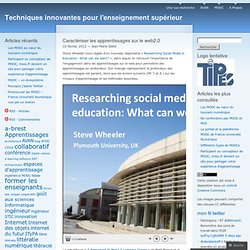
», dans lequel on retrouve l’importance de l’engagement dans les apprentissages sur le web pour permettre des apprentissages en profondeur. Son triangle représentant la profondeur des apprentissages est parlant, ainsi que les écrans suivants (PP. 7 et 8 ) sur les niveaux d’apprentissage et les méthodes associées. Lu par ailleurs « A framework fo Web2.0 Learning Design » de Matt Bower et al.
Propose comme organisation la classique taxonomie de Bloom (revisité par Krathwohl et Anderson) pour classifier des usages pédagogiques de différents outils. Ils couvrent ainsi quasiment toute la taxonomie par des exemples d’usages de twitter, de blogs, de wikis, de vidéos dans des scénarios pédagogiques. Un autre aspect qui me paraîtrait important de creuser, c’est de voir les dimensions qui peuvent être couvertes par tel ou tel outil.
Qu’en pensez vous? Like this: Education & Formation : Parutions. Pédagogie, université et numérique : paradigmes de recherche et cultures d’action (1/5) Pédagogie universitaire – Enseigner et Apprendre en Enseignement Supérieur. Teaching and Learning Services. Below, you will find information on preparing a course outline in keeping with current McGill policy.

Course Outline Brief Guide - Printable Version [.pdf] Introduction.