
Think like a kid. Book Review: The Power of Inquiry. Teaching through inquiry is like handling a slippery fish.

Just when you think you have got a grasp on it, the fish is flailing on the floor. Inquiry seems so simple. It starts by asking really good questions. What is inquiry learning? What isn’t inquiry learning? Which leads to the slipperiest question of all: How do inquiry teachers teach? Kath Murdoch answers that question in her new book The Power of Inquiry.
Often books about education fall into one of two categories. What I love about the Power of Inquiry is how Kath seamlessly navigates between the two worlds. However, the book’s strong foundation of pedagogical research isn’t at the expense of accessibility for the busy classroom teacher. Each section has ideas and suggestions that can be easily implemented by tweaking existing teaching practices as well as frameworks to develop learning. Strengthening Lessons With A Student Work Protocol. As the chill in the air gets chillier, and your stacks of student work pile up like fallen leaves, why not pause, take a breath, and take a moment to look at that student work in a new way.
Sure, you need to look at the work to assess student progress, provide feedback, and celebrate student successes, but you can also use it to assess, refine, and celebrate your own work. The EQuiP Student Work Protocol is one way to do just that. In part one of our series with Achieve.org, we introduced you to their work with EQuIP (Educators Evaluating the Quality of Instructional Products), an initiative designed to identify high-quality materials aligned to the Common Core.
We took a close look at EQuIP’s rubrics and process for evaluating lessons for Common Core alignment, and saw the power of teachers viewing and discussing a lesson together. The concept of different “learning styles” is one of the greatest neuroscience myths. Are you a visual learner who writes notes in a rainbow of different colors, or do you have to read something aloud before it will sink it?

Chances are, you’ve been asked a similar question at some point in your life, and believe the concept of different “learning styles” is perfectly valid. But, as Quartz reported in December, we all learn in fundamentally similar ways. And, as New York magazine reports, the idea that students learn differently depending on their personal preference for visual, auditory or kinesthetic cues is just a myth. In fact, it’s considered a “neuromyth,” which, as Paul Howard-Jones, professor of neuroscience and education at Bristol University, writes in a 2014 paper on the subject, is characterized by a misunderstanding, misreading, or misquoting of scientifically established facts. Other examples of neuromyths include that we only use 10% of our brain, and that drinking less than six to eight glasses of water a day will cause the brain to shrink.
Peer Coaching: Positive Conversation about teaching practice. Edutopia. All educators care deeply about their students' motivation.
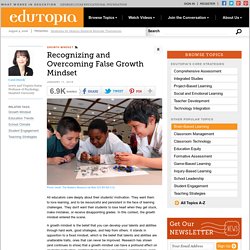
They want them to love learning, and to be resourceful and persistent in the face of learning challenges. They don't want their students to lose heart when they get stuck, make mistakes, or receive disappointing grades. In this context, the growth mindset entered the scene. A growth mindset is the belief that you can develop your talents and abilities through hard work, good strategies, and help from others. Edutopia. 2015 was a great year for education research. fMRI technology gave us new insight into how exercise can improve math ability by changing the structure of children's brains (#13 below).
We saw how Sesame Street's 40-year history has made an impact on preparing young children for school (#7). Search the School Leadership eCollection. Search the School Leadership eCollection. Tips for leading and driving change on Vimeo: Couch Mode. 10 proven ways teachers can improve their sleep. A good night’s sleep is the holy grail for today’s generation of overworked and overstressed individuals.
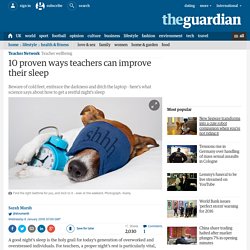
For teachers, a proper night’s rest is particularly vital, especially when the next morning involves managing a classroom of excitable and unruly children. But getting a full eight hours of slumber isn’t as elusive as you might imagine. Here are 10 simple, scientifically proven ways to beat insomnia. Is this a habitat in which inquiry can thrive? Questions and warning bells for the inquiry classroom. I was reading an interesting post from @langwitches in which she refers to @brholland’s slideshow from a recent ASCD conference.
In true domino style, Beth’s post got Sylvia thinking and blogging and Sylivia’s post got me thinking and blogging! The issue being explored by these two educators was around what we are ‘looking for’ when we walk into a learning space/classroom. Beth raised a number of key questions that we can ask to help reflect more closely on the effective use of technologies. The post and slideshow are great…as is Sylvia’s sketched response to it. Results PLUS: Data and evidence: 1. Data and evidence. Professor Martin Westwell. Is it time to erase erasers? Academic says 'instrument of the devil' should be removed ... Character Education Guy Claxton. The idea of Building Learning Power - Prof. Guy Claxton. Early Childhood Australia - Learning Hub. Edutopia. Time for another staff meeting. Need an idea for something that engages teachers? Shakes things up a bit? Starts the year off right? Lessee. Maths science resources. Inquiring as Teachers.
Inquiring as Teachers Inquiry.
The heart of the PYP. In a PYP school, we encourage our children to inquire, wonder, think and dream. It comes to kids naturally, and so mostly, we encourage and provide a safe space where they can do that. Edutopia. Time.
It's the thing every teacher needs more of, and no teacher has enough of. Whether you wish to get deeper into student data analysis or want to spend more time with your own children, no teacher has enough hours in the day to do it all. But with very careful planning of their non-teaching time, I've seen thousands of teachers get more time back in their lives. Here are the top five ways you can make the most of your limited "free" time each week: Edutopia. I love trading opinions with friends about what we read for pleasure.
Good books, strong coffee, and rainy-day conversations are an unbeatable combination. But when it comes to my professional bookshelf, I seem to keep my margin notes and musings to myself. After taking part in a recent online book study as part of Connected Educator month, however, I'm reminded that reading together inspires thinking together. And thinking sets the stage for action as we look for opportunities to put compelling, carefully considered ideas into practice. Default. Record Yourself to Improve Your Practice. Posted 09/15/2015 11:10AM | Last Commented 10/31/2015 5:52AM I took a speech class one semester when I was in undergraduate school. For our first assignment we had to give a short speech that the teacher videotaped. Our extended assignment was to watch the recording and critique our performance. That proved to be a very eye-opening experience for me. If you had asked me how I did right after I gave my speech I would have told you I was pleased with my delivery.
Education Week. Grant-Beacon Middle School (GBMS) serves 460 students, predominantly of color, 85% live in/near poverty and 40% are English language learners. With two centers of expertise, the school serves a high percentage of students with special needs. What was a working class neighborhood of southeast Denver 40 years ago when my wife went to school there is now a gentrifying neighborhood where small brick bungalows fetch more than half a million making it difficult for Grant-Beacon families to live in the neighborhood, 80% choose GBMS and are bussed in. Austin's Butterfly: Building Excellence in Student Work - Models, Critique, and Descriptive Feedback. Praise The Process Build A Growth Mindset. Growth Mindset Made Visible With Praise And Encouragement. Why do some students thrive in the face of challenges, while others fall apart? One reason is because students have different beliefs about the nature of intelligence.
Persist Through Challenges Build A Growth Mindset. Embedding Coaching and Mentoring to improve Teaching and Learning. How does teaching and learning improve in your school? How open are colleagues to being coached to improve? Are teachers disengaged or anxious at the prospect of being observed? The following is an effective way to approach staff to begin the process of addressing their areas for development. What Happens When Teachers Connect. What Happens When Teachers Connect. Being an experienced educator does not necessarily mean expert. In many education systems the teacher pay scale is linked to experience; the more years that you have taught, the more you are paid. The Difference Between Pedagogy, Andragogy, And Heutagogy. 5 TED talks you need to watch if you care about learning - Belinda Jennings - ABC Splash - Patrick Griffin Becoming an expert classroom practitioner. A (massive) collaborative curriculum review… Tips for changing practice.
Professional learning: From engagement to impact. ‘Every teacher needs to improve, not because they are not good enough, but because they can be even better,’ - Professor Dylan Wiliam, 2012 SSAT National Conference. There is a growing appreciation and commitment to self-improvement among the teaching profession, yet the practical connection between professional learning outcomes and changed practice continues to be elusive. Links between teacher professional learning and improved student outcomes also need to be strengthened. In this article, we consider recent international data and the potential implications for Australian educators. The situation in Australia. Learning & Play: Ten ways to interact with children in play
Resources and support - Primary Curriculum Management - The Australian Curriculum v7.4. Developing a Growth Mindset in Teachers and Staff. 15 Mistakes New Teachers Make (and what I learned making them) Innovative_50_interactive_guide_print_version.pdf. Watch What's Working: Carol Dweck Talks Growth Mindset.
Reflective Teaching Questions: A Challenge For Teachers. What does John Hattie think about education? SAMR as a Framework for Moving Towards Education 3.0. Excuse me, Change Agent, what’s your strategy? How-to guide for educators. Why (And How) Teachers And Students Should Backchannel. Untitled. Using SAMR to Teach Above the Line - Getting Smart by Susan Oxnevad - 1:1 program, Apple, edchat, EdTech, SAMR, technology. Future Learning. 12 Choices to Help You Step Back from Burnout. Co-inventing the Curriculum. Education Week. Classrooom_practice_continuum. It’s About Learning - Leading Learning – Coaching and Teaming for Innovation. Being a Skype Granny – School in the Cloud. Do-It-Yourself Virtual Professional Development: Taking Ownership of Your Learning. Peer-coaching-models. Co-teachers Rupprecht and Victory Combine Three Routines in 6th Grade Mathematics » Cultures of Thinking.
This is how inquiry teachers teach! Learning Principles. Engagement_in_Australian_Schools-Background_Paper.pdf. Response: Ways To Observe Teachers Without Demoralizing Them - Classroom Q&A With Larry Ferlazzo. Search results. GlobalEdCon Schedule GMT + 11. A Collection Of “The Best…” Lists On Parent Engagement. Catholic Education Melbourne. Icrcon13 » Transcript. Illustrations of Practice. ASCD Express 8.11 - Building Skills for Independent Learning. Hot Topics. The Politics of Personalization in the 21st Century. Want to Be a More Effective Leader? Start by Stepping Into Your Followers' Shoes. What has changed in the Top 100 Influential Education Blogs ranking? TMBrochure%202013. Why Connect? Global Learning in the Primary Grades. How to Make Your Classroom a Thinking Space. Learning2learn. Celebrate What's Right With the World - Changing the world one celebration at a time. YouTube. Considering Using Technology In Education? Read This First.
It's not about getting the right answers but rather, asking really good questions. 10 people whom you might know. AllThingsPLC — Research, education tools and blog for building a professional learning community.
17 Signs Your Classroom is Behind the Times. Generational Divide in Education. Sugata Mitra: The child-driven education. What forms of formative assessment do you use, and do you grade them for the overall average? The 21st century skills teachers should have. My Island View. Participating in professional learning networks. Louie Schwartzberg: Nature. Beauty. Gratitude.