
Choosing a Camera Lens Filter. Camera lens filters still have many uses in digital photography, and should be an important part of any photographer's camera bag.
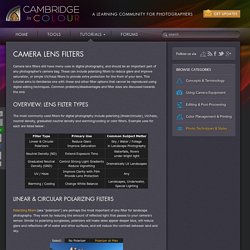
These can include polarizing filters to reduce glare and improve saturation, or simple UV/haze filters to provide extra protection for the front of your lens. This tutorial aims to familiarize one with these and other filter options that cannot be reproduced using digital editing techniques. Common problems/disadvantages and filter sizes are discussed towards the end. The most commonly used filters for digital photography include polarizing (linear/circular), UV/haze, neutral density, graduated neutral density and warming/cooling or color filters. Example uses for each are listed below: Polarizing filters (aka "polarizers") are perhaps the most important of any filter for landscape photography. Two separate handheld photos taken seconds apart Note how the sky becomes a much darker blue, and how the foliage/rocks acquire slightly more color saturation. Canon Lenses - Canon EF Camera Lens Information. Canon Wedding Lens Recommendations. Weddings are one of the most commonly photographed events - and one of the most common paid events photographers can find.

Images captured at weddings become some of the most-cherished memories of those involved. Those contracted to photograph these events are expected to deliver high quality results regardless of the circumstances encountered. And the lens kit is one of the big keys to a successful wedding shoot. Not everyone photographs a wedding the same way.
I prefer a more photojournalistic wedding photography approach mixed with the classic portraits. Traditional/formal wedding photography may be done just as easily using a few prime lenses. A wide range of focal lengths are often needed for a good wedding shoot - meaning more than one lens. Since the ambient lighting is usually not very good (to be kind) at indoor weddings, fast (wide aperture) lenses and image stabilization are usually preferred. How to Use Ultra-Wide Lenses. August 2008 Nikon Reviews Canon Reviews Leica Reviews Pentax Reviews Introduction Ultrawide lenses are the most difficult lenses to use well.
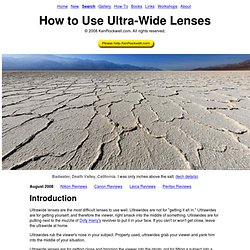
Ultrawides are not for "getting it all in. " Ultrawides are for getting yourself, and therefore the viewer, right smack into the middle of something. Ultrawides are for putting next to the muzzle of Dirty Harry's revolver to put it in your face. Ultrawides rub the viewer's nose in your subject. Ultrawide lenses are for getting close and bringing the viewer into the photo, not for fitting a subject into a photo.
Ultrawides are not for the faint of heart. Most people use ultrawides too sheepishly, and get crummy results with tiny subjects dwarfed in the middle of an open frame. Ultrawides require you to get very close and personal to anything you are shooting. If you use them properly, you'll be rewarded with dynamic images. My 17-35mm zoom always seems to be shot at 17mm, my 16-35mm always at 16mm, and my 14-24mm always seems to be at the 14mm stop. Polarizers. Care, Feeding & Proper Use There are few more important things that a nature photographer can do to improve his or her photography than becoming familiar with the use of the polarizing filter.

What can a polarizing filter do for you? Among other things it can darken the sky, remove reflections from water, and make foliage appear less shiny. Colour saturation is also significantly enhanced. It is the only filter for use with colour film that can do all of this. Lone Crane � Yucatan, 2002 Photographed with a Pentax 645NII and Pentax (67) 200mm f/4 lens on Provia 100F � Polarizer.
Canon EF 24-105mm f/4 L IS USM Lens Review. Boasting the superb build, mechanical and optical quality found in the Canon L-Series Lenses and a widely used range of focal lengths, the Canon EF 24-105mm f/4L IS USM Lens is one of the best and most popular Canon general purpose lenses made.

The 24-105 L Lens quickly became one of my favorite and most-used lenses. If I had only one lens, this would be the one. One of the most important features in a lens is the focal length or focal length range - get it wrong and you might not be able to take the shots you want. And the use for a particular focal length or focal length range varies, of course, depending on the FOVCF of the body being used. That said, this lens gives us a very nice general purpose focal range to work with. Use the mouseover links under the above picture to compare the field of view at various focal lengths. When you care about the pictures, you want a well-built lens with great optical quality.
Looking at the numbers ... I find the 77mm filter size to be an asset. The Best Canon EOS Lenses. • You are here --> BobAtkins.com > photography > reviews > This Page "Best" is a subjective term and selecting the "best" lens is often a matter of compromise between cost, size, weight, how often the lens will be used, how convenient the lens is to use and, of course, the optical quality of the lens.

On this page I have several sets of "best" lenses. Best lenses listed by user ratings, with no regard for price Best lenses listed by user ratings, priced under $700 Best lenses listed by user ratings priced under $400 My personal pick of the best lenses for EOS cameras based on my own experience and testing.