W3C Resources
Get flash to fully experience Pearltrees
Color Names Supported by All Browsers 147 color names are defined in the HTML and CSS color specification (16 basic color names plus 130 more). The table below lists them all, along with their hexadecimal values. Tip: The 16 basic color names are: aqua, black, blue, fuchsia, gray, green, lime, maroon, navy, olive, purple, red, silver, teal, white, and yellow.
HTML Color Names
World Wide Web Consortium (W3C)
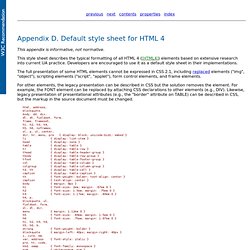
W3C announces today a Workshop on Using Open Data: policy modeling, citizen empowerment, data journalism . For many years, W3C has been a keen promoter of Open Data, fostering a culture in which public administrations make their data available, ideally in machine-processable formats. Many governments have embraced the idea with enthusiasm, setting up national data portals. As part of the FP7-funded Crossover Project, W3C and the European Commission are running a Workshop to ask a simple question: what is all the 'new' government open data being used for? The Workshop takes place 19-20 June in Brussels, Belgium at the European Commission Headquarters.This appendix is informative, not normative. This style sheet describes the typical formatting of all HTML 4 ( [HTML4] ) elements based on extensive research into current UA practice. Developers are encouraged to use it as a default style sheet in their implementations. The full presentation of some HTML elements cannot be expressed in CSS 2.1, including replaced elements ("img", "object"), scripting elements ("script", "applet"), form control elements, and frame elements. For other elements, the legacy presentation can be described in CSS but the solution removes the element. For example, the FONT element can be replaced by attaching CSS declarations to other elements (e.g., DIV).