
Giovanni Pierluigi da Palestrina. Giovanni Pierluigi da Palestrina Giovanni Pierluigi da Palestrina (c. 1525 – 2 February 1594)[1] was an Italian Renaissance composer of sacred music and the best-known 16th-century representative of the Roman School of musical composition.[2] He has had a lasting influence on the development of church music, and his work has often been seen as the culmination of Renaissance polyphony.[2] Biography[edit]
The Counter-Reformation. The subject will be considered under the following heads: I.
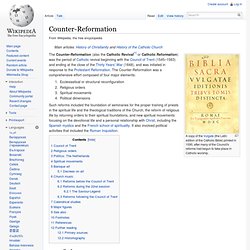
Significance of the term II. Low ebb of Catholic fortunes III. Counter-Reformation. A copy of the Vulgate (the Latin edition of the Catholic Bible) printed in 1590, after many of the Council's reforms had begun to take place in Catholic worship.
The Counter-Reformation (also the Catholic Revival[1] or Catholic Reformation) was the period of Catholic revival beginning with the Council of Trent (1545–1563) and ending at the close of the Thirty Years' War (1648), and was initiated in response to the Protestant Reformation. The Counter-Reformation was a comprehensive effort composed of four major elements: Ecclesiastical or structural reconfigurationReligious ordersSpiritual movementsPolitical dimensions Council of Trent[edit]