
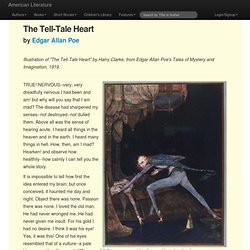
The Tell-Tale Heart. By Edgar Allan Poe Illustration of "The Tell-Tale Heart" by Harry Clarke, from Edgar Allan Poe's Tales of Mystery and Imagination, 1919.
TRUE! -NERVOUS--very, very dreadfully nervous I had been and am! But why will you say that I am mad? The Facts in the Case of M. Valdemar by Edgar Allan Poe. By Edgar Allan Poe(published 1845) Of course I shall not pretend to consider it any matter for wonder, that the extraordinary case of M.
Valdemar has excited discussion. The Monkey's Paw. By W.
W. Jacobs "Be careful what you wish for, you may receive it. " --Anonymous Part I Without, the night was cold and wet, but in the small parlour of Laburnum villa the blinds were drawn and the fire burned brightly. "Hark at the wind," said Mr. "I'm listening," said the latter grimly surveying the board as he stretched out his hand.
"I should hardly think that he's come tonight, " said his father, with his hand poised over the board. The Lottery. By Shirley Jackson Shirley Jackson's short story The Lottery was published in 1948 and is not in the public domain.
Accordingly, we are prohibited from presenting the full text here as part of our short story collections, but here is a short summary of the story, followed by some commentary and explanations. It is important to have some historical context to understand this story and the negative reaction that it generated when it was published in the June 26, 1948 issue of The New Yorker. The setting for the story, a village gathering, wasn't a fictional creation in rural America during the summer this story was published.
Rural community leaders often organized summertime gatherings to draw people together in town centers to socialize and hopefully frequent some of the business establishments. On a warm summer day, villagers gather in a town square to participate in a lottery. The night before Mr. The villagers start to gather at 10 a.m. so that they may finish in time for lunch. The Bear Got Me by Matthew Licht. The Bear Got Me Garson Thayer didn't like driving at night, but since his internal clock, an expensive Swiss gadget, sent signals to the effect that it wasn't officially night yet, he kept going.

He was on his way to do a job for Strategic Air Command. He worked for them fairly often, couldn't help wondering why they paid stratospheric consultation fees yet refused to spring for drivers. The US Military had a near-infinite pool of uniformed serfs with valid military licenses and civilian hot rod/speedway experience. He could've used expensive travel time to review classified documents and equipment diagrams in the back seat, in a cone of light from some highly engineered inner-automobile reading apparatus. He also wondered why SAC never sent him to Hawaii. The Veldt - Ray Bradbury. The Curious Case of Benjamin Button by F. Scott Fitzgerald. By F.

Scott Fitzgerald Chapter 1 As long ago as 1860 it was the proper thing to be born at home. At present, so I am told, the high gods of medicine have decreed that the first cries of the young shall be uttered upon the anaesthetic air of a hospital, preferably a fashionable one. So young Mr. and Mrs. I shall tell you what occurred, and let you judge for yourself. The Roger Buttons held an enviable position, both social and financial, in ante-bellum Baltimore. On the September morning consecrated to the enormous event he arose nervously at six o'clock, dressed himself, adjusted an impeccable stock, and hurried forth through the streets of Baltimore to the hospital, to determine whether the darkness of the night had borne in new life upon its bosom.
Mr. The doctor heard him, faced around, and stood waiting, a curious expression settling on his harsh, medicinal face as Mr. "What happened? " "Talk sense! " "Is the child born? " Doctor Keene frowned. "Is my wife all right? " "Yes. " "Here now! " Rapunzel by Brothers Grimm. Rapunzel There were once a man and a woman who had long, in vain, wished for a child.
At length it appeared that God was about to grant their desire. These people had a little window at the back of their house from which a splendid garden could be seen, which was full of the most beautiful flowers and herbs. It was, however, surrounded by a high wall, and no one dared to go into it because it belonged to an enchantress, who had great power and was dreaded by all the world. One day the woman was standing by this window and looking down into the garden, when she saw a bed which was planted with the most beautiful rampion, and it looked so fresh and green that she longed for it.