
Xpo: UNCONTAINABLE & Untitled. Suivi: Sniff, Scrape, Crawl - Part 2. Bringing together artists, programmers and theorists, these interdisciplinary panels will look at how surveillance and data-mining technologies shape and influence our lives and the consequences they have on our civil liberties.
Dates: Tuesday, 20 September, 2011 - 13:00 - 14:30 Chair: Renée Turner. AYMERIC MANSOUX. Naked on Pluto. FLOSS+Art. Puredyne. Suivi: Sniff, Scrape, Crawl. Bringing together artists, programmers and theorists, these interdisciplinary panels will look at how surveillance and data-mining technologies shape and influence our lives and the consequences they have on our civil liberties.
Dates: Tuesday, 20 September, 2011 - 09:00 - 10:30 Chair: Renée Turner We are living in a time of unprecedented surveillance, but unlike the ominous spectre of Orwell’s Big Brother, where power is clearly defined and always palpable, today’s methods of information gathering are much more subtle and woven into the fabric of our everyday life. Through the use of seemingly innocuous algorithms Amazon tells us which books we might like, Google tracks our queries to perfect more accurate results, and Last.fm connects us to people with similar music tastes. Immersed in social media, we commit to legally binding contracts by agreeing to ‘terms of use’. “Sniff, Scrape, Crawl…” is an ongoing interdisciplinary research project. Paper Abstracts by Dr. My meta is your data Benji. BIRGIT BACHLER: The Discrete Dialogue Network. The Discrete Dialogue Network is a telephony-based communication network for leaving anonymous voice messages to strangers in public space.
For the full project description please visit www.discretedialoguenetwork.org This network proposes an alternative to the flatness of common online social networks. It is a medium that works outside the business of profile pictures, status updates and “Like”-buttons. People can connect by leaving anonymous voice messages in public space and listen to what has been previously recorded. Constant. Residency Iterations In june / july 2016 we organise the second edition of Iterations, with the name I don’t know where this is going.
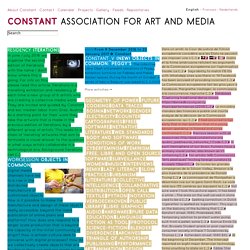
For info on this, please read this article. Iterations is a travelling exhibition and residency of each time a new group of 6 artists who are creating a collective media work. Workshop: Cosmopolitics of Food Interactions: Design Fiction on Food Cults. We will build design prototypes and document design fiction related to future “diet-tribes” and “food-cults” that use emergent technologies for novel dining and social practices related to food.
Dates: Monday, 19 September, 2011 - 10:00 - 18:00 Secret Cooks Dinner Sous Vide Dinner in Singapore Workshop Leader: Denisa Kera, denisa [at] nus.edu.sg2nd Leader: Marc Tuters, mtuters [at] gmail.com In this workshop we would like to rethink the relation between food and technology and experiment with future metabolic exchanges that are biological, technological and political at the same time.
Workshop: Labster. Labster project aims at creating an online, interactive map, in order to offer personal narratives related to the worldwide Art and Technology DIY culture.
In the first phase of the project, narrative texts are collected without a standard data input process to catch site of a wide range of terms, notions, definitions of lab’s practices, ecosystems and lab-life. Dates: Saturday, 17 September, 2011 - 10:00 - 15:00 Workshop Leader: Attila Nemes, anemes [at] fictionlab.hu2nd Leader: Catherine Lenoble, catherine [at] pingbase.net.
PiNG. A lab for collecting theories of medialabs. Suivi: Zones of Contact and Fields of Consistency in Electronic Literature. This panel will explore the relationship between criticism and creative practice in electronic literature.
Participants will discuss the potentials of and limits to literary criticism in the realm of digital poetics and narrative. Born Digital by Stephanie Strickland. E-poetry relies on code for its creation, preservation, and display: there is no way to experience a work of e-literature unless a computer is running it—reading it and perhaps also generating it.
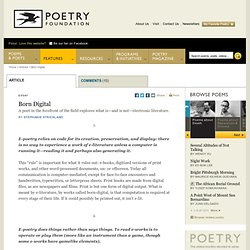
This “rule” is important for what it rules out: e-books, digitized versions of print works, and other word-processed documents, on- or offscreen. Today all communication is computer-mediated, except for face-to-face encounters and handwritten, typewritten, or letterpress sheets. Print books are made from digital files, as are newspapers and films. Print is but one form of digital output. The Good Captain (@goodcaptain) sur Twitter. Electronic Literature as a Model of Creativity and Innovation in Practice. Suivi: Media Art Explores Image Histories: New Tools For Our Field. Dates: Friday, 16 September, 2011 - 10:45 - 11:45 The evolution of media art has a long history and now a new technological variety has appeared.
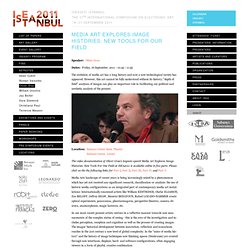
However, this art cannot be fully understood without its history; "depth of field" analyses of images can play an important role in facilitating our political and aesthetic analysis of the present. The video documentation of Oliver Grau's keynote speech Media Art Explores Image Histories: New Tools For Our Field at ISEA2011 is available online in five parts. Suivi: Hackerspaces, DIYbio and citizen science: the rise of tinkering and prototype culture. The global spread of alternative R&D places outside the universities and corporate labs offers an integrated model for art and science cooperation and public participation in science.
These places (Hackerspaces, FabLabs, Maker communities) and projects (DIYbio) offer a direct involvement of citizens in the R&D process in term of translational and participatory research. What are the opportunities and challenges of these novel institutions across the globe? MadLab - Manchester Digital Laboratory - home of creative community technology in Manchester. AltLab » Lisbon's Hackerspace – [DIT] Do It Together. Ars Biologica. Yogyakarta new media art laboratory. Food Hackerspace. ITAS - Institut für Technikfolgenabschätzung und Systemanalyse. Genspace community biolab.
The internet of things. Suivi: Changing Vocabularies of Digital Art. A Cybersemiotic Approach to Technoetic Arts - new vocabularies in transdisciplinary research by Kathrine Elizabeth Anker/ Trajectories, circulation, assemblages by Damien Charrieras/ Sketches of an interdisciplinary practice: essential in-formation for post-digital thinkers by Charles Walker and Kim Newall/ The ephemeral in AV realtime practices by Ana M Carvalho/ Investigating the notion of Art2.0 by Sander Veenhof and Kasia Molga/ Dates: Thursday, 15 September, 2011 - 17:00 - 18:40 A Cybersemiotic Approach to Technoetic Arts - new vocabularies in transdisciplinary research by Kathrine Elizabeth Anker Contemporary, technoetic arts (art, technology and consciousness), that oscillate between analogue and digital technologies, often approach a situation, that in many ways resembles transdisciplinary research.
Trajectories, circulation, assemblages. By Damien Charrieras by Ana M Carvalho. API for art. Visual Agency. Suivi: Collaborations across Borders: Physical and Disciplinary. Digital Mediterranean and New Media Dialogue by Herman Bashiron Mendolicchio/ ART IN PROCESS – cross-border and beyond by Elisabeth Maria Eitelberger and Bello Benischauer/ Phi territories by Alexandra Antonopoulou and Elenaor Dare/ Technology, Creativity and the Artist-led Workshop by Jamie Allen, Rachel Clarke, Kamila Wajda, and Areti Galani/ ZEUGMA by Anna Hatziyiannaki/ Sustaining Creative Relationships across Africa and Europe through Artist-led Innovation by Atau Tanaka and Joelle Bitton Dates: Thursday, 15 September, 2011 - 14:45 - 16:45 Digital Mediterranean and New Media Dialogue by Herman Bashiron Mendolicchio In the contemporary global framework, the convergence between art, creativity and new media offer a different way to think about the community, with its local connections and intercultural relations.
The Phi Books : house stories. Newcastle University. Jamie allen. Joelle Biton. SIDE: Social Inclusion through the Digital Economy. Vu: perf NAME Readymade. 4 -25 October 2008 Forum Stadtpark, Graz Stadtpark 1, 8010 Graz, Austria in the frame of the steirischer herbst Festival of new art The exhibition NAME – Readymade by three Slovenian artists - who all changed their names to Janez Janša in the summer of 2007 – is focused on the acts of changing one's personal name and the effects of such gesture. Works exhibited are generated by the reality itself. Vu: Tapio Makela (Helsinki) et sa version eco du geocaching. Pajasali, Suomenlinna | Friday, March 11th, 2011 The program is devised by Susanne Jaschko, a Berlin based independent curator of contemporary art with a focus on public and experimental art and digital culture, with the assistance of Giovanna Esposito Yussif, an independent curator currently based in Helsinki.
Jointly they will moderate the seminar. 9.30 Welcome by Juha Huuskonen, introduction by Susanne Jaschko 10.00 KEYNOTE | Brian Holmes (US/FR) Christian Nold (UK), An Internet of People – building a post oil network It seems clear that in the face of climate change, peak oil and social breakdown the present system will have to dramatically change.
Baruch Gottlieb (CA/DE), Where are our maps taking us? Guy Debord’s speculative mapping promised to emancipate the citizen from the anesthesia of urban routine. Graham Harwood, YoHa (UK), Database as documentary / Kari A. . / / / www.julkinendata.fi. 21 Art House - Accomodation for artists and art lovers.