
10 iPad Apps for Web Curation. The Ultimate List of Content Curation Tools and Platforms. Are you the education technology curator for your organisation? #curation. In December I had the pleasure of visiting the The Hague headquarters of Shell, courtesy of @hansdezwart, their Innovation Manager for Global Learning Technologies.

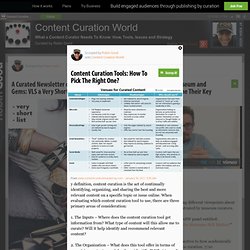
After a long Twitter “courtship”, we finally met IRL at Online Educa in Berlin (#oeb11) and found we indeed had lots of shared interests. One of the things I wanted to know more about was his use of Yammer to improve team connections and collaborations. I was lucky enough to have a personal demonstration and discussion, but you can read all about his Narrating Your Work project on Hans’ blog. Sharing As we were talking, we hit upon an activity we both do, that is not strictly part of our job but seems to have evolved naturally. We both work in roles that connect us to many different colleagues, within our teams, across our organisation, and in similar positions in other organisations. In our discussion, Hans described how he used to send people links he had found through his PLN via email. What tools have you used? Content Curation Tools: How To Pick The Right One? I’m seeing more Scoopit links in my Twitter stream and I’m not crazy about it.
Sure it’s quick and easy to share with Scoopit. But it not quick and easy to consume. For me it's all about the econ... Marty Note (here is comment I wrote on Dr. V's blog) Appreciate Bryan’s and Joseph’s comment, but I rarely use Scoop.it as a pass through. Rich snippets are “blog” posts that fall between Twitter and the 500 to 1,000 words I would write in Scenttrail Marketing.
What are the best content curation tools for daily use. Digital Curation Blog. Content Curation versus Content Creation Uptown Treehouse Blog. As many of us know, in the social media marketing game content is king! Without anything to Tweet about or post about on Facebook our communities would fall by the wayside and our customers would stop listening to us.
For most brands, the first question that must be answered before starting a social media strategy is “Where do we find good content to post about?” Creating content can be very expensive and time consuming. Most marketers cannot rely on their own content alone to fill an editorial calendar and to keep the conversation moving forward. Instead, you have to play the role of curator to ensure people find value in following your brands’ feeds. At Uptown Treehouse, we are responsible for reaching technologists and software developers on behalf of our Microsoft clients.
Amongst the two communities that we manage on behalf of Microsoft we are responsible for 20 Tweets and 5 Facebook posts every day. RSS Feeds: Twitter Lists: Google Alerts: Facebook Lists: Twitter Searches: Curation is a Means to an End, Not the Objective. Posted on February 14, 2011 by william Image via Wikipedia Any hype period has its share of buzzwords.
4 Soft Skills For Content Curation. It seems that old is new again in terms of individuals using the title, “community manager” when it comes to social media marketing and social networks. One of the fundamental roles of a community manager at the present time is being a good content curator. Content curators fuels the community to engage to become “more social” and participate in discussions.
Ultimately, these discussions will lead the members one step closer in the buying process. Content curation is more than tools and engaging with members of the target audience. As an individual who was a community manager from the days of web portals in the mid 90′s, there are soft skills that must be put into practice to reach marketing objectives. Digital Curation and Collaboration. Editing vs. curation and the evolution of Forbes.
By Chief product officer Lewis Dvorkin writes about how Forbes magazine is evolving as the traditional role of editing is changing.

Forbes writes, “The Forbes news experience, like so many others, is evolving, but we remain steadfast in our focus on editing, or curation. The thing is, our competitors look different. They don’t so much resemble our fellow Big Media companies any more. They increasingly look like you and me — that is, members of the news audience. “On the Web today, knowledgeable people can publish content for next to nothing.
Online Curation: The Personalization Danger Content Curation Strategies for Corporate Learning « Media1derLand. Welcome to the legacy Media1derland blog site.
Welcome To The New Age Of Curation. I’m guessing that a lot of you think that now – right now – is a golden age of creation.
And in many ways, it is. It’s never been a better time to make art of all kinds, from video games – my own art of choice – through books to filmed entertainment and beyond. Sure, the massive media disintermediation spawned by the Internet has spawned a golden age for creators, at least for touching audiences directly. But finding great, sometimes underappreciated art is the thing we consumers need the most help on right now – especially because there’s so much of it out there, and so much of it that can be easily accessed. That’s why, in many ways, this is the ‘Age Of Curation’, not the age of creation. 1. 2. 3. Get down too deep, and you’ve no idea what’s going on across the entire medium. Bloomstein @ SXSW 2011 Creation, curation, and the ethics of content strategy.