
Sputnik 2. Sputnik 2 (Russian pronunciation: [ˈsputʲnʲək], Russian: Спутник-2, Satellite 2), or Prosteyshiy Sputnik 2 (PS-2, Russian: Простейший Спутник 2 Elementary Satellite 2)) was the second spacecraft launched into Earth orbit, on November 3, 1957, and the first to carry a living animal, a dog named Laika.

Sputnik 2 was a 4-metre (13 foot) high cone-shaped capsule with a base diameter of 2 metres (6.6 feet). It contained several compartments for radio transmitters, a telemetry system, a programming unit, a regeneration and temperature control system for the cabin, and scientific instruments. A separate sealed cabin contained the dog Laika. Engineering and biological data were transmitted using the Tral D telemetry system, which would transmit data to Earth for a 15 minute period during each orbit. Two photometers were on board for measuring solar radiation (ultraviolet and x-ray emissions) and cosmic rays.
Mission profile[edit] Passenger[edit] Sputnik 2 and the Van Allen radiation belt[edit] Laika. Romanian stamp from 1959 with Laika (the caption reads "Laika, first traveller into Cosmos") Laika (Russian: Лайка, meaning "Barker"; c. 1954 – November 3, 1957) was a Soviet space dog who became one of the first animals in space, and the first animal to orbit the Earth.
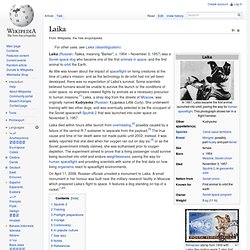
As little was known about the impact of spaceflight on living creatures at the time of Laika's mission, and as the technology to de-orbit had not yet been developed, there was no expectation of Laika's survival. Some scientists believed humans would be unable to survive the launch or the conditions of outer space, so engineers viewed flights by animals as a necessary precursor to human missions.[1] Laika, a stray dog from the streets of Moscow, was originally named Kudryavka (Russian: Кудрявка Little Curly). She underwent training with two other dogs, and was eventually selected to be the occupant of the Soviet spacecraft Sputnik 2 that was launched into outer space on November 3, 1957.
Sputnik 1. The signals of Sputnik 1 continued for 22 days.
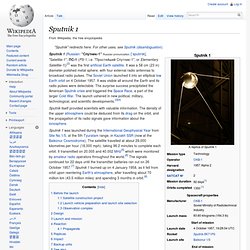
Sputnik 1 (Russian: "Спу́тник-1" Russian pronunciation: [ˈsputnʲɪk], "Satellite-1", ПС-1 (PS-1, i.e. "Простейший Спутник-1", or Elementary Satellite-1))[2] was the first artificial Earth satellite. It was a 58 cm (23 in) diameter polished metal sphere, with four external radio antennas to broadcast radio pulses. The Soviet Union launched it into an elliptical low Earth orbit on 4 October 1957. It was visible all around the Earth and its radio pulses were detectable. Sputnik itself provided scientists with valuable information.
Sputnik 1 was launched during the International Geophysical Year from Site No.1/5, at the 5th Tyuratam range, in Kazakh SSR (now at the Baikonur Cosmodrome). Before the launch[edit] Satellite construction project[edit] On 29 July 1955 the U.S. This metal arming key is the last remaining piece of the first Sputnik satellite.
Launch vehicle preparation and launch site selection[edit] Observation complex[edit] Design[edit]