
Exciting Futures. Whaling,fishing,ocean degradation. BobPolitical_Issues. New Energy. Environment. Sustainable living. Advanced Energy Efficiency, Lectures 1-5 - Video. Energy Tech - Environment. Harvard Controls The Minds of Worms…With Lasers! (video. I love cutting edge science, but sometimes it can seem nefarious enough to make a James Bond villain squeal in delight.
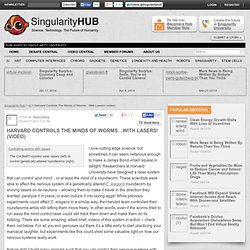
Researchers at Harvard University have designed a laser system that can control your mind…or at least the mind of a roundworm. These scientists were able to affect the nervous system of a genetically altered C. elegans roundworm by shining lasers on its neurons – allowing them to make it travel in the direction they wanted, paralyze it in place, or even induce it into laying eggs! While previous experiments could affect C. elegans in a similar way, the Harvard team controlled their roundworms while still letting them move freely. In other words, even if the worms tried to run away the mind control laser could still track them down and make them do its bidding.
There are some amazing, albeit brief, videos of this system in action – check them out below. Nature didn’t build many animals such that you can control their nervous systems with lasers. Our Earth is who sustains us. U.N. report slams Shell for Nigeria oil pollution Shell Oil - The Awful Truth Fight continues for Nigeria oil spill victims A brief look: UN says Nigerian oil pollution worse than first thought. Thursday’s report by the United Nations Environmental Programme (UNEP) into the state of oil pollution in Nigeria’s Ogoniland region revealed that the situation is much, much worse than Nigeria or the oil industry has ever acknowledged.
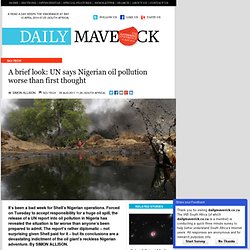
The report was a monster, involving 4,000 samples analysed, 142 groundwater monitoring wells drilled, 264 formal community meetings conducted, and 780 boreholes monitored. Oil pollution takes its toll on Niger Delta UN confirms massive oil pollution in Nigeria. Oil giant Shell has had a disastrous impact on the human rights of the people living in the Niger Delta in Nigeria, said Amnesty International.
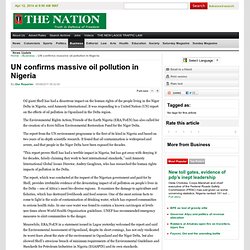
It was responding to a United Nation (UN) report on the effects of oil pollution in Ogoniland in the Delta region. The Environmental Rights Action/Friends of the Earth Nigeria (ERA/FoEN) has also called for the creation of a $100 billion Environmental Restoration Fund for the Niger Delta. The report from the UN environment programme is the first of its kind in Nigeria and based on two years of in-depth scientific research.
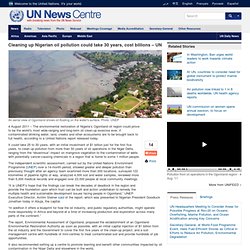
It found that oil contamination is widespread and severe, and that people in the Niger Delta have been exposed for decades. Cleaning up Nigerian oil pollution could take 30 years, cost billions – UN. 4 August 2011 – The environmental restoration of Nigeria’s Ogoniland oil region could prove to be the world’s most wide-ranging and long-term oil clean-up exercise ever, if contaminated drinking water, land, creeks and other ecosystems are to be brought back to full health, according to a United Nations report released today.
Pictures: Save the Kimberley Day 30. Environmental. Earth, Ocean, & Environmental Science. Forests. Green. Politics Global. Unbearable Legacies: The Politics of Environmental Degradation in North Korea. Unbearable Legacies: The Politics of Environmental Degradation in North Korea Peter Hayes Nearly 15 years ago, I wrote Enduring Legacies: Economic Dimensions of Restoring North Korea's Environment.

This essay not only described a set of urgent environmental problems in North Korea, but also described its institutional and legal framework for environmental management. Environmental Issues. Author and Page information by Anup ShahThis Page Last Updated Monday, February 02, 2015 This part of the global issues web site attempts to highlight some of the environmental issues and concerns that have an affect on all of us — from what we do, to what we don’t do. 50 articles on “Environmental Issues” and 7 related issues:
War added to Lebanon's many environmental problems. The year in review BEIRUT: Three months after the summer 2006 war with Israel, the Lebanese cannot swim in the sea, harvest crops, hike through the woods, drink water or breathe the air without worrying about the environmental impacts of the 34-day conflict.
Many environmental concerns about the war's damage have yet to be fully assessed, as their impacts need to be monitored with time. Other concerns pose a further potential threat. An Opportunity for Greener Politics : Environment: The end of the Cold War also ends the rationale for tolerating toxic pollution by the defense industry. The environmental problems and politics of the United States have been shaped by the Cold War, from the kinds of hazards we face and the technologies we use to our budget priorities and controls on information.
The political discourse framed the agendas and set the policies that strongly affected the kind of environmental politics that emerged here. There is no doubt that an end to the Cold War will mean a change in the military and ideological posture that this country has assumed for more than 40 years, a transformation with extraordinary political and policy consequences. Whaling: the latest culture war : This Magazine // Canadian progressive politics, environment, art, culture // Subscribe today.
Japan claims its annual Antarctic whale hunt is its cultural heritage.
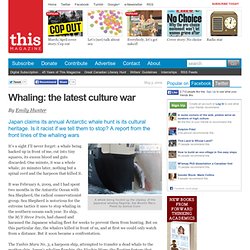
Is it racist if we tell them to stop? A report from the front lines of the whaling wars A whale being hauled up the slipway of the Japanese whaling flagship, the Nisshin Maru. Photo by Joshua Gunn It’s a sight I’ll never forget: a whale being hacked up in front of me, cut into tiny squares, its excess blood and guts discarded. Bs1999bs's favorite websites. Letters: Our planet's appetite for destruction. Oxfam is right to highlight the long-term impacts of climate change, land grabbing and natural resource degradation on the price of staple foods, and the consequent rapid increase in the number of hungry people (Harsh effects of global warming, 1 June).
But while these trends require major policy and societal shifts to reverse, some of the short-term causes of hunger could be dealt with almost overnight. For example, much of the price volatility and inflation in food prices could be prevented by limiting the ability of banks and hedge funds to speculate on financial derivatives in food. Make Green Money, Not Green War : Becker's Iowa Environmental Law Update. On Sunday, the Prime Minister of England published an interesting article in The Observer. In the article, he advances the case that England is going to be the “greenest government ever” and that, in doing so, “it will drive by more than ten-fold the increase of renewable heat over the coming decade, radically reducing carbon emissions and creating thousands of jobs.”
His primary point in the article is to say that there is a lot of money to be made in climate change initiatives and that it is not necessary to use the language of “threats and punishments,” which doesn't seem to be working anyway. It is a message that many in this country should take to heart. I thought EPA had come to this realization six months ago, but the inability to even have a discussion on cap-and-trade and, more recently, the election, has (as calculated) left EPA in a defensive mode. Global food crisis: Counting the real cost of biofuels.
Shark Fin Soup: War of Culture, Politics, Business. Shark Fin Soup Facts. Wednesday, 13 January 2010 Laurel Beauprie/ Watershed Sentinel Stefan Klein/iStockphotos. It wouldn’t be news if I told you our planet has its environmental problems. We’re making some progress in controlling what we put into the air, put into our landfills and even put into our oceans.
But we’re not paying enough attention to what we are taking out of our oceans – sharks – and they’re being killed at the rate of up to 73 million per year. That number refers to the number being killed only for their fins and almost entirely to make shark fin soup. Shark's Fin — Understanding the Political Soup - Page 1 - Dining. The roiling rhetoric that has washed over San Francisco since two California assemblymen introduced a bill banning the statewide sale and import of shark's fin has left many people in the city sputtering. AB-376 has brought out a host of accusations of animal cruelty, ecological devastation, and racism. Most of the articles covering the horrific practice of shark-finning the bill is trying to prevent — in which fishing boats capture live sharks by the thousand, slice off their fins, then throw them back in the water to die — report that shark's fin is flavorless and chewy, which leaves many Westerners puzzled as well as traumatized.
But there's a reason it is ubiquitous in Chinese wedding banquets and New Year's dinners: The pleasure one takes in eating shark's fin, like other delicacies such as sea cucumber, fish maw, and jellyfish, is in savoring its texture. To discuss only the flavors within a Chinese dish is like trying to sculpt something in 2-D. Related Stories. Biofuels boom in Africa as British firms lead rush on land for plantations. British firms have acquired more land in Africa for controversial biofuel plantations than companies from any other country, a Guardian investigation has revealed. Can Biofuels Save Sub-Saharan Africa? Jacob Silberberg for The New York TimesA man sprays pesticide on a farm in Sangalkam, Senegal. When soaring food prices, climate change, growing energy demands, poverty, international politics and social justice are in the mix, you have a tried and true recipe for heated debate with just about anyone.
I’m referring, as you may have guessed, to the hot-button topic of biofuels. Last week, the journal Nature published a special outlook issue dedicated to the state of, and prospects for, biofuels production in an energy-hungry future. Biofuel demand driving land grab in Africa: report. Water. "Groundwater depletion" 'Groundwater Depletion Raises Likelihood of Global Food Crises'
Groundwater depletion rate accelerating worldwide. Content : Groundwater depletion and pollution. Jay Famiglietti on alarming groundwater depletion across globe. Today – groundwater depletion and how it’s affecting global food production. At a recent science conference, EarthSky spoke to Jay Famiglietti, director of the University of California’s Center for Hydrologic Modeling. The Politics of Water in Central Asia - Photo Essays. The Dead Sea Is Dying - Photo Essays.
WATER POLLUTION IN CHINA. Wastewater Pollution in China. Water pollution. China's dam projects. Water Pollution in China Consequences as Himalayan Glaciers Melt. Water Crisis in the West Bank. Cambodia's oil must not be the slippery slope to corruption and catastrophe. Emerging from genocide and decades of civil war, Cambodia's discovery of oil raised hopes of faster development for the country – but also fears that the "resource curse" might strike again.
Oil production will come on line next year and local campaigners are racing to prevent Cambodia going the same way as countries such as Nigeria, where the industry has fuelled corruption and environmental catastrophe. Things got off to a bad start, according to Global Witness. Ensuring fair shares in a world of limits. As the 21st-century global economy increasingly hits natural resource limits and planetary boundaries, fundamental questions about fair shares will start to arise. Your chance to save Ecuador's rainforest. Our Earth is who sustains us. ENVIRONMENTAL ORG. Rainforest Advocates. The EnviroLink Network. Environmental. Earth, Ocean, & Environmental Science. RIVERLIFE. Brazil's plan to save the Amazon rainforest. Brazil has its own designs for REDD Accounting for roughly half of tropical deforestation between 2000 and 2005, Brazil is the most important supply-side player when it comes to developing a climate framework that includes reducing emissions from deforestation and forest degradation (REDD).
But Brazil's position on REDD contrasts with proposals put forth by other tropical forest countries, including the Coalition for Rainforest Nations, a negotiating block of 15 countries. Instead of advocating a market-based approach to REDD, where credits generated from forest conservation would be traded between countries, Brazil is calling for a giant fund financed with donations from industrialized nations. Contributors would not be eligible for carbon credits that could be used to meet emission reduction obligations under a binding climate treaty. Rainforest Rescue - Protecting Rainforests Forever.
Rainforest. Sustainability. Environmental-education. Minerals Depletion. The lowdown on topsoil: It's disappearing. Diet For A Healthy Planet. DocWatch spotlight on topsoil depletion. The End of the Line. Energy Summit Showcases Breakthroughs and Barriers to Sustainability. Environment. Activism. How Monsanto owns and manipulates the world’s food supply. Monsanto Whistleblower Says Genetically Engineered Crops May Cause Disease. Monsanto : Corporate Crimes. Why Monsanto Always Wins. Percy Schmeiser vs Monsanto: The Story of a Canadian Farmer's Fight to Defend the Rights of Farmers and the Future of Seeds. The World According To Monsanto - FULL LENGTH Halliburton, Other Gas Fracking Companies Violated Safe Drinking Water Act, Congressional Democrats Say.
'Fracking' threatens WA water resources Toxins found at third site as fracking fears build. Coal Seam Gas Not What It’s Fracked Up to Be. Fracking Faultlines Extend Into Heritage Areas. Is our future FRACKED! Coal seam gas in Australia « Inside Water. 60 Minutes: The Vanishing The ecologist. Environment & Climate Change news & features plus green living advice. Ecology. Water. Is freshwater scarcity a real threat? Climate Change Could Diminish Drinking Water More Than Expected. Climate Change Threatens Drinking Water, As Rising Sea Penetrates Coastal Aquifers.
Population.