
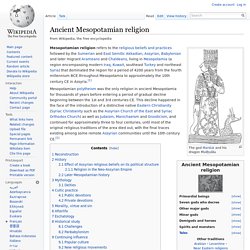
Assyro-Babylonian religion. The god Marduk and his dragon Mušḫuššu Mesopotamian religion refers to the religious beliefs and practices followed by the Sumerian and East Semitic Akkadian, Assyrian, Babylonian and later migrant Arameans and Chaldeans, living in Mesopotamia (a region encompassing modern Iraq, Kuwait, southeast Turkey and northeast Syria) that dominated the region for a period of 4200 years from the fourth millennium BCE throughout Mesopotamia to approximately the 10th century CE in Assyria.[1] Mesopotamian polytheism was the only religion in ancient Mesopotamia for thousands of years before entering a period of gradual decline beginning between the 1st and 3rd centuries CE.
Akkadian language. The mutual influence between Sumerian and Akkadian had led scholars to describe the languages as a sprachbund.[3] Akkadian proper names were first attested in Sumerian texts from ca. the late 29th century BC.[4] From the second half of the third millennium BC (ca. 2500 BC), texts fully written in Akkadian begin to appear.

Hundreds of thousands of texts and text fragments have been excavated to date, covering a vast textual tradition of mythological narrative, legal texts, scientific works, correspondence, political and military events, and many other examples. By the second millennium BC, two variant forms of the language were in use in Assyria and Babylonia, known as Assyrian and Babylonian respectively. Mesopotamian religion.