
Reinventing the way stories are told. Every Platform Tells a Story: Transmedia has the power to make any topic more vivid and personal. By Peter Gutierrez When Andy Plemmons, a progressive media specialist at David C.
Barrow Elementary in Athens, GA, was asked to help create a set of interdisciplinary lessons for fifth graders to learn about September 11, 2001, he naturally took a transmedia approach. Plemmons remembers turning to TV, radio, and the Web to try to find out what was going on that day. Transmedia Storytelling and the New Media Convergence. Narrative media is undergoing a shift from the traditional model of single, linear story lines to much broader explorations of the story world. Narratives are developed within larger contexts where even tertiary characters can act as launch points for new stories that flesh out the fictional universe. These bleed into the physical world through alternate reality gaming and transmedia cross-platform experiences that directly engage the audience, drawing them into the story through real-world challenges.
ARG's may not be especially new but they're being more commonly integrated into franchise productions through transmedia campaigns across web sites, mobile engagement, shorts, graphic novels, video games, music, and any other possible medium that can extend the story. The pieces here aren't particularly new but they're all starting to converge with the technologies that enable these experiences.
The majors are fighting hard to control this space. Pt1: Investigating the Possibilities of Transmedia; Collapsus, a Case Study. This blog post focuses on the intersection of transmedia and learning.
Presented in 4 segments, we will look at how transmedia is revolutionizing media creation and presentation. As modes of human communication continue to change, so too does the concept of audience, and the projects envisioned and produced. Through a case study on Collapsus, an Energy Risk Conspiracy project, I will expose components necessary for building a successful transmedia project, along with the capabilities and influence accessible through employing such processes.
Gain access to exclusive storyboards and scripts, behind the scene details, and interactive interviews as WorkBook Project delves deeper into the process of transmedia. I. Which Transmedia Practices are Best Suited to Publishing? Transmedia Lab. You Suck at Transmedia. Henry Jenkins. Henry Jenkins III (born June 4, 1958) is an American media scholar and currently a Provost Professor of Communication, Journalism, and Cinematic Arts, a joint professorship at the USC Annenberg School for Communication and the USC School of Cinematic Arts.[1] Previously, he was the Peter de Florez Professor of Humanities and Co-Director of the MIT Comparative Media Studies program with William Uricchio.
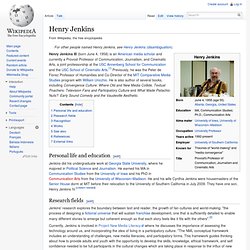
He is also author of several books, including Convergence Culture: Where Old and New Media Collide, Textual Poachers: Television Fans and Participatory Culture and What Made Pistachio Nuts? : Early Sound Comedy and the Vaudeville Aesthetic. Personal life and education[edit] Jenkins did his undergraduate work at Georgia State University, where he majored in Political Science and Journalism. He earned his MA in Communication Studies from the University of Iowa and his PhD in Communication Arts from the University of Wisconsin–Madison. Research fields[edit] Recognition[edit] Works[edit] Confessions of an Aca-Fan: The Official Weblog of Henry Jenkins. Transmedia – it’s about the story, not the tools. I’m on a early flight this morning what made me skip to publish another series of pictures from Iceland but instead use the time and share with you some thoughts on the concept of transmedia I got pretty obsessed about recently after hearing about it .
The concept is simple, actually that simple that it barely feels as new information. But I think it is something what we often forget about. And it is also a bit scary when you think of labels like photojournalist. Transmedia storytelling. "Transmedia" redirects here.
For a related process, see Transmediation. Transmedia storytelling (also known as transmedia narrative or multiplatform storytelling, cross-media seriality[1] etc.) is the technique of telling a single story or story experience across multiple platforms and formats including, but not limited to, games, books, events, cinema and television.
The purpose being to not only reach a wider audience by expanding the target market pool, but to expand the narrative itself ([2]). Henry Jenkins, an author of the seminal book Convergence Culture warns that this is an emerging subject and different authors have different understanding. He warns that the term "transmedia" per se means "across media" and may be applied to superficially similar, but different phenomena. History[edit] Current state[edit] Educational Uses[edit] References[edit] Further reading[edit] The Rise of the Corporate Transmedia Storyteller - The Steve Rubel Stream. The Clip Report: An eBook on the Future of Media In the early 1990s when I began my career in PR there were clip reports.
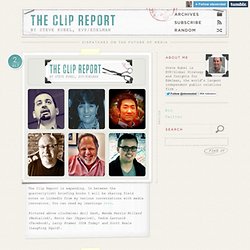
These were physical books that contained press clips. It seems downright archaic now but that’s how I learned about the press - by cutting, pasting up and photocopying clippings. My fascination with the media never abated. Today my role is to form insights into how the entire overlapped media landscape - the pros, social channels, and corporate content - is rapidly evolving and to help Edelman clients turn these learnings into actionable strategies. Today I am re-launching my Tumblr site with a new name, a new focus and a new format. How to Build Legends Out of Stories. October 6, 2010 · By Daniël van Gool in Events, Info During the Netherlands Film Festival the brand new transmedia event From Story to Legend was held in Utrecht as an initiative of both the Dutch Organisation for Professionals in the Movie and TV Industry (NBF) and the transmedia agency Dondersteen Media.
The goal of FSTL was to introduce professionals in the TV/movie industry to transmedia and the opportunities and possibilities it has to offer by having several experts who have earned their stripes in the field speak on the subject. And ARGNet was there to report! What follows below is a recap of the four presentations that were held by the panel of international experts, after which everyone who attended got a chance to join the experts for Q&A in several round table sessions. The first speaker was Drew Davidson from Carnegie Mellon’s Entertainment Technology Center. Transmedia tales and the future of storytelling. If you could choose how to receive your favourite novel, how would you?
Many of us have been programmed from childhood to accept that stories come on a page, as a book or on a screen, as a TV show or a movie. However new technologies are disrupting the publishing business as stories are downloaded to be consumed on e-readers, mobile devices and computer screens. Authors are increasingly "curators", "story architects" or "experience designers" and are looking toward the creation of storyworlds rather than a linear stream.
In addition, the relationship between consumers and media is changing as the value of print alters and the human tidal wave moving from print to screen-reading is causing seismic shifts in the way that entertainment and content is conceived and received. The entertainment industries are no stranger to buzzwords.