
30 Challenges for 30 Days. Did you know that it takes 30 days to form a new habit?
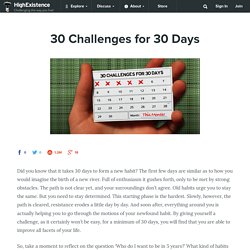
The first few days are similar as to how you would imagine the birth of a new river. Full of enthusiasm it gushes forth, only to be met by strong obstacles. The path is not clear yet, and your surroundings don’t agree. Old habits urge you to stay the same. But you need to stay determined. So, take a moment to reflect on the question ‘Who do I want to be in 5 years?’ Check out this short TED talk first to get inspired: Now pick one or more challenges and stick with them! However, be cautioned, picking too many challenges at the same time can easily result in a failure of all of them. #1 Write a I-Like-This-About-You note/text/email each day for someone (Easy) This is the perfect way to let someone else know you care.
. #2 Talk to one stranger each day (Hard) This is a great one to cure approaching anxiety. . #3 Take one picture each day (Hard) #4 Re-evaluate one long-held belief each day (Intermediate) Do you love yourself? Test how self-compassionate you are. Bias (psicologia) Da Wikipedia, l'enciclopedia libera.

Il bias, contribuendo alla formazione del giudizio, può quindi influenzare un'ideologia, un'opinione, e un comportamento. È probabilmente generato in prevalenza dalle componenti più ancestrali e istintive del cervello. Un'applicazione alla sociologia è il modello di propaganda che vuole spiegare le distorsioni (dette media bias) delle notizie nei mezzi d'informazione. In ogni momento della vita l'individuo deve utilizzare le sue facoltà cognitive per decidere cosa fare o per valutare la situazione che ha di fronte. Questo processo è influenzato direttamente dai seguenti fattori: Esperienza individualeContesto culturale e credenzeGiudizio altruiSchemi mentaliPaura di prendere una decisione che causi danno Se da una parte questi fattori consentono di prendere una decisione in tempi piuttosto brevi, dall'altra parte ne possono minare la validità. La correttezza dipende da ulteriori fattori: Esistono molti tipi di bias di memoria, tra cui: 5 Insane Ways Words Can Control Your Mind.
It Skews Your Perception of Time Picture, in your head, a timeline of your life.

Your birth at one end, your death at the other, today somewhere in the middle. The night you burnt that clown's body, buried safely behind you. We're going to take a wild guess and say that you imagined that line running horizontally, your birth on your left, your death on your right. Most English speakers imagine time that way, and then when we talk about events we picture ourselves moving along it like we were walking down a path. It might be enough to get you through freshman philosophy though. Mandarin speakers, on the other hand, imagine time in a vertical sense. Now here's where it gets weird: They did an experiment at Stanford where they'd try to trip up this process by taking Mandarin speakers and having them arrange objects horizontally in a certain order, then asked them a series of time-based questions ("Does April come before or after March?
"). They also often do this, whatever it is. Holy shit! Personality Quiz - VisualDNA. VisualDNA brings a new layer of information to the world of technology that will help bring it closer to the people who use it – making it more enjoyable and relevant.
Technology provides businesses with a surfeit of DATA – what and when. However it provides very little in the way of UNDERSTANDING – who did things, and why they did them. We see this effect in all areas of business from marketing to financial services. Despite all the targeting and site metrics, digital marketing isn’t getting any more effective. And despite all the data gathering there’s a limit to what credit histories can tell financial services about customers and potential customers.
We have a different approach. In the financial sector this approach has led to a five-fold increase in ROI, in media we have seen 35% improvement in click rates. Watch a short video about VisualDNA. Learn more about our solutions for business: