
Feed yourself for free: the 12 'Survival Plants' Part 1. Out of the many hundred edible British foods detailed in the best 'wild plant' guides, just these 12 will provide all you truly need, and more, for a continual fresh food supply.
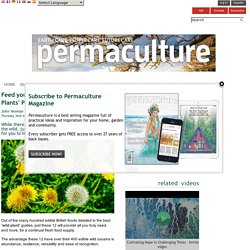
The advantage these 12 have over their 400 edible wild cousins is abundance, resilience, versatility and ease of recognition. Dandelion (Taraxacum officinale) Compared with an equal weight of lettuce, dandelion has three times the vitamin C, four times the protein, carbohydrate, fat, calcium, iron and vitamin B, five times the phosphorous - and an astounding 12 times the vitamin A. After that shopping list, it's almost surprising to hear it's good to eat as well. Its leaves and roots are available the year round although, like all greens, the young leaves gathered in the spring make the best eating. Perennialsolutions. February 12, 2013 User Admin Eric Toensmeier This post is to celebrate the release of my new Perennial Vegetable Gardening DVD!
Perennial Vegetables Defined These are crops that fit my definition of perennial vegetable: living three or more years, used as a vegetable and not a novelty crop or culinary herb, and not destroyed by harvesting. Some of these root crops are plant/replant perennials, meaning they are dug up for harvest but then some portion is replanted in the same or another hole, keeping the plant alive to produce again the following year. Climate Zones. Cardone/Cardoon from Ocean Mist Farms. How to Prepare Cardoons.
At the Alemany Farmer's Market right now we're seeing a lot of cardoons in season.
Cardoons are closely related to - and taste very much like - artichokes. Why is this vegetable not well-known, then? Cardoons are high-maintenance vegetables. They look like very large hearts of celery, but have thorns in the stalks, so handle with care. The stalks are not solid like celery, and are semi-hollow and stringy. To prepare cardoons, first trim off the bottom and pull apart the stalks. Most recipes require cardoons to be parboiled. We really like this Golden Fried Cardoon recipe from Food & Wine, and Cardoon Gratin from Saveur as well. (Photo by Kathryn Hill) Plant Recommendations Zones 6-8 » Edible Landscaping with Rosalind Creasy. USDA Zones 6 through 8 cover areas of the country where the winter low temperatures seldom go below – 10 degrees F.
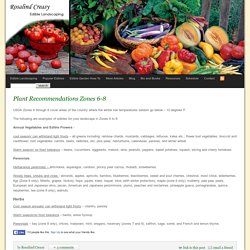
The following are examples of edibles for your landscape in Zones 6 to 8: Annual Vegetables and Edible Flowers - cool season/ can withstand light frosts – all greens including: rainbow chards, mustards; cabbages, lettuces, kales etc.; flower bud vegetables: broccoli and cauliflower; root vegetables: carrots, beets, radishes, etc; plus peas, nasturtiums, calendulas, pansies, and winter wheat.
Make an edible garden border. Garden Edging Ideas. 10 design ideas for a tiny edible garden. 7 edible garden design ideas. How to Plant Vegetables. North Carolina Cooperative Extension. — Written By NC Cooperative Extension As a result of the economic downswing, backyard fruit and vegetable gardening is increasing in popularity.
Many people who have never raised fruits or vegetables are now planting seed and buying transplants, hopeful to reap the rewards of their time and labor. Traditionally, produce gardens were located away from the house because they were unsightly. North Carolina Cooperative Extension. — Written By NC Cooperative Extension We have heard that the 7th billion person has been born and I wonder, how are we going to feed 7 billion people?
The term “edible landscape” will become quite familiar to many North Carolinians in future years. An edible landscape challenges the home gardener to incorporate fruit- and vegetable-producing plants into the overall design. It is not necessary to substitute these plants for all ornamentals in the landscape. The idea is to progress from the typical backyard garden and develop a plan that uses edible plants to solve functional landscape problems. For example, try planting fruit trees. Instead of planting junipers, liriope, or cotoneaster, think about planting strawberries as a ground cover.
Blueberry bushes are a good substitute for a ligustrum or burford holly hedge. An Edible Landscape - Home + Garden - April 2013. Eat Your Yard!
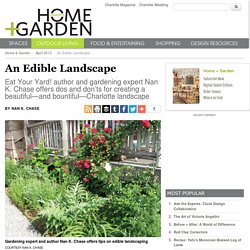
Author and gardening expert Nan K. Chase offers dos and don’ts for creating a beautiful—and bountiful—Charlotte landscape By Nan K. Chase Gardening expert and author Nan K. Any plant that goes into my edible landscape has to meet these requirements: is it beautiful up close and from a distance? An Edible Landscape - Home + Garden - April 2013. Edible Landscaping Plant Sale: Buy plants online from our garden center and plant nursery. Edible Landscaping Plant Sale: Buy plants online from our garden center and plant nursery. Vegetables and Flowers Mix in Beautiful Edible Gardens.
Vegetables and Flowers Mix in Beautiful Edible Gardens. An Edible Cottage Garden With a Pleasing Symmetry. Eating from the Ground Up (National Gardening Association) Alpine strawberries feature tasty small berries on diminutive plants that flower and fruit all summer long.
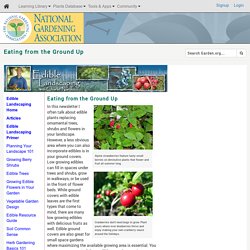
Cranberries don't need bogs to grow. Plant yours where ever blueberries thrive and enjoy making your own cranberry sauce around the holidays. In this newsletter I often talk about edible plants replacing ornamental trees, shrubs and flowers in your landscape. However, a less obvious area where you can also incorporate edibles is in your ground covers.