
Online Art Teacher. Company Name: The Art Institutes APPLY Job Title: Adjunct Art Teacher Job Code: 17846 Location: Draper, Utah 84020 Job Category: Education/Training Date Posted: 08-16-2012 SEND TO FRIEND Job Description: Job Summary The part time instructor facilitates meaningful learning of the course competencies in the curriculum and proactively supports all facets of the learning environment.

Key Job Elements Will teach classes in foundation arts, color theory, fundamentals of design, observation drawings, drawing in perspective. Reports To: Dean of System-Wide Programs, Academic Department Director Directly Supervises: None Interacts With: Academic affairs department, other school/campus functional areas, curriculum task force and other committees, other faculty, and students Job Requirements Knowledge: Master’s degree in Art. The eCourse « Teaching Art Online.
Tao: the way is an eCourse designed to teach artists how to create an eLearning environment for their students with digital download tutorials, eBooks and multimedia online classes.

The journey begins by learning how to create a small (5-10 page), beautiful and effective PDF tutorial suitable to share a short technique. The course continues on the path to a rich student experience by showing you how to turn a series of tutorials into an eBook and then takes eLearning to another level by exploring ways to give your students a rich, multimedia learning experience. Build on your skills with each module. When it’s time to put it all together, choose the components that work best for your teaching needs.
The eCourse comes with me as your patient guide. Teaching Art Online - the way to bring art classes to students around the world. Class begins February 4, 2013 and ends March 29, 2013. Module One: Creating A Digital Download {Art Tutorials} Module One is spread out over two weeks. Permission Request Template. The TEACH Act. The TEACH Act Intro | Section 110(2) | Checklist | TEACH Act Toolkit Introduction Copyright law provides educators with a separate set of rights in addition to fair use, to display (show) and perform (show or play) others' works in the classroom.

These rights are in Section 110(1) of the Copyright Act and apply to any work, regardless of the medium. Until recently, however, when the classroom was remote, the law's generous terms for face-to-face teaching in Section 110(1) shrank dramatically in Section 110(2) -- some would say to the vanishing point! These severe limitations on what could be performed in distance education received lots of attention. The Copyright Office prepared its report and recommended significant changes. CR-Teach-Act. Fair use. Fair use is a limitation and exception to the exclusive right granted by copyright law to the author of a creative work.
In United States copyright law, fair use is a doctrine that permits limited use of copyrighted material without acquiring permission from the rights holders. Examples of fair use include commentary, search engines, criticism, parody, news reporting, research, teaching, library archiving and scholarship. It provides for the legal, unlicensed citation or incorporation of copyrighted material in another author's work under a four-factor balancing test. Fair use is one of the traditional safety valves intended to balance the public's interest in open access with the property interests of copyright holders. Fair use under United States law[edit] Choose a License. This work is licensed under the Creative Commons LICENSE_NAME License. To view a copy of this license, visit LICENSE_URL. We are currently testing a new version of the License Chooser.
Please consider using the Chooser beta, and leave us feedback on how we can improve. Creative Commons is a non-profit organization. We need your support to continue providing these tools. Lorem ipsum dolor sit amet... About earlier versions The most recent license version is 4.0, which can be used internationally. If your jurisdiction is not on this list, or if you want to use the latest version of the licenses instead of a ported license, you can return to the 4.0 license chooser. The most recent license version is 4.0, which can be used internationally. Free Technology for Teachers: A New Tool for Choosing a Creative Commons License. Thanks for the email! Copyright and Intellectual Property. The Ultimate Guide to The Use of Blogs in Teaching. Free Blogging platforms for teachers and students :A- Edublogs The world's most popular educational blogging service, Edublogs lets you easily create and manage student and teacher blogs, quickly customize and include videos.
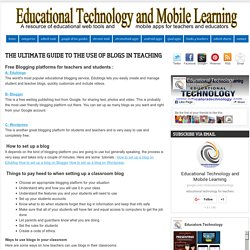
B- Blogger This is a free weblog publishing tool from Google, for sharing text, photos and video. This is probably the most user friendly blogging platform out there. You can set up as many blogs as you want and right from your Google account. C- Wordpress This is another great blogging platform for students and teachers and is very easy to use and completely free. How to set up a blog It depends on the kind of blogging platform you are going to use but generally speaking, the process is very easy and takes only a couple of minutes. Tony Bates » Nine steps to quality online learning: introduction.