
Scientists create "artificial life"
Origin Of Life On Earth: Simple Fusion To Jump-start Evolution. With the aid of a straightforward experiment, researchers have provided some clues to one of biology's most complex questions: how ancient organic molecules came together to form the basis of life.

Specifically, this study demonstrated how ancient RNA joined together to reach a biologically relevant length. RNA, the single-stranded precursor to DNA, normally expands one nucleic base at a time, growing sequentially like a linked chain. Life's Origin May Have Been a Shallow Affair. In finding answers to the mystery of the origin of life, scientists may not have to dig too deep.
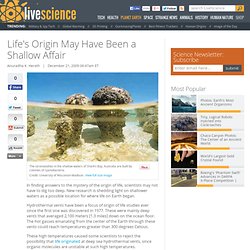
New research is shedding light on shallower waters as a possible location for where life on Earth began. Hydrothermal vents have been a focus of origin of life studies ever since the first one was discovered in 1977. These were mainly deep vents that averaged 2,100 meters [1.3 miles] down on the ocean floor. The hot gasses emanating from the center of the Earth through these vents could reach temperatures greater than 300 degrees Celsius.