
i4j.info. Five Majors That Let You Survive in the Double Dip Recession. The recession hasn’t been good for most people’s job prospects.
The nationwide unemployment rate is up to approximately 9.1% according to statistics for July 2011—up from an average of 4.6% throughout 2005 and 2006, before the recession. The Great Freelancer Movement: 8 Reasons Why your Next Job will be a Project. By 2025, over 75% of the workforce will be comprised of Millennials, a group many refer to as the Facebook generation.

That’s just over 11 years away. For big corporations this should come as shocking news. 6 Ways To Save U.S. Startups And Jobs From Death By Regulation. Declining Industries vs Growing Jobs: What the WaPo Deal Tells Us About Innovation : Progressive Policy Institute. Does innovation create or destroy jobs?
10 Surprising Marketing Job Titles For The Next 10 Years. The Rise of the Supertemp. Armies of Expensive Lawyers, Replaced by Cheaper Software. August Employment Report: 96,000 Jobs, 8.1% Unemployment Rate. By Bill McBride on 9/07/2012 08:30:00 AM From the BLS: Total nonfarm payroll employment rose by 96,000 in August, and the unemployment rate edged down to 8.1 percent, the U.S.
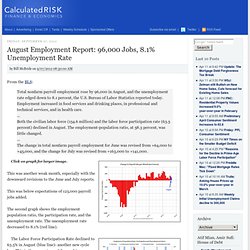
Bureau of Labor Statistics reported today. Employment increased in food services and drinking places, in professional and technical services, and in health care. ... Both the civilian labor force (154.6 million) and the labor force participation rate (63.5 percent) declined in August. Click on graph for larger image. This was another weak month, especially with the downward revisions to the June and July reports. This was below expectations of 125,000 payroll jobs added. The second graph shows the employment population ratio, the participation rate, and the unemployment rate.
The Labor Force Participation Rate declined to 63.5% in August (blue line)- another new cycle low. The Employment-Population ratio declined to 58.3% in August (black line). Choosing-a-career-Large.jpg 2,338×1,800 pixels. Which USA do you work in ? When it comes to getting a job, the USA has bifurcated into two employment worlds, the digital world and the brick and mortar world.
The brick and mortar world is everything you physically touch. Its manufacturing. Its retail sales. How Social Currency Is Driving Identity, Trust and New Industries. Editor’s Note: Markus Barnikel joined carpooling.com as CEO in 2011, in order to expand into new countries and make carpooling a convenient transportation option for all.

Barnikel has also held various leadership positions at Yahoo, including as Chief Sales Officer in Australia and Global Director of Sales in the U.S. As our lives increasingly move to the digital realm – whether it’s what we read, what we watch, photos that once sat in frames now uploaded to a server farm somewhere in the rural United States, or even the 140-character thoughts we share with the world – comes the very reconstitution of our identities online. A German artist named Tobias Leingruber recently took this concept to its logical extreme when he produced physical identification cards based on Facebook profiles (this attempt at satire was executed so well that Facebook sent Leingruber a cease-and-desist letter three days later).
Future - Technology - Robot swarms aim to bring buildings to life. Meet the man who wants to create architecture that understands everything about us – down to our emotional states – and learns from its mistakes.

It doesn’t take much to be considered smart if you’re a building. What Does Work Look Like When Half of Americans Are Not In A Job? The world at work: Jobs, pay, and skills for 3.5 billion people. Over the past three decades, as developing economies industrialized and began to compete in world markets, a global labor market started taking shape.
As more than one billion people entered the labor force, a massive movement from “farm to factory” sharply accelerated growth of productivity and per capita GDP in China and other traditionally rural nations, helping to bring hundreds of millions of people out of poverty. To raise productivity, developed economies invested in labor-saving technologies and tapped global sources of low-cost labor. Podcast A skills-scarce world DownloadMcKinsey director Richard Dobbs and MGI senior fellow Anu Madgavkar detail key findings from the report and policy implications for addressing labor market imbalances. Today, the strains on this market are becoming increasingly apparent. The dynamics of the global labor market will make these challenges even more difficult. Is Your Job Robot-Proof? The Long March from Crowdsourcing to a Global Meritocracy. Who Should be Your Chief Collaboration Officer? - Morten T. Hansen and Scott Tapp.
Why Your Company Needs A Chief Collaboration Officer. The Global Talent Crisis. By Edward Gordon The Futurist, September-October 2009 Contrary to popular opinion, there are plenty of open jobs.
What's missing are candidates with skills. We are in the midst of a global job and talent upheaval, the most remarkable of any job and talent change since the Industrial Revolution and encompassing every aspect of the global economy. The dawning of a new industrial age, a period characterized by a growing need for highly skilled technical workers, is driving this revolution. How To Find Meaningful Work. It’s a phenomenon that has become increasingly apparent over the last five years: For many people, the ideal job has morphed from one that offers lots of money to one that offers meaning--and a competitive salary doesn’t hurt, either.
It isn’t just that people are rejecting jobs at large financial institutions with questionable morals (see this New York Times article on Wall Street’s campus recruiting crisis). Jobseekers today want a position that makes them feel good inside. ReWork, a startup that came out of the 2011 Unreasonable Institute, may be the first company that places young professionals directly with "disruptive, world changing organizations"--including non-profits and all manner of triple-bottom-line businesses.
Anyone interested in getting a job through ReWork fills out an application on the website. A Jobs Compact for America's Future. Idea in Brief Three realities stand in the way of building the stronger human capital that U.S. business and the U.S. economy need. Competing on—and investing in—human capital is often not in the short-term interest of individual companies. Strategies and practices aimed at achieving both high productivity and high wages are not spreading widely across companies and industries. Call in the sensemaker, the future isn't working.
IN THE future your children and their children will be doing jobs we can scarcely imagine now. Their titles will be as wacky to us as ''software developer'' must once have been to a baby boomer. Try making sense of a ''virtchandise manager'', an ''outcome aggregator'', a ''data evangelist'' or even a ''sensemaking analyst'', for starters.
For London Youth, Down and Out Is Way of Life. Will these 10 jobs disappear in 2012? Discover your passion. 2 Billion Jobs to Disappear by 2030. Jobs Outlook 2012: Careers Headed For The Dustbin. Disappearing Middle-Class Jobs.