
Diane de Poitiers. Diane de Poitiers (3 September 1499 – 25 April 1566) was a French noblewoman and a prominent courtier at the courts of kings Francis I and his son, Henry II of France.
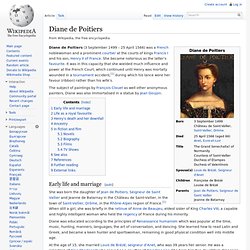
She became notorious as the latter's favourite. It was in this capacity that she wielded much influence and power at the French Court, which continued until Henry was mortally wounded in a tournament accident,[1] during which his lance wore her favour (ribbon) rather than his wife's. The subject of paintings by François Clouet as well other anonymous painters, Diane was also immortalised in a statue by Jean Goujon. Early life and marriage[edit] Diane was educated according to the principles of Renaissance humanism which was popular at the time, music, hunting, manners, languages, the art of conversation, and dancing. Mary Leakey. During her career, Leakey discovered fifteen new species of other animals, and one new genus.
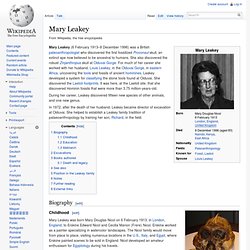
In 1972, after the death of her husband, Leakey became director of excavation at Olduvai. She helped to establish a Leakey family tradition of palaeoanthropology by training her son, Richard, in the field. Julie d'Aubigny. "Mademoiselle Maupin de l'Opéra".
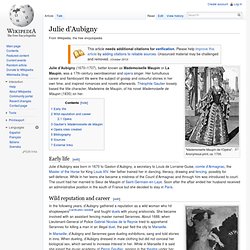
Anonymous print, ca. 1700. Julie d'Aubigny (1670–1707), better known as Mademoiselle Maupin or La Maupin, was a 17th-century swordswoman and opera singer. Her tumultuous career and flamboyant life were the subject of gossip and colourful stories in her own time, and inspired romances and novels afterwards. Théophile Gautier loosely based the title character, Madeleine de Maupin, of his novel Mademoiselle de Maupin (1835) on her. Ada Lovelace. Augusta Ada King, Countess of Lovelace (10 December 1815 – 27 November 1852), born Augusta Ada Byron and now commonly known as Ada Lovelace, was an English mathematician and writer chiefly known for her work on Charles Babbage's early mechanical general-purpose computer, the Analytical Engine.
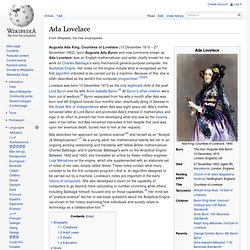
Her notes on the engine include what is recognised as the first algorithm intended to be carried out by a machine. Because of this, she is often described as the world's first computer programmer.[1][2][3] Nzinga of Ndongo and Matamba. Queen Njinga Mbande (c. 1583 – December 17, 1663), also known as Ana de Sousa Nzingha Mbande, was a 17th-century queen (muchino a muhatu) of the Ndongo and Matamba Kingdoms of the Mbundu people in southwestern Africa.
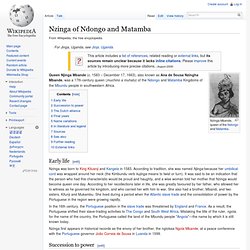
Early life[edit] Nzinga was born to King Kiluanji and Kangela in 1583. According to tradition, she was named Njinga because her umbilical cord was wrapped around her neck (the Kimbundu verb kujinga means to twist or turn). Eleanor of Provence. Eleanor of Provence (c. 1223 – 24/25 June 1291[1]) was Queen consort of England, as the spouse of King Henry III of England, from 1236 until his death in 1272.
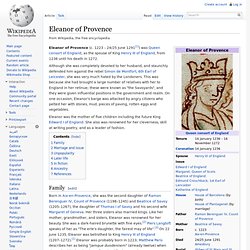
Although she was completely devoted to her husband, and staunchly defended him against the rebel Simon de Montfort, 6th Earl of Leicester, she was very much hated by the Londoners. This was because she had brought a large number of relatives with her to England in her retinue; these were known as "the Savoyards", and they were given influential positions in the government and realm. On one occasion, Eleanor's barge was attacked by angry citizens who pelted her with stones, mud, pieces of paving, rotten eggs and vegetables. Eleanor was the mother of five children including the future King Edward I of England. Empress Matilda. Empress Matilda (c. 7 February 1102 – 10 September 1167), also known as the Empress Maude, was the claimant to the English throne during the civil war known as the Anarchy.
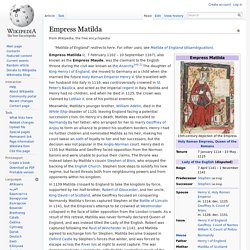
[nb 1] The daughter of King Henry I of England, she moved to Germany as a child when she married the future Holy Roman Emperor Henry V. She travelled with her husband into Italy in 1116, was controversially crowned in St. Peter's Basilica, and acted as the imperial regent in Italy. Margaret of France, Queen of England. Margaret of France (c. 1279[1] – 14 February 1318[1]), a daughter of Philip III of France and Maria of Brabant, was Queen of England as the second wife of King Edward I.

Early life[edit] Her father died when she was three years old and she grew up under guidance of her mother and Joan I of Navarre, her half-brother King Philip IV's wife.[2] Marriage[edit] Rosalind Franklin. Rosalind Elsie Franklin (25 July 1920 – 16 April 1958)[1] was a British biophysicist and X-ray crystallographer who made critical contributions to the understanding of the fine molecular structures of DNA (deoxyribonucleic acid), RNA, viruses, coal, and graphite.[2] Her DNA work achieved the most fame because DNA plays an essential role in cell metabolism and genetics, and the discovery of its structure helped her co-workers understand how genetic information is passed from parents to their offspring.

Franklin is best known for her work on the X-ray diffraction images of DNA which led to the discovery of the DNA double helix. According to Francis Crick, her data was key to determining the structure[3] to formulate Crick and Watson's 1953 model regarding the structure of DNA.[4] Franklin's images of X-ray diffraction confirming the helical structure of DNA were shown to Watson without her approval or knowledge. Simone de Beauvoir. Simone-Lucie-Ernestine-Marie Bertrand de Beauvoir, commonly known as Simone de Beauvoir (French: [simɔn də bovwaʁ]; 9 January 1908 – 14 April 1986), was a French writer, intellectual, existentialist philosopher, political activist, feminist and social theorist.
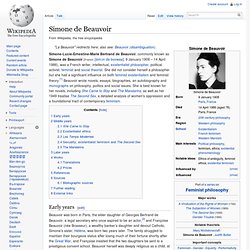
She did not consider herself a philosopher but she had a significant influence on both feminist existentialism and feminist theory.[1] Beauvoir wrote novels, essays, biographies, an autobiography and monographs on philosophy, politics and social issues. She is best known for her novels, including She Came to Stay and The Mandarins, as well as her 1949 treatise The Second Sex, a detailed analysis of women's oppression and a foundational tract of contemporary feminism.
Early years[edit] Anaïs Nin. Anaïs Nin (Spanish: [anaˈis ˈnin]; born Angela Anaïs Juana Antolina Rosa Edelmira Nin y Culmell, February 21, 1903 – January 14, 1977) was an author born to Spanish-Cuban parents in France, where she was also raised. She spent some time in Spain and Cuba but lived most of her life in the United States where she became an established author. She published journals (which span more than 60 years, beginning when she was 11 years old and ending shortly before her death), novels, critical studies, essays, short stories, and erotica. A great deal of her work, including Delta of Venus and Little Birds, was published posthumously. Biographies. Women Rulers. The Trung Sisters. In Vietnam women have always been in the forefront in resisting foreign domination. Two of the most popular heroines are the Trung sisters who led the first national uprising against the Chinese, who had conquered them, in the year 40 A.D.
The Vietnamese had been suffering under the harsh rule of a Chinese governor called To Dinh. Some feel that if the sisters had not resisted the Chinese when they did, there would be no Vietnamese nation today. Empress Wu Zetian. Even though according to the Confucian beliefs having a woman rule would be as unnatural as having a "hen crow like a rooster at daybreak," during the most glorious years of the Tang dynasty a woman did rule, and ruled successfully. She was Wu Zetian, the only female in Chinese history to rule as emperor. To some she was an autocrat, ruthless in her desire to gain and keep power.
To others she, as a woman doing a "man's job," merely did what she had to do, and acted no differently than most male emperors of her day. They also note that she managed to effectively rule China during one of its more peaceful and culturally diverse periods. The Tang dynasty (618-906 AD) was a time of relative freedom for women. Wu Zetian. Wu Zetian (Wu Tse-tien; simplified Chinese: 武则天; traditional Chinese: 武則天; pinyin: Wǔ Zétiān; Wade–Giles: Wu3 Tse2-t'ien1) (February 17, 624 – December 16, 705),[12] also known as Wu Zhao (Wu Chao; Chinese: 武曌; pinyin: Wǔ Zhào; Wade–Giles: Wu3 Chao4), Wu Hou (Chinese: 武后; pinyin: Wǔ Hòu; Wade–Giles: Wu3 Hou4), in Tang dynasty, Tian Hou (天后), and in English as Empress Consort Wu, or by the deprecated term,[13] "Empress Wu", was a Chinese sovereign, who ruled officially under the name of her self-proclaimed "Zhou dynasty", from 690 to 705.
She was the only female emperor in the Chinese feudal dynasties spanning more than 4,000 years. However, she had previous imperial positions under both Emperor Taizong of Tang and his son Emperor Gaozong of Tang, of the Tang dynasty of China. Ching Shih. Ching Shih Ching Shih (1775–1844)[1] (simplified Chinese: 郑氏; traditional Chinese: 鄭氏; pinyin: Zhèng Shì; Cantonese: Jihng Sih; "widow of Zheng"), also known as Cheng I Sao (simplified Chinese: 郑一嫂; traditional Chinese: 鄭一嫂; pinyin: Zhèng Yī Sǎo; Cantonese: Jihng Yāt Sóu; "wife of Zheng Yi"), was a prominent pirate in middle Qing China, who terrorized the China Sea in the early 19th century.
She commanded over 300 junks manned by 20,000 to 40,000 pirates[2] another estimate has Cheng's fleet at 1800 and crew at about 80,000[3][4]— men, women, and even children. She challenged the empires of the time, such as the British, Portuguese and the Qing dynasty. Undefeated, she would become one of China and Asia's strongest pirates, and one of world history's most powerful pirates. She was also one of the few pirate captains to retire from piracy. Ching Shih II. Marie of Romania. Maria of Yugoslavia. Princess Ileana of Romania. Tura Satana. Eleanor of Aquitaine. Florence Nightingale. Catherine the Great. Cleopatra VII. Boudica. Elizabeth I of England. Madeleine de Verchères. Laura Secord. Joan of Arc. Margaret Thatcher. Mary Wollstonecraft. Emmeline Pankhurst. Georgiana Cavendish, Duchess of Devonshire. Barbara Castle, Baroness Castle of Blackburn. Queen Victoria. Isabella of France.