
Mario Hoops 3-on-3. Mario Hoops 3-on-3, known in Europe and Australia as Mario Slam Basketball and in Japan as Mario Basketball 3on3 (マリオバスケ 3on3, Mario Basuke 3on3?)

, is a sports game developed by Square Enix and published by Nintendo for the Nintendo DS in 2006. Gameplay[edit] Touch control is used for all actions besides movement (which is handled by the directional pad). Dribbling is performed automatically, but at a lower rate if the touch screen is not used actively to dribble. Touching the screen in a certain direction causes the character that the player is controlling to change which way the character is dribbling and face in another direction, allowing the player to turn his/her character without having to move with the d-pad and gives the player better defense. Navigating menus and playing the game can be done with either the touch screen or the d-pad. The player shoots by drawing a line forward on the touchscreen. Super Princess Peach. Super Princess Peach (スーパープリンセスピーチ, Sūpā Purinsesu Pīchi?)

Is a platform video game published by Nintendo for the Nintendo DS handheld game console. It was released in Japan in October 2005, the United States in February 2006, Australia in March 2006, and Europe in May 2006. Despite the role reversal in the plot, the game was criticized for the nature of how Peach attacked, the marketing campaign, and the simple gameplay. It sold 1.15 million units worldwide. Mario Party DS. Mario Party DS (Japanese: マリオパーティDS, Hepburn: Mario Paati Dī Esu?)

Mario vs. Donkey Kong: Mini-Land Mayhem! Mario vs.

Donkey Kong: Mini-Land Mayhem! (マリオvs.ドンキーコング 突撃! ミニランド, Mario vs. Donkī Kongu Totsugeki! Mini Rando?) Gameplay[edit] The puzzle-based gameplay in Mini-Land Mayhem is built upon that of earlier Mario vs. Construction Zone[edit] The Construction Zone is a level editor that allows the players to design their own levels. Plot[edit] Development[edit] Mini-Land Mayhem! Mario vs. Donkey Kong 2: March of the Minis. Gameplay[edit] The game consists of eight worlds, or floors, each with nine levels, or rooms, a minigame, and a DK stage.

In addition to these levels are the Roof, which consists entirely of the final DK stage, and the Basement, which consists of two extra boss stages that are only accessible by earning 40 Silver stars and 40 Gold stars. Mario Kart DS. Yoshi's Island DS. Gameplay[edit] A screenshot showing Yoshi's Island DS's distinctive graphical style.
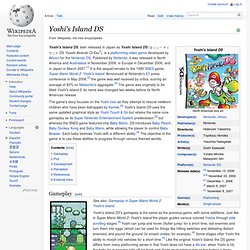
The Nintendo DS's two screens function as one tall screen. Yoshi's Island DS's gameplay is the same as the previous game, with some additions. Just like in Super Mario World 2: Yoshi's Island the player guides various colored Yoshis through side scrolling stages.[5] Yoshi can jump and hover (flutter jump) for a short time, eat enemies and turn them into eggs (which can be used for things like hitting switches and defeating distant enemies) and pound the ground (to smash crates, for example).[4] Some stages offer Yoshi the ability to morph into vehicles for a short time.[5] Like the original Yoshi's Island, the DS game differs from many platforming series in that Yoshi does not have a life bar; when Yoshi is hit, the baby he is carrying falls off his back and Yoshi must retrieve him or her before a timer expires. Flowers and coins, as well as stars, are scattered about the game's stages. Super Mario 64 DS. Super Mario 64 DS (スーパーマリオ64DS, Sūpā Mario Rokujūyon Dī Esu?)

Is produced by Nintendo for the Nintendo DS handheld game console. The game was a launch title for the Nintendo DS, released in North America and Japan in 2004; it was later released in Europe and Australia in 2005. Overall, the game was critically and commercially successful. It won video game awards, and received positive comments from the gaming press, that focused on elements of the single-player mode. The multiplayer mode and lack of analog controls used in Super Mario 64 were common complaints among reviewers.
Plot[edit] The game begins with a letter from Princess Peach inviting Mario to come to her castle for a cake she has baked for him.[2] Mario travels to her castle, and is followed by his brother Luigi and greedy counterpart Wario. He first defeats Goomboss to free Mario who assists him as the two continue searching the castle and collecting Power Stars. New Super Mario Bros. Reviews of the game were very favorable.

Praise focused on improvements made to the Mario franchise, while criticism targeted the game's simplicity, and similarity to previous games. New Super Mario Bros. received several honors, including Game of the Month awards from Game Informer and Electronic Gaming Monthly, and Editors' Choice Awards from IGN and GameSpot. New Super Mario Bros. Mario Party DS.