
Moodle.org: open-source community-based tools for learning. eFront: Open Source Authoring Tools for e-Learning. As an e-Learning consultant I was always a fan of open source software.
Why? The answer is simple. Because I could use them as I wish, for whatever I wish, without long-term commitments and with the extra bonus of a community of professionals that use, extend and support them. In this post I am not going to talk about open source learning management systems such as eFront[1] but rather dedicated open source “authoring tools”. The list that it follows is not in particular order. => If you know a free or open source authoring tool that is not included in the list I will highly appreciate if you write a comment with a link! Free & Open Source Authoring Tools for e-Learning What2Learn makes it easy for e-Learning developers to create interactive games and quizzes and track learners’ attainment.
Xical.org ClassTools.net Create free educational games, quizzes, activities and diagrams in seconds! eXe Wink CourseLab Quandary An application for creating Web-based Action Mazes. Hot Potatoes. Adobe. Learn Adobe Captivate, RoboHelp and FrameMaker! Everyone's E-Learning Inc. Course Demo. Adobe in eLearning & mLearning.
Adobe. Techniques for WCAG 2.0. Techniques and Failures for Web Content Accessibility Guidelines 2.0 W3C Working Group Note 8 April 2014 This version: Latest version: Previous version: Editors: Michael Cooper, W3C Andrew Kirkpatrick, Adobe Systems Inc.
Joshue O Connor, NCBI Centre for Inclusive Technology (CFIT) Previous Editors: Loretta Guarino Reid (until May 2013 while at Google, Inc.) Gregg Vanderheiden (until May 2013 while at Trace R&D Center, University of Wisconsin-Madison) Ben Caldwell (until September 2010 while at Trace R&D Center, University of Wisconsin-Madison) Wendy Chisholm (until July 2006 while at W3C) John Slatin (until June 2006 while at Accessibility Institute, University of Texas at Austin) This document is also available in these non-normative formats: Copyright © 2014 W3C® (MIT, ERCIM, Keio, Beihang), All Rights Reserved.
Status of This Document This section describes the status of this document at the time of its publication. This is a Working Group Note "Techniques for WCAG 2.0". eLearning & mLearning: Everything You Need to Know About Graphics, Part III. By AJ George So far in this graphics series we've covered whether you should use dynamic or static images and then how to best use static images if you so choose.
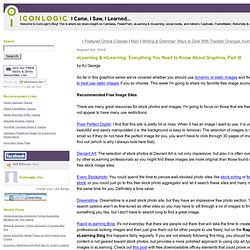
This week I'm going to share my favorite free image sources. Recommended Free Image Sites There are many great resources for stock photos and images. I'm going to focus on those that are free and do not appear to have many use restrictions. Pixel Perfect Digital: I find that this site is pretty hit or miss. Click here for Part I of the Graphics Series, Dynamic or Static Images? Click here for Part II of the Graphic Series, Using Static Images to Improve Learning. Click here for Part IV of the Graphics Series, Easy Image Manipulation. Click here for Part V of the Graphics Series, Tips for Making Your Own PowerPoint Graphics.
Camtasia Studio, Screen Recorder Software, Product Tour. Camtasia Studio Features Top New Features TechSmith Fuse TechSmith Fuse, our new mobile app, makes it simple to get exactly what you need from your devices into your projects.
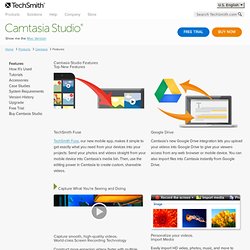
Send your photos and videos straight from your mobile device into Camtasia’s media bin. Then, use the editing power in Camtasia to create custom, shareable videos. Google Drive Camtasia’s new Google Drive integration lets you upload your videos into Google Drive to give your viewers access from any web browser or mobile device. Capture What You're Seeing and Doing Capture smooth, high-quality videos. Construct more engaging videos faster with multiple video and audio tracks. Personalize your videos. Easily import HD video, photos, music, and more to create unique videos that stand out. Camtasia Studio Tutorial Overview. New Lectora Beta. Introducing Power, Ease & Value: All in One Solution Discover power and ease with the authoring tool that allows you to get started right away with an intuitive interface and easy-to-use tools, wizards and custom templates.
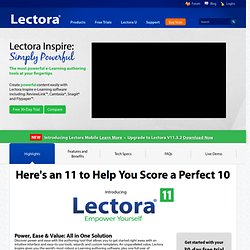
An unparalleled value, Lectora Inspire gives you the world’s most robust e‑Learning authoring software, plus one full year of Maintenance with FREE upgrades. Lectora Inspire also includes*: Fundamentals Classroom Training at the METS Center ($595 value) Online Fundamentals Training ($495 value) Flypaper Pro animated interactions builder ($1,495 value) Camtasia by TechSmith ($299 value) Snagit by TechSmith ($49 value) Powerful interactivity. Lectora makes it easy to bring your courses to life. Touch Screen Trigger Quickly trigger any action when the learner swipes left or right on touch screen devices such as tablets and smartphones. * Training options may not be substituted for other locations, cash or offerings.