
Gen Y survey reveals need for more targeted advertising. 'The Generation Y and Brand Loyalty' survey from w00t!
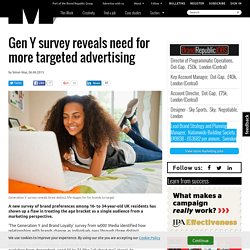
Media identified how relationships with brands change as individuals pass through three distinct life-stages within the Generation Y age bracket. According to w00t! 's analysis, individuals brand preferences reflect their evolution from dependent, aged 16 to 21 (the "all about me" stage), to independent, aged 21 to 30 ("all about us"), and finally accountable, aged 25 to 34 ("all about them").
The latter two age groups' brand preferences change to include firstly, more alcohol, retailer and household grocery brands – reflecting the move out of home, onto the career ladder and in with partners – and finally more family-oriented brands, such as Johnsons, Kellogg's and Warburtons, as partner and child concerns start to become present. Dan McDevitt, joint managing director of w00t! He said: "Regardless of age, two common denominators emerged about why brands appeal to Generation Y – the product's perceived quality and performance. The Retailer Winning the Battle for Millennial Women.
Millennial Engagement And Loyalty. Millennial Support For Gay Marriage Hits All-Time High: Pew Research Center. Approval of same-sex marriage among young adults is at an all-time high, according to new findings from the Pew Research Center.
The poll found 70 percent of adults born in 1981 or later, often referred to as millennials, support marriage equality. That's up from 64 percent in 2012, and an increase from 51 percent since the inauguration of President Barack Obama in 2009. Slightly more, 74 percent of millennials, say they believe gay and lesbian individuals should be accepted by society, while 22 percent disagree. By contrast, 49 percent of people in Generation X (adults born between 1965 and 1980) support same-sex marriage, and only 38 percent of Baby Boomers (born between 1946 and 1964) are in favor, according to Pew. Overall, a plurality of 49 percent of Americans are in favor of allowing gays and lesbians to marry. Pew points out millennials are part of the reason the overall number keeps climbing. The Millennial Consumer. Move aside, U.S. baby boomers.
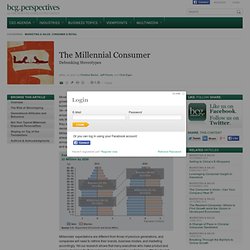
The Millennial generation is bigger than you and growing in influence. (See Exhibit 1.) Now numbering 79 million (compared with the boomers’ 76 million), U.S. Millennials and Cause: Seven Things We Learned from 5,493 People. Millennials care about causes and are more likely to show a preference toward products from companies which support causes—even if it means paying a bit more for those items.
They are interested in making a difference in the world and they believe they can contribute to causes they care about more easily through a company’s program than through their own initiative. “American Millennials: Deciphering the Enigma Generation” is a study from Barkley in partnership with SMG and The Boston Consulting Group that examined the attitudes and purchasing habits of 4,259 Millennials (ages 16-34), compared with 1,234 non-Millennials (ages 35-74).
Here are seven things the research revealed you should keep in mind when targeting Millennials for cause programs: 1. Millennials are very interested in what other people think. Q » Please indicate how much you agree or disagree with the following statements. 2. 3. Q » Which of the following best describes your likelihood to try new technologies? 4. Publications Turning On The "No-Collar" Workforce 03/15. Millennials in the workplace seems to be the topic d’jour in business media right now.
And small wonder: around 10,000 millennials turn 21 every day in America right now, and by some estimates there arealready 40 million millennials in the workforce. While much of the media commentary can seem to caricature the Millennial worker as an "entitled” hot house flower, MTV's new "No Collar Workers" study seeks to understand the working experiencethrough Millennial eyes...and to help employers decode how to leverage the abundant creative energies of their cubicle-dwelling populations. What the data and feedback point to a generation primed to give their all, but calling for meaning, mentorship and meritocracy in a workplace that can channel what they bring to the table.
Raised by "peer-ents" who encouraged them to constantly learn, grow and self actualize, the quest for meaningful work that makes a difference has become a core Millennial trait. Millennial Women Are Feeling Burned Out By The Age Of 30. How Generation Y Should Be Looking For A Job. It’s graduation season, and a fresh batch of my fellow Millennials are ready to trade their caps and gowns for business casual.
However hard they’ve worked, though, many twentysomethings can attest that a diploma doesn’t guarantee success in a down economy. We’ve learned the hard way that there are some things that college simply didn’t prepare us for. But as Lindsay Verstegen, a Senior Recruiter at Groupon, tells me, “The hand that teaches is not always the hand that’s being held so nicely. Sometimes, it’s the hand that burns.” Whether you’ve landed a full-time job in your chosen industry, a part-time job as an office assistant, or even an unpaid internship making coffee for the summer, here’s what Gen Y really needs to know about taking the first steps down the career path.
13 Ways The Recession Has Changed How Millennials View Work.