
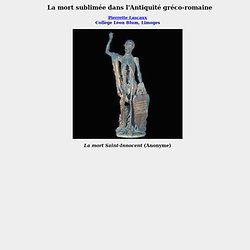
Histoire critique du christianisme romain. Index. LLa mort sublimée dans l'Antiquité gréco-romaine Pierrette Lascaux Collège Léon Blum, Limoges La mort Saint-Innocent (Anonyme)
THE CHRISTIAN CATACOMBS OF ROME. Les divertissements. La magie dans l'antiquité. Rome cité des jeux : introduction. Page suivante page précédente Avant d'entreprendre l'étude des textes relatifs aux "jeux", il est important de rappeler quelques notions essentielles à propos de l'origine, de l'importance, de l'organisation et des aléas de ce que nous appelons communément aujourd'hui "jeux du cirque".
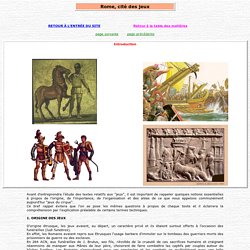
Ce bref rappel évitera que l'on se pose les mêmes questions à propos de chaque texte et il éclairera la compréhension par l'explication préalable de certains termes techniques. D'origine étrusque, les jeux avaient, au départ, un caractère privé et ils étaient surtout offerts à l'occasion des funérailles (ludi funebres). En effet, les Romains avaient repris aux Etrusques l'usage barbare d'immoler sur le tombeau des guerriers morts des prisonniers de guerre ou des esclaves.
En 264 ACN, aux funérailles de J. Romains 1 : Jeux en Arènes. Les romains et les gallo-romains étaient friands de spectacles sanguinaires C'est l'occasion pour les empereurs de commémorer leurs victoires, leur avènement, un anniversaire ou un mariage, et ainsi de se rendre plus populaires : "O spirituelle bonté d'un prince invincible".
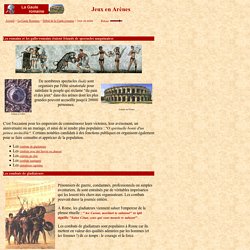
Certains notables candidats à des fonctions publiques en organisent également pour se faire connaître et apprécier de la population. Les combats de gladiateurs. Monnaies. Nous sommes heureux de vous présenter ce site consacré aux monnaies de l'antiquité.
La partie relative à la numismatique de l'empire romain est la plus importante. Vous y retrouverez de nombreux articles numismatiques, par exemple sur les divinités, et un catalogue de monnaies de l'empire romain qui sera actualisé régulièrement. Actuellement, il compte principalement des monnaies choisies parmi les plus intéressantes historiquement et iconographiquement, mais au fil du temps vous y découvrirez de plus en plus de monnaies. (voir mises à jour). Vous trouverez sur la fiche de chaque monnaie des indices de rareté que nous affinerons de plus en plus, afin d'en proposer de plus fiables que ceux qui sont indiqués par le RIC. Catalogue (Consultez les mises à jours) Vie quotidienne. ROMA-QUADRATA. Roman Names. There are indications that in the ancient times Romans possessed only one name like the most Indo-European peoples.
By the Republican period of the Roman history, a stable naming system, called „tria nomina“ developed and was actively used. Roman Nomenclature. UTA - Groupe de la Table Gallo-Romaine. De re coquinaria/Liber I - Epimeles. I.

Conditum paradoxum. Mellis p.XV in aeneum uas mittuntur, praemissis vini sextariis duobus, ut in coctura mellis vinum decoquas. Quod igni lento et aridis lignis calefactum, commotum ferula dum coquitur, si effervere coeperit, vini rore conpescitur, praeter quod subtracto igni in se redit. Cum perfrixerit, rursus accenditur.
Hoc secundo ac tertio fiet, ac tum demum remotum a foco postridie despumatur. Piper tritum cum melle despumto in cupellam mittis conditi loco, et ad momentum quantum sit bibendum, tantum aut mellis proferas aut vini misceas. II. Conditi Camerini praeceptis, utique pro absinthio cessante; in cuius vicem absinthi Pontici purgati terendique unciam, Thebaicam dabis, masticis, folii scripulos III, vini eius modi sextarios XVIII. Apicius ou la cuisine romaine. Petite histoire de la cuisine Pour s'informer sur la cuisine romaine, il n’y a hélas que peu de sources qui nous sont parvenues puisque nous n’avons conservé qu’un ouvrage complet de cuisine romaine, le "De re coquinaria" (ouvrage encore disponible en librairie) d’Apicius, le plus célèbre cuisiner romain, si l’on excepte quelques recettes transmises par Caton comme des bouillies et des petits pains au fromage, qui ressemblent plus à des croquants salés.
Né en 25 avant J.C., Marcus Gavius Apicius a vécu sous le règne de l'Empereur Tibère et était son cuisinier officiel. - le repas romain. Dans l'univers universitaire... La cuisine romaine antique. Accueil - banquet-latin. Vin rouge - vin blanc.

Apicius, L'art culinaire Comment conserver la viande? Apicius, L'art culinaire Plat pour tous les jours. Apicius, L'art culinaire Et si c'était meilleur à la cantine ? Lacuisneantique. Rome: Map of Trade Routes. Rome Project for 6th Grade Social Studies Welcome This site is a collection of “Rome resources” for the The Dalton School community.
Anyone interested in Classical Rome will find this site to be a valuable research tool. Armes. Ancient Roman Medicine. EtruscansAncient RomeMedieval RomeRenaissanceBaroqueModern Rome Ancient Roman medicine was in many ways a development of what they learned from the Greeks and then applied in exasperated situations such as continuous war or gladiatorial shows.
The wealth of Rome was such that it created medical situations and needs which required the best techniques and knowledge of the time: the wealth of the rich created a demand for cosmetic surgery. Large cities with high concentrations of population regularly created situations of fire or plague of various sorts and this brought a need for public health strategies, even if only rudimentary. Medical abilities were taken to the extreme with a few attempts at sex change, a notable one being ordered by Nero for a man he chose to wed because of his close similarity to his late wife Poppea, though some would argue this was just slander.
Some notes.... Medecine index. Spectacles.