
Explorer 1. Explorer 1 was the first satellite of the United States, launched as part of its participation in the International Geophysical Year.

The mission followed the first two satellites the previous year; the Soviet Union's Sputnik 1 and 2, beginning the Cold War Space Race between the two nations. Explorer 1 was launched on January 31, 1958 at 22:48 Eastern Time (equal to February 1, 03:48 UTC) atop the first Juno booster from LC-26 at the Cape Canaveral Missile Annex, Florida. It was the first spacecraft to detect the Van Allen radiation belt,[2] returning data until its batteries were exhausted after nearly four months. It remained in orbit until 1970, and has been followed by more than 90 scientific spacecraft in the Explorer series. Space_Race_1957-1975_.jpg (1350×1080) R-7 Semyorka. The widely used nickname for the R-7 launcher, "semyorka", means "the digit 7" or a "group of seven" in Russian.

Description[edit] The R-7 was 34 m (112 ft) long, 3.02 m (9.9 ft) in diameter and weighed 280 metric tons (280 long tons; 310 short tons); it had two stages, powered by rocket engines using liquid oxygen (LOX) and kerosene and capable of delivering its payload up to 8,800 km (5,500 mi), with an accuracy (CEP) of around 5 km (3.1 mi). A single thermonuclear warhead was carried with a nominal yield of 3 megatons of TNT. The initial launch was boosted by four strap-on liquid rocket boosters making up the first stage, with a central 'sustainer' motor powering through both the first and the second stage. Each strap-on booster included two vernier thrusters and the core stage included four.[2] The guidance system was inertial with radio control of the vernier thrusters. Development[edit] Contrary to statements[by whom?] Operational history[edit] Variants[edit] SS-6 Sapwood. Sputnik crisis. Soviet stamp depicting Sputnik's orbit around Earth.

National Defense Education Act. The National Defense Education Act (NDEA) was signed into law on September 2, 1958, providing funding to United States education institutions at all levels.[1] It was one of a suite of science initiatives inaugurated by President Dwight D.

Eisenhower in 1958, motivated to increase the technological sophistication and power of the US alongside, for instance DARPA and NASA. It followed a growing national sense that U.S. scientists were falling behind scientists in the Soviet Union, catalyzed, arguably, by early Soviet success in the Space Race, notably the launch of the first-ever satellite, Sputnik, the year before.[2] The act authorized funding for four years, increasing funding per year: for example, funding increased on eight program titles from $183 million in 1959 to $222 million in 1960.[3] However, in the aftermath of McCarthyism, a mandate was inserted in the act that all beneficiaries must complete an affidavit disclaiming belief in the overthrow of the U.S. government. Sputnik. NASA Main Page Multimedia Interactive Feature on 50th Anniversary of the Space Age Sputnik and The Dawn of the Space Age History changed on October 4, 1957, when the Soviet Union successfully launched Sputnik I.
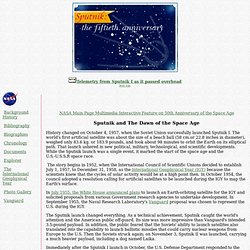
The world's first artificial satellite was about the size of a beach ball (58 cm.or 22.8 inches in diameter), weighed only 83.6 kg. or 183.9 pounds, and took about 98 minutes to orbit the Earth on its elliptical path. That launch ushered in new political, military, technological, and scientific developments. Sputnik 1. The signals of Sputnik 1 continued for 22 days.
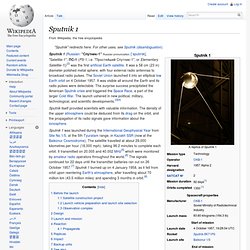
Sputnik 1 (Russian: "Спу́тник-1" Russian pronunciation: [ˈsputnʲɪk], "Satellite-1", ПС-1 (PS-1, i.e. "Простейший Спутник-1", or Elementary Satellite-1))[2] was the first artificial Earth satellite. It was a 58 cm (23 in) diameter polished metal sphere, with four external radio antennas to broadcast radio pulses. The Soviet Union launched it into an elliptical low Earth orbit on 4 October 1957.
It was visible all around the Earth and its radio pulses were detectable. Sputnik itself provided scientists with valuable information. Timeline of Space Race firsts. This is a timeline of first achievements in spaceflight from the first intercontinental ballistic missile through the first multinational human-crewed mission—spanning the era of the Space Race. 1957–1960[edit] 1Project Vanguard transferred from the NRL to NASA immediately before launch. 1961–1969[edit] 1970–1975[edit]
