
Top 10 Most Influential Scientists. This is part one of what will be a two part series on the most influential scientists in history.
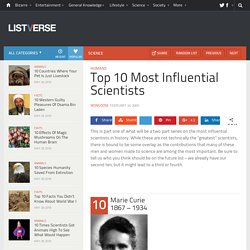
While these are not technically the “greatest” scientists, there is bound to be some overlap as the contributions that many of these men and women made to science are among the most important. Be sure to tell us who you think should be on the future list – we already have our second ten, but it might lead to a third or fourth. Marie Curie “One never notices what has been done; one can only see what remains to be done.” Polish physicist and chemist, Marie Curie was a pioneer in the field of radioactivity, the only person honored with Nobel Prizes in two different sciences, and the first female professor at the University of Paris.
Alan Turing “Science is a differential equation. English mathematician and logician, Turing is often considered to be the father of modern computer science. “An expert is a man who has made all the mistakes which can be made in a very narrow field.” Charles Darwin. Les Œuvres de Lavoisier > l'édition électronique. Oral History Interviews in Physics, Astronomy, and Geophysics — The Niels Bohr Library & Archives at the American Institute of Physics. Spencer Weart interviewing Martin Schwarzschild, 1977 The Niels Bohr Library and Archives of the American Institute of Physics holds more than a thousand tape-recorded interviews.
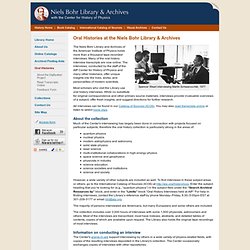
Many of the oral history interview transcripts are now online. The interviews, conducted by the staff of the AIP Center for History of Physics and many other historians, offer unique insights into the lives, works, and personalities of modern scientists. Most scholars who visit the Library use oral history interviews. While no substitute for original correspondence and other primary source materials, interviews provide invaluable overviews of a subject, offer fresh insights, and suggest directions for further research. All interviews can be found in our Catalog of Sources (ICOS). About the collection Much of the Center's interviewing has largely been done in connection with projects focused on particular subjects; therefore the oral history collection is particularly strong in the areas of:
Œuvres et rayonnement de Jean-Baptiste Lamarck (1744-1829) Darwin Correspondence Project. Site de l'édition des Œuvres Complètes de D'Alembert (1717-1783) Bibliothèque Virtuelle Claude Bernard. Jubilothèque — Fonds Charcot. The BUPMC keeps in the Bibliothèque de Neurosciences Jean-Martin Charcot, historical collections mainly constituted by J.M.
Charcot's personal library (books, journals, theses and offprint collections, manuscripts, observations, neurological covering the second part of the XIXth century) to which is added the Salpêtrière Interns' library (books, journals, neurology and psychiatry theses thèses for the period 1900-1950). Part of these collections was digitized with the double aim of preserving the original documents and ensuring the valorization of collections notable for their iconography : manuscripts of lessons and observations by J.M. The collection has been enhanced with four sets of documents, selected among Charcot's library and the Salpêtrière Interns' library and reflecting the treasures of the library, as well as the work of Charcot's colleagues and successors :
Buffon et l'histoire naturelle : l'édition en ligne. @.Ampère et l'histoire de l'électricité. Archives Bourbaki. The Problem of the Planets -Astronomy Books Online- The publication of Nicholas Copernicus' ON THE REVOLUTIONS OF THE HEAVENLY SPHERES in 1543 is often thought to mark the beginning of a revolution not only in astronomy, but in Western thought more broadly construed.
Co-taught by a physicist and a philosopher, this course will explore the scientific, historical, and philosophical implications of Copernicus's proposal, with special emphasis on his solution to the age-old problem of planetary motion. In the process, it will offer students the opportunity to work with some of the unique materials in the Library's Department of Special Collections.
Course Syllabus (PDF) Group Assignments (PDF) Copernicus De revolutionibus orbium coelestium [On the Revolutions of the Heavenly Spheres]. Brahe Astronomiae instauratae mechanica [Instruments for the Restoration of Astronomy]. See Note on Typography for guidance with reading and transcription.