
Voyage au coeur de la matière... Voyage vers l'infiniment petit. Quantum Mechanics for Beginners; a fun-filled Introduction. — an introduction —
Lectures. Untitled. Welcome to the Cassiopeia Project. LE PHENOMENE. La matière est faite d'atomes, la plupart du temps assemblés en molécules.
Au cœur de ces atomes, se trouve un noyau, 10 000 à 100 000 fois plus petit. La radioactivité est un phénomène qui se produit dans ce noyau au plus profond des atomes. Le phénomène est difficile à observer : il a fallu attendre 1896 pour que soient décelés des rayonnements d'origine inconnue, émis par des sels d'uranium. Certains noyaux atomiques instables sont la source de rayonnements, désignés par les trois premières lettres de l'alphabet grec : alpha (α), bêta (β) et gamma (γ).
Ces rayonnements sont des particules émises par des noyaux avec une grande énergie. Pour quelles raisons certains noyaux sont-ils instables ? Telles sont les questions auxquelles ce chapitre sur le phénomène de la radioactivité tente de répondre. Voir le film M.Prudent découvre la radioactivité ou Télécharger - (durée 12 min) Quantum Entanglements 1, I. Quantum Mechanics for Beginners; a fun-filled Introduction.
How the Princess began to Feel the Pea.
Science is exciting because it is always in trouble. No matter how excellent a theory is, it always misses some point or other. Even our most precious ideas about the universe are not able to explain everything; there's always a blind spot. And when the hopeful folks zoom in on that blind spot it pretty much always turns out to be a lot larger than anybody thought, and all of us a mere bunch of naive beginners. At the end of the eighteenth century the blind spot of regular mechanics (=the library of dogmas that teach the ins and outs of objects moving and colliding) covered the behavior of very small objects, such as electrons, and the behavior that light caused when it hit small things like electrons. Light had been a mystery for centuries. Seven wonders of the quantum world. Cookies on the New Scientist website close Our website uses cookies, which are small text files that are widely used in order to make websites work more effectively.
To continue using our website and consent to the use of cookies, click away from this box or click 'Close' Find out about our cookies and how to change them Log in Your login is case sensitive I have forgotten my password close. Chaîne de cassiopeiaproject. Welcome to the Cassiopeia Project. CERN: The Standard Model Of Particle Physics. LHC: l’expérience la plus fascinante de tous les temps. Le modèle standard. Les théories et découvertes de milliers de physiciens au cours du siècle dernier ont permis une compréhension remarquable de la structure fondamentale de la matière.
L’Univers est fait de douze constituants de base appelés particules fondamentales et gouverné par quatre forces fondamentales C’est le Modèle standard de la physique des particules qui nous aide le mieux à comprendre la façon dont ces douze particules et dont trois des quatre forces de la nature sont reliées entre elles. Élaboré au début des années 1970, il a permis d’expliquer les résultats d’un grand nombre d’expériences et à prédire avec exactitude une grande variété de phénomènes. Avec le temps, et bien des expériences plus tard, le Modèle standard s’est imposé comme une théorie ayant de solides fondements expérimentaux. Les particules de matière Tout ce qui nous entoure est constitué de particules de matière divisées en deux familles : les quarks et les leptons. Forces et particules porteuses Le boson de Higgs. Boson de Higgs, supersymétrie, théorie des cordes au LHC pour 2010 ? Peter Higgs contemplant le détecteur CMS au LHC.
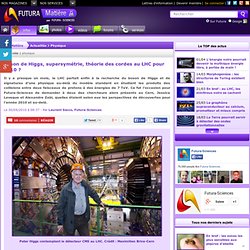
Crédit : Maximilien Brice-Cern Boson de Higgs, supersymétrie, théorie des cordes au LHC pour 2010 ? - 7 Photos C’est la troisième fois que je me retrouve au Cern en moins de deux ans. Il faut dire que les grands événements s’y multiplient... Le début de décembre 2009 fut aussi un grand moment en raison de la présence au Cern de plusieurs des architectes du modèle standard des particules élémentaires. Le 30 mars 2010 promettait lui aussi d’être un jour à marquer d’une pierre blanche. Peut-être d’ailleurs ne se limitera-t-il pas à cela. Etrange sensation que de se retrouver poussières d’étoiles et au bout du processus évolutif d'une biosphère, prêt à se pencher sur les forces et les énergies à l’œuvre au début du monde, avant que n’existent ni galaxies, ni étoiles et pas même des atomes. Une sélection de vidéos en science physique. Cours de mathématiques Ces cours aborde la plupart des théories mathématiques et dans les différentes branches mathématiques : cours d'algèbre, de géométrie, de statistique et probabilité ...
Cours de physique Vous y trouverez des explications théoriques d'un ensemble de phénomènes physiques liés aux ours de mécanique, d'électromagnétisme, d'atomistique, d'astrophyque ... Cours de chimie Apprendre les différentes théories de chimie quantique, de chimie moléculaire et de chimie analytique Cours d'astronomie Des explications des phénomènes astronomiques qui se déroule dans la galaxie, étoiles relativité restreinte et générale, planètes, trou noire, ...