
3 Ways to Tout Your Accomplishments (Without Being Obnoxious) LearnVest. The Daily Muse always has invaluable tips and advice for females in the workplace.

Check out their latest, which you’ll need going into review season! Ask just about anyone what personality trait grates his or her nerves the most, and a braggart is bound to top the list. 5 Things You Can Do to Land the Interview. The online application process is a big frustration for job seekers.
Many equate applying online to sending a resume into a black hole, never to be seen by human eyes. Some coaches advise their clients not to apply using online systems. Blog your way to a better career. A successful blog can help you transition to a new career.
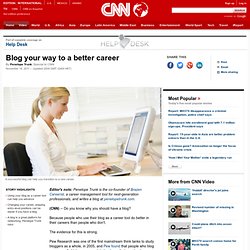
Using your blog as a career tool can help you advanceChanging your career, skipping entry-level positions can be easier if you have a blogA blog is a great platform for networking, Penelope Trunk says Editor's note: Penelope Trunk is the co-founder of Brazen Careerist, a career management tool for next-generation professionals, and writes a blog at penelopetrunk.com. (CNN) -- Do you know why you should have a blog? Because people who use their blog as a career tool do better in their careers than people who don't. Tony Smith: Winners, Opportunists, Hustlers. In the United States, we do not know how to train, develop and educate authentic leaders.
The few that we do have are authentic despite their education, not because of it. So let's ask: "What does our system of educating leaders produce? " What do we get for our investment of time, money and energy? Leah Busque: How to Hire Extraordinary People. Hiring's tough.
It's not just filtering through hundreds of applications and blocking out big chunks of your day for interviews -- those are the simple parts. The difficult thing is the nagging feeling that, despite your best efforts, the perfect candidate will somehow fall through the cracks. This feeling is deepened by screening processes designed for efficiently identifying suitable candidates, rather than isolating the absolute best match. Top Skills and Values Employers Seek from Job-Seekers. Printer-Friendly Version by Randall S.
Hansen, Ph.D., and Katharine Hansen, Ph.D. Most job-seekers wish they could unlock the secret formula to winning the hearts and minds of employers. What, they wonder, is that unique combination of skills and values that make employers salivate with excitement? Every employer is looking for a specific set of skills from job-seekers that match the skills necessary to perform a particular job. [Wondering where you stand on some of the most sought-after soft skills? Skills Most Sought After by Employers. Skills Employers Seek. Back to Careers Page Index Back to Psych Web Home Page As you take your undergraduate courses, you may wonder how they are going to help you eventually "on the job.
" Michelle Beckett: Your Facebook, LinkedIn and Twitter Profiles: 1/10th of a Second Is All It Takes to Blow It. "What a prat," I thought, a few seconds after I was introduced to a delegate at a recent business event I was speaking at.
"Rude, uptight, patronising, condescending... I would quite like to get away from this person as quickly as possible. " And to my relief, I managed to politely extricate myself from the conversation. It's not often I meet someone and get an immediately negative first impression. I like to think my default is to believe all people are lovely, until they prove otherwise. Harsh? When we all meet someone for the first time, our brain is making decisions. So, if we are making all these snap judgments about other people, doesn't that mean *gulp* that they are doing the same back to us?
Not only are people making these snap decisions about us, but the speed at which they do so is quite shocking. And it's not just in the physical world that this happens. In my headhunting days, I would trawl LinkedIn for suitable candidates. I'm not the only one. 1. 2. 3. 4. Facebook: 5 Ways Your Profile Can Help You Get A Job. 10 Skills You Need to Succeed at Almost Anything. What does it take to succeed? A positive attitude? Well, sure, but that’s hardly enough. The Law of Attraction? The Secret? These ideas might act as spurs to action, but without the action itself, they don’t do much. Success, however it’s defined, takes action, and taking good and appropriate action takes skills.
Below is a list of general skills that will help anyone get ahead in practically any field, from running a company to running a gardening club. 1. The ability to speak clearly, persuasively, and forcefully in front of an audience – whether an audience of 1 or of thousands – is one of the most important skills anyone can develop. 2. Writing well offers many of the same advantages that speaking well offers: good writers are better at selling products, ideas, and themselves than poor writers. 3. If success depends on effective action, effective action depends on the ability to focus your attention where it is needed most, when it is needed most. Careers Centre - Advice and guidance - Applying for jobs - Skills. When applying for jobs It is important to provide evidence of your skills and this can come from work experience, academic work, your social life and any interests you pursue.
Below is a selection of the skills that employers are looking for in graduates. Analytical ability The ability to assess a situation or issue and identify key elements that need to be addressed to move on. You will have used this skill in your academic work to solve problems, in your choice of university course and where you decided to live. Commercial awareness Being aware of the business issues affecting the sector to which you are applying. Having an understanding of external factors and internal structures. Computer literacy Virtually all employers will expect a basic level of familiarity with a range of computer packages for word-processing and spreadsheets, and of course email and web use.
Leadership Leadership centres on encouraging others to move towards a specific goal. A List Of Personal Skills To Help You With Your Career Change. | Home | Getting Started | Know Yourself | Career Tests | Money Issues | Keeping Motivated | Resume Help | Successful Interviews | Blog | About Me | Contact |
Watch A 5-Minute Primer On The Fundamentals Of Product Design. Take a moment and glance around. Unless you’re standing naked in the wilderness, you’re surrounded by products: mass-produced, man-made artifacts as far as the eye can see. Every one of these things was designed by someone (or more likely, several someones), but how often do we notice or appreciate that fact? Employability Skills Profile. 'Reinvention expert' guarantees job in 30 days. Former mortgage broker Ernie Casillas is still searching for work after three years Casillas can find a job in 30 days if he does his homework, says "reinvention expert" Eli Davidson Networking is a crucial tool that job seekers tend to overlook, Davidson says Casillas, 48, is among 14 million-plus Americans who are unemployed Los Angeles (CNN) -- During the California housing boom a few years ago, mortgage broker Ernie Casillas was living the American dream.
The 48-year-old father of one earned a solid middle-class income and built a diversified retirement portfolio. Then the housing market collapsed in 2008, and Casillas soon found himself on the brink of financial ruin. Turn your volunteer work into a career. Making volunteering purely about advancing career goals will take away from the enriching experience. Take charge of your career by volunteeringVolunteering adds to your resume and allows you to develop new skillsChoosing certain associations will allow you to meet people in that particular industry (CareerBuilder.com) -- Volunteering in your community can be rewarding for many reasons -- you get to help others, give back to your community and hopefully enjoy some personal growth along the way. Volunteering may help with professional growth as well -- by gaining new experiences and meeting new people, you may just end up with a new job.
"Anyone who's interested in taking charge of their career, whether they are currently employed or not, should volunteer," says Marsha Egan, career coach and workplace productivity expert. "It is perhaps one of the best kept career development secrets. Skills Search.