background preloader

Science Articles

Facebook Twitter

Accelerating Future » 10 Interesting Futuristic Materials. 1. Aerogel Aerogel holds 15 entries in the Guinness Book of Records, including "best insulator", and "lowest-density solid". Sometimes called "frozen smoke", aerogel is made by the supercritical drying of liquid gels of alumina, chromia, tin oxide, or carbon. It's 99.8% empty space, which makes it look semi-transparent. Aerogel is a fantastic insulator -- if you had a shield of aerogel, you could easily defend yourself from a flamethrower. It stops cold, it stops heat. You could build a warm dome on the Moon. 2. Carbon nanotubes are chains of carbon held together by the strongest bond in all chemistry, the sacred sp2 bond, even stronger than the sp3 bonds that hold together diamond. 3.
"Metamaterial" refers to any material that gains its properties from its microscopic structure rather than bulk composition. 4. We're starting to lay down thick layers of diamond in CVD machines, hinting towards a future of bulk diamond machinery. 5. 6. 7. 8. 9. 10. Sixty Amazing But True Facts!!! Awesome milk trick!. - StumbleUpon. NASA OKs Feb. launch of private space station trip. CAPE CANAVERAL, Fla. (AP) — A private California company will attempt the first-ever commercial cargo run to the International Space Station in February. NASA announced the news Friday, one year and one day after Space Exploration Technologies Corp., or SpaceX, became the first private business to launch a capsule into orbit and return it safely to Earth.
On Feb. 7, SpaceX will attempt another orbital flight from Cape Canaveral Air Force Station. This time, the unmanned Dragon capsule will fly to the space station and dock with a load of supplies. NASA stressed it is a target date. "Pending all the final safety reviews and testing, SpaceX will send its Dragon spacecraft to rendezvous with the International Space Station in less than two months," said NASA's No. 2, deputy administrator Lori Garver. NASA has turned to industry to help stock the space station now that the space shuttles are retired, investing hundreds of millions of dollars in this startup effort. Online: SpaceXNASA. Asteroid Crash May Explain Mercury's Strange Spin. A collision with an asteroid might have set the planet Mercury whirling oddly in its orbit, a new study suggests. When one body orbits another — say, a moon around a planet or a planet around a star — the orbiting body often spins.
Our planet experiences day and night because it spins on its axis, regularly changing which side it exposes to the sun. However, the gravitational pull that orbiting moons and planets experience slows the rate of their spin. The most stable arrangement they can reach is to keep just one side always facing the body they are orbiting. If the same were to happen with Earth and the sun, our planet would rotate once on its axis for every orbit it completed around the sun. Scientists had long assumed that Mercury was tidally locked with the sun — the planet's tiny size and proximity to the sun suggested the star's gravitational pull would quickly force Mercury into such a state.

Such an impact might also explain certain hollows seen on Mercury's surface. Mysterious planet-sized object spotted near Mercury | The Sideshow. A mysterious object is seen following in Mercury's path Is a giant, cloaked spaceship orbiting around Mercury? That's been the speculation from some corners aftera camera onboard NASA's STEREO spacecraft caught a wave of electronically charged material shooting out from the sun and hitting Mercury. Theorists have seized on the images captured from the "coronal mass ejection" (CME) last week as suggestive of alien life hanging out in our own cosmic backyard.
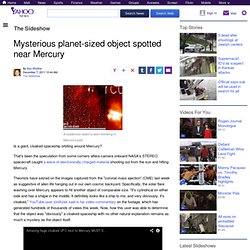
Specifically, the solar flare washing over Mercury appears to hit another object of comparable size. "It's cylindrical on either side and has a shape in the middle. It definitely looks like a ship to me, and very obviously, it's cloaked," YouTube-user siniXster said in his video commentary on the footage, which has generated hundreds of thousands of views this week. Head NRL group scientist Russ Howard and lead ground systems engineer Nathan Rich say the mysterious object is in fact Mercury itself. Other popular Yahoo! Earth, Meet Your Long-Lost Sibling: The Christmas Planet. It may sound like something from a very special episode of Doctor Who, but the Christmas planet is real. What's more, it's the most Earth-like world yet discovered.

The planet, more properly known as Kepler 22-b, was revealed to the world Monday via a press conference at NASA Ames Research Center. It is one of thousands of planets discovered outside our solar system via the Kepler space telescope — and the first one that is slap-bang in the middle of what astronomers (really) call the Goldilocks zone: not too hot, not too cold, just right for life. So why call it the Christmas Planet? Because it took three snapshots for the telescope to determine Kepler 22-b was really there, and the snapshots had to happen 290 days apart (the length of 22-b's year). The last of those three encounters happened during the 2010 holiday season — just hours before the NASA telescope came down with a blinding technical glitch.

Don Harper Mills: 1994's Most Bizarre Suicide. This story can be found in many places on the Web, usually without attribution, and claims that it is true. But the story of its origin, and how to spot it must be an UL, can be found at Deconstructing Ronald Opus At the 1994 annual awards dinner given by the American Association for Forensic Sciences, AAFS President Don Harper Mills astounded his audience in San Diego with the legal complications of a bizarre death.

Here is the story... On March 23 the medical examiner viewed the body of Ronald Opus and concluded that he died from a gunshot wound of the head caused by a shotgun. Investigation to that point had revealed that the decedent had jumped from the top of a ten story building with the intent to commit suicide. (He left a note indicating his despondency.) Ordinarily a person who starts into motion the events with a suicide intent ultimately commits suicide even though the mechanism might be not what he intended. The medical examiner closed the case as a suicide. Most Amazing Time Lapse Video of Milky Way Ever Made. Seriously. Chandra :: Photo Album :: The Big Chandra Picture. The Big Chandra Picture In more than a decade of operation, NASA's Chandra X-ray Observatory has transformed our view of the high-energy Universe with its ability to make exquisite X-ray images of star clusters, supernova remnants, galactic eruptions, and collisions between clusters of galaxies.

As Chandra expands the realm of the known, it continues to raise new questions and point the way for future exploration. This photo blog presents some of Chandra's most spectacular images in a large and shareable format. Follow Chandra on Twitter 10 Apr 2014 G352.7-0.1: Supernovas are the spectacular ends to the lives of many massive stars. These explosions can produce enormous amounts of energy and be as bright as an entire galaxy. 03 Apr 2014 El Gordo: This is a composite image of X-rays from Chandra and optical data from Hubble of the galaxy cluster ACT-CL J0102-4915, located about 7 billion light years from Earth. 20 Mar 2014 05 Mar 2014 04 Mar 2014 18 Feb 2014 06 Feb 2014 23 Jan 2014 08 Jan 2014.

Thermal Physics Jokes. As we all know, it takes 1 calorie to heat 1 gram of water 1 degree centigrade. Translated into meaningful terms, this means that if you eat a very cold dessert (generally consisting of water in large part), the natural processes which raise the consumed dessert to body temperature during the digestive cycle literally sucks the calories out of the only available source, your body fat. For example, a dessert served and eaten at near 0 degrees C (32.2 deg. F) will in a short time be raised to the normal body temperature of 37 degrees C (98.6 deg. F). For each gram of dessert eaten, that process takes approximately 37 calories as stated above.

Obviously, the more cold dessert you eat,the better off you are and the faster you will lose weight, if that is your goal. Frozen desserts, e.g., ice cream, are even more beneficial, since it takes 83 cal. Happy eating! School of Physics, University of Sydney. Match Stick Rocket. Match Stick Rocket SUBJECT: Rocketry TOPIC: Propulsion DESCRIPTION: A small solid propellant rocket is made from a match and a piece of aluminum foil. CONTRIBUTED BY: Steve Culivan, KSC EDITED BY: Roger Storm, NASA Glenn Research Center 2 match book matches or wooden stick matches Small square of aluminum foil Paper clip Safety pin Take one match and wrap a small piece of aluminum foil around the match-head. Caution: Be sure the match rocket is pointed away from people or burnable materials. it is recommended to have water or some other fire extinguishant available. DISCUSSION: The match stick rocket demonstrates Isaac Newton's Laws of Motion as they relate to rocketry.
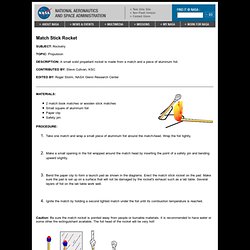
In an interesting variation of the experiment, try making holes of different diameters to let the combustion products out at different rates. Return to Rocket Activities Return to Aerospace Activities Page Newton's Third Law Rocket Thrust Aerospace Education Services Project Oklahoma State University. Scientists find monster black holes, biggest yet. CAPE CANAVERAL, Fla. (AP) — Scientists have found the biggest black holes known to exist — each one 10 billion times the mass of our sun. A team led by astronomers at the University of California, Berkeley, discovered the two gigantic black holes in clusters of elliptical galaxies more than 300 million light years away. That's relatively close on the galactic scale. "They are monstrous," Berkeley astrophysicist Chung-Pei Ma told reporters.

"We did not expect to find such massive black holes because they are more massive than indicated by their galaxy properties. They're kind of extraordinary. " The previous black hole record-holder is as large as 6 billion suns. In research released Monday by the journal Nature, the scientists suggest these black holes may be the leftovers of quasars that crammed the early universe. Black holes are objects so dense that nothing, not even light, can escape. Most if not all galaxies are believed to have black holes at their center. Online: black holes.