
Gonzalo Lira: Structural Pliancy. A lot of people—and I am one of them—claim that personal and business freedoms are being eroded as never before.

They show as evidence the roll-back of civil liberties, the over-regulation of business, the insistence on “compliance” by the various security agencies of every little rule, no matter how trivial—in short, the over-regulation of American life. They are right: The U.S. government is guilty of over-regulating individuals and businesses—egregiously so. On the other hand, a lot of other people—and I am one of them too—claim that certain persons and corporations act lawlessly as never before.
They show as evidence the abuses of power of those in leadership—be it business, government, the military, or the intelligence/security aparatus—and they insist that something has to be done about it, some regulations have to be imposed. Obvious question: How can they both be right? Simple answer: Structural Pliancy. Let me explain. But that is increasingly becoming the case. Why? Nothing. The Great Transformation: The Political and Economic Origins of Our Time.
The Koch Brothers, The Cato Institute, And Why Nations Fail. By Simon Johnson A dispute has broken out between the Cato Institute, a leading libertarian think tank, and two of its longtime backers – David and Charles Koch.

The institute is not the usual form of nonprofit but actually a company with shares; the Koch brothers own two of the four shares and are arguing that they have the right to acquire additional shares and thus presumably exert more control. The institute and some of its senior staff are pushing back. According to Edward H. Crane, the president and co-founder of Cato, “This is an effort by the Kochs to turn the Cato Institute into some sort of auxiliary for the G.O.P.” Far from being just an unseemly row between prominent personalities on the right, this showdown reflects a much deeper set of concerns for American politics and society. At one level, the Acemoglu and Robinson argument lines up well with the standard Cato Institute – and libertarian – view of the world. I’m not so sanguine.
Michael Hudson: Banks Weren’t Meant to Be Like This. By Michael Hudson, a research professor of Economics at University of Missouri, Kansas City and a research associate at the Levy Economics Institute of Bard College A shorter version of this article in German will run in the Frankfurter Algemeine Zeitung on January 28. 2012 The inherently symbiotic relationship between banks and governments recently has been reversed.
In medieval times, wealthy bankers lent to kings and princes as their major customers. But now it is the banks that are needy, relying on governments for funding – capped by the post-2008 bailouts to save them from going bankrupt from their bad private-sector loans and gambles. Yet the banks now browbeat governments – not by having ready cash but by threatening to go bust and drag the economy down with them if they are not given control of public tax policy, spending and planning. If there is any silver lining to today’s debt crisis, it is that the present situation and trends cannot continue. The Global Minotaur: America, The True Origins of the Financial Crisis and the Future of the World Economy - Economic Controvers. Yanis Varoufakis, Professor of Economic Theory at the National and Capodistrian University of Athens, is mainly known for his work (with Shaun Hargreaves-Heap) on critical analysis of game theory.
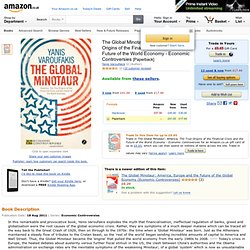
He is however also one of the foremost currently active left-Keynesian economists. In this book, "The Global Minotaur", he sets out his analysis of the origins and nature of the current economic depression from this perspective. The book is well-written and should be generally accessible to the interested layman, but it is also rather disjointed; it has at times insufficient theoretical depth to clearly separate causes, and at the same time insufficient structuring to make it wholly work as a popular text. That said, it is highly informative, clear in the purely descriptive aspects of its content, and should make the Keynesian interpretation of the current crisis and global trade relations clear to all involved.
Grand Narratives.