
WhitePaper: UDL & CommonCoreELA pdf. Flex_udl. Differentiated UDL. ADHD. Reading. Links to Interactive Whiteboard Lessons. Math. Early Literacy. Early Literacy. Self Regulation. The Development of Self-Regulation. Self-Regulation: The Second Core Strength. The ability to self-regulate is the second of six core strengths that are an essential part of healthy emotional development.

These core strengths are the foundation of Scholastic's company-wide program, Keep the Cool in School: A Scholastic Campaign Against Violence and Verbal Abuse. In this article, Bruce D. Perry, M.D., Ph.D., explores self-regulation and how it contributes to preventing aggression and anti-social behaviors in children. Self Regulation The Second Core Strength "Mine! A just-fed newborn, rocking in the arms of her loving parent, is warm, full, calm, and safe. Again and again, attentive teachers respond to the needs of the dependent child.
At the same time, in these same interactions, other crucial areas of the infant's brain are being shaped-the stress-response systems. Responding to Stress The brain is continually sensing and responding to the needs of the body. Much of this regulation takes place automatically-beyond our awareness. Understanding Body Signals. Stuart Shanker: How Can a Five-Year-Old Be Stressed? Learning to Write on the iPad. Lots of people have been asking about using the iPad as a way of teaching young students to write.
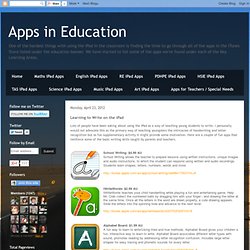
I personally would not advocate this as the primary way of teaching youngsters the intricacies of handwriting and letter recognition but as fun supplementary activity it might provide some motivation. Here are a couple of fun apps that reinforce some of the basic writing skills taught by parents and teachers. School Writing: $4.99 AU. Reading Intervention. Essential Questions. Interactive Graphic Organizer - Teaching Notes. Teaching Reading and Writing. Questioning Toolkit. Essential Questions These are questions which touch our hearts and souls.
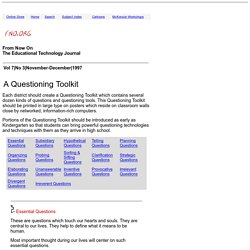
They are central to our lives. They help to define what it means to be human. Most important thought during our lives will center on such essential questions. What does it mean to be a good friend? If we were to draw a cluster diagram of the Questioning Toolkit, Essential Questions would be at the center of all the other types of questions. All the other questions and questioning skills serve the purpose of "casting light upon" or illuminating Essential Questions. Autism, Aspergers, ADHD. Rti 1. RTI. Teaching Resources using technology. Insight/helpful information. CCSS: Mathematics. iCreate to Educate.
Adrian Bruce's Educational Teaching Resources-Reading Games-Math Games-Educational Software-Motivational Posters-Line Symmetry-Readers Theater-Art Lessons-Science Lessons- Accommodations for Students with ADHD. Curriculum-Based Measurement Warehouse: A World of CBM Resources... Accommodations for Students with ADHD. Learning Disabilities in Children: Symptoms, Types, and Testing.
SMARTBoard Activities. Accommodations and Modifications. Accommodations, modifications, and alternative assessments may be necessary for a special needs child to succeed while working on materials for learning.
A student who cannot read nor write at grade level may be able to understand and participate in discussions about material that is read aloud and taught at the child's age-appropriate level. The Florida Center for Reading Research. Autism. Classroom. Readwritethink. Kindergarten counting and cardinality. A Complete Handwriting Curriculum for All Children. 1st grade general common core. Depths of knowledge. Math for Smarty Pants. School Administration. School Administration. Ict games. Interactive Whiteboard Resources. Subitizing and Guided Math Groups: Part 2 Why it is so important! Posted on December 15, 2010.
Filed under: During the Guided Math Lesson, Elementary math, Graphic Organizers, Guided math, Guided math with Dominos, Math is a Language | Tags: beginning addition, domino math, dot cards, Elementary math, fact sort, Guided math, math talk, mathematical thinking, subitizing | Subitizing provides a basis for early addition skills. Different arrangements help children to see and discuss different ways to name a number. Ten frames are another tool to use to build subitizing skills. Subitizing is a fundamental skill in the development of students’ understanding of number (Baroody, 1987). Here are some game ideas. Kindergarten operations and algebraic thinking. 1st grade general common core. Math foldables. 1st Grade - get2MATH K-5. Represent and solve problems involving addition and subtraction. 1.

Use addition and subtraction within 20 to solve word problems involving situations of adding to, taking from, putting together, taking apart, and comparing, with unknowns in all positions, e.g., by using objects, drawings, and equations with a symbol for the unknown number to represent the problem.1. 1st grade nbt. Dyslexia Friendly. 7notes for iPad Lets You Take Notes On-Screen with Your Finger. Apps for special needs. Back Issues. Say No to Retention Retention Does Not Work From a parent: Except of an article by Jayne Matthews Published in the Baltimore Times It did not seem possible, but my son's second year of first grade was even less successful than his first.
When my son still could not read words like "cat" and "ball," I knew there was something seriously wrong. Bile Learning. Tech Tools for Students with Learning Disabilities: Infusion into Inclusive Classrooms. By: Jane Quenneville (2001) The potential for assistive technology in general education classrooms for students with disabilities is great.
Its benefits include enhancing academic achievement in written expression, reading, mathematics, and spelling; improving organization; and fostering social acceptance. Support technology provides many benefits by facilitating writing for students with learning disabilities (LD) who often find the writing process frustrating (MacArthur, 1996). When students have the opportunity to accommodate writing challenges, they are more successful in the general education classroom. A necessary component of this effort is collaboration between classroom teachers and assistive technology specialists. Literacy Journal: Only 1 iPad in the Classroom? [for additional ELA/Reading specific apps and ideas see Reading on the iPad] Is only one iPad in a classroom worth it?
This question keeps reappearing on the EC Ning and in other blog spaces. The answer is easy: YES, especially if the teacher has access to a Mac desktop or (preferably) laptop and a wifi network in the classroom. It is an even larger YES if the Mac device has the most current operating system. Having a computer to which the iPad can sync is not absolutely necessary, but it is a Best Idea. If more iPads are in the future, you might want to check out iPad App Reviews and iPad 3C's: Some Planning Questions. How to Create Your Own Textbook — With or Without Apple. By Dolores Gende Apple’s iBooks2 and authoring app has created big waves in education circles.

But smart educators don’t necessarily need Apple’s slick devices and software to create their own books. How educators think of content curation in the classroom is enough to change their reliance on print textbooks. As the open education movement continues to grow and become an even more rich trove of resources, teachers can use the content to make their own interactive textbooks. It might seem daunting, but the availability of quality materials online and the power of tapping into personal learning networks should make it easier. Apps For Therapy. Useful Tips For iPad. Apps & links edu. Apps for special needs. Blooms Taxonomy with Apps.
Getting started.