
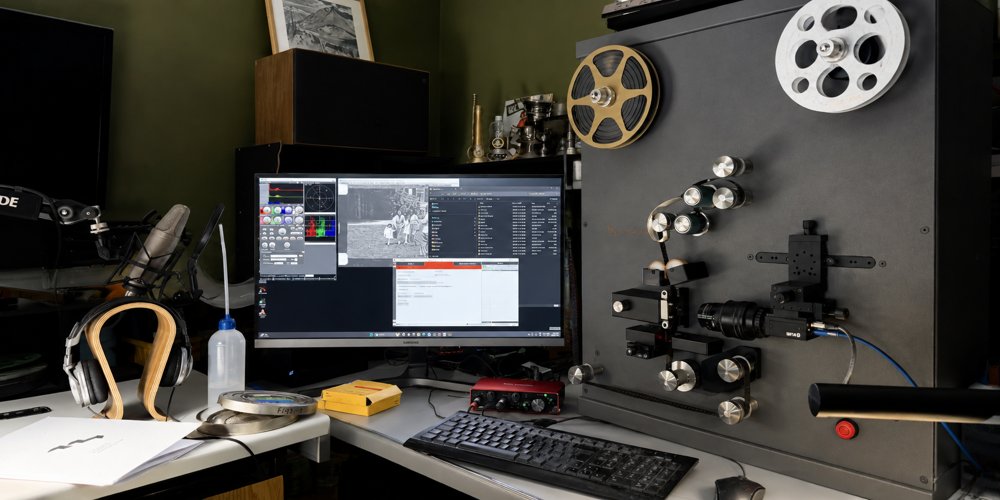
When families bring their vintage media collections into our studio at Lifetime Heritage Films Inc., they are often surprised by the range of modern digitization options. One of the most common debates we hear at the intake desk revolves around resolution. Many people assume that because their old 8mm or Super 8 films look blurry on a vintage projector, they only need a basic, low-resolution digital conversion.
This is a major misconception. The blurriness people remember usually comes from the projector lens or the wall they were projecting onto, not the film itself. In reality, modern<!--td {border: 1px solid #cccccc;}br {mso-data-placement:same-cell;}-->4K film scanning unlocks hidden details that standard-definition transfers simply cannot see.
Here is an insider’s look into why capturing your vintage reels at the highest possible resolution is the best investment for your family archive.
To understand why resolution matters, you have to look at how film works.<!--td {border: 1px solid #cccccc;}br {mso-data-placement:same-cell;}-->Digital video is made of a rigid grid of square pixels. Analog motion picture film, however, is completely different. The images are formed by thousands of microscopic, randomly scattered silver halide crystals (or dye clouds) known as film grain.
If you scan a film at a low standard definition (like old DVD quality), the digital sensor is not powerful enough to see those individual grains. Instead, it crushes them together, creating a muddy, pixelated image that looks unnatural on a modern television.
When we utilize 4K film scanning, the digital sensor captures a massive $3840 \times 2160$ resolution image for every single frame. This high resolution is dense enough to accurately map the physical grain structure of the film. The result is a digital file that actually looks like real cinematic film, complete with sharp edges, natural textures, and deep color saturation.
Not all digitization methods are created equal. In the past, many budget companies transferred film by simply projecting it onto a mirror or a screen and recording it with a digital camcorder. This caused massive quality loss, screen flickering, and hot spots in the center of the image.
At Lifetime Heritage Films Inc., our professional workflow completely bypasses projection. We use sprocketless, frame-by-frame scanning technology. This means the film is gently pulled over soft rollers, and a dedicated 4K sensor takes a high-resolution raw photograph of every individual frame. This method protects brittle film from mechanical damage while ensuring perfectly flat, corner-to-corner focus.
You might wonder if an amateur family video from the 1970s really holds enough detail to justify a high-end scan. The answer is almost always yes. Even consumer-grade Super 8 film contains roughly the equivalent of 2K to 3K resolution worth of optical data. If you have larger formats, like 16mm or 35mm, the optical detail goes far beyond 4K.
If you are currently setting up a broader transfer to digital project for your household, prioritizing your physical film reels for high-resolution scanning should be at the top of your list. While magnetic tapes degrade through signal loss, film fades through chemical color shifts. Capturing the maximum amount of visual data now gives digital colorists the raw information they need to bring faded greens, blues, and reds back to life.
The ultimate goal of preservation is to ensure you only have to do this once. By choosing a 4K capture, you are future-proofing your family history.
When we complete a high-resolution scan, we provide clients with uncompressed or high-bitrate master files. These files look incredible on modern large-format OLED TVs and will continue to look sharp on future displays. More importantly, having a high-resolution master allows you to easily crop, edit, and pull crisp still photographs from the video without losing visual quality.