
Virginia-EcoArts_InfoComNantes
Pearltrees videos. Help. Art et écologie. Militantisme Écologique. Un « point de vue éthique de la fourrure »?

Au nom de l’écologie??!! La Planète est prête à sauter, tout le monde se lâche et fait n’importe quoi sous couvert de l’écologie, enfin n’importe quoi… N’importe quoi pour faire de l’argent, ou bien pour réussir. Ici deux exemples, avec tout d’abord la fourrure justifiée par l’industrie par… l’écologie. Et à l’inverse mais dans un mouvement qui revient au même, le nouveau discours de PeTA qui justifie pareillement la mise de côté des principes végans au nom de l’écologie. 1. Le site Eco-fourrure.com est vraiment le symbole de cette nouvelle attitude, qu’on retrouve dans l’ensemble des magazines écolos (comme ceux distribués gratuitement en magasins diététiques). Cette attitude consiste à dire que l’utilisation d’animaux c’est « écolo » et « naturel ». On trouve donc tout et (surtout) n’importe quoi pour se dire écolo, jusqu’à…. la fourrure! 2. Oui, mais pour cela il faut déjà y croire. Soit. Art Total. Site-specific art. History[edit] Site-specifiс art emerged after the modernist objects as a reaction of artists to the situation in the world.
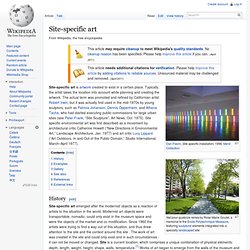
Modernist art objects were transportable, nomadic, could only exist in the museum space and were the objects of the market and co modification. Since 1960 the artists were trying to find a way out of this situation, and thus drew attention to the site and the context around this site . The work of art was created in the site and could only exist and in such circumstances - it can not be moved or changed. Examples[edit] Site-specific dance is also created to exist in a certain place. Site-specific performance art, site-specific visual art and interventions are commissioned for the annual Infecting the City Festival in Cape Town, South Africa. Gallery[edit] Map of the artworks on the roofs around the plaine of PlainpalaisOlafur Eliasson's Waterfalls under the Brooklyn BridgeSite specific dance by Blue Lapis Light at the Texas State History Museum in Austin, Texas.
Green-Art: a guide to sites of artists concerned with ecology an. Reverse Graffiti Project. Art contemporain. Un article de Wikipédia, l'encyclopédie libre.
L'expression « art contemporain » désigne de façon générale et globale l'ensemble des œuvres produites depuis 1945 à nos jours, et ce quels qu'en soient le style et la pratique esthétique. Dans cette classification périodique, l'art contemporain succède à l'art moderne (1850-1945). Cette désignation s'applique également aux musées, institutions, galeries, foires, salons, biennales montrant les œuvres de cette période. Qu'est-ce que l'art contemporain ? [modifier | modifier le code] La notion de « contemporanéité » est d’abord une notion historique. . « Contemporanéité » signifie aussi « simultanéité ». Festival international des Très Courts. Recyclart.org, the art of recycling ! WHAT IS ENVIRONMENTAL ART? In a general sense, it is art that helps improve our relationship with the natural world.

There is no definition set in stone. This living worldwide movement is growing and changing as you read this. Much environmental art is ephemeral (made to disappear or transform), designed for a particular place (and can't be moved) or involves collaborations between artists and others, such as scientists, educators or community groups (distributed ownership). These variables can make exhibiting this work difficult for traditional museums so we created greenmuseum.org: an online museum for global the environmental art movement. See "A Profusion of Terms", by Sam Bower of greenmuseum.org, for a look at some of the many terms used on this site such as eco-art, art in nature, Land Art, etc.. See also "A Brief Introduction" by Clive Adams of the Centre for Contemporary Art and the Natural World.
Ecoart. Edith Meusnier, Artefact, Bois de Belle Rivière, Québec, 2010 Environmental art is an umbrella term for a range of artistic practices encompassing both historical approaches to nature in art and more recent ecological and politically-motivated types of works.[1][2] 'The term "environmental art" often encompasses "ecological" concerns but is not specific to them.[3] It acknowledges the early history of this movement (which was often more about art ideas than environmental ones) as well as art with more activist concerns and art which primarily celebrates an artist's connection with nature using natural materials.[1][2] Aviva Rahmani's Blue Rocks project (2002) drew attention to a degraded estuary on Vinalhaven Island, Maine.

The USDA then contributed over $500,000. to restore twenty-six acres of wetlands in 2002. (Photograph by Aviva Rahmani) History: Landscape painting and representation[edit] Challenging traditional sculptural forms[edit] Caroline Laengerer, Poygonum-Kugel, Weide, 2002.