
Nuclear Experts Explain Worst-Case Scenario at Fukushima Power Plant. First came the earthquake, centered just off Japan's east coast, near Honshu.

The added horror of the tsunami quickly followed. Now the world waits as emergency crews attempt to stop a core meltdown from occurring at the Fukushima Daichi nuclear reactor, already the site of an explosion of the reactor's housing structure. At 1:30 P.M. Eastern Standard Time on March 12, American nuclear experts gathered for a call-in media briefing.
Whereas various participants discussed the policy ramifications of the crisis, physicist Ken Bergeron provided most of the information regarding the actual damage to the reactor. "Reactor analysts like to categorize potential reactor accidents into groups," said Bergeron, who did research on nuclear reactor accident simulation at Sandia National Laboratories in New Mexico. Rick Rescorla. Rick Rescorla From both a military and a civilian capacity, it's hard to argue with the statement that Rick Rescorla is one of the greatest heroes in modern American history.

This is pretty damn impressive, especially considering that he was British and everything. Cyril Richard Rescorla was born in Cornwall, on the southwest tip of England, in 1939. A rugby star and high school shot put champion growing up, it soon became apparent that the whole book-learning thing really wasn't as appealing to young Rick as a good old-fashioned ass-whipping was. So as soon as this adventure-hungry athlete turned 16 he quit school, joined the British military, and dedicated the majority of his life to pummeling the ever-loving cock-and-balls off of Communist douchebags wherever he could find them. After transferring out of Rhodesia in 1963, Rick Rescorla suddenly found himself in something of a dilemma: He'd run out of asses to kick.
Now think about this shit for a second. Links: HistoryNet. Iranian Navy to Patrol off U.S. Coast, What!? Well, this is interesting.

After recently sending its ships through the Suez Canal for the first time in decades, the Iranian Navy will apparently send ships to establish a “powerful presence” off the East Coast of the United States. Here’s CNN quoting Iran’s state-run Islamic Republic News Agency: Iranian Warship Route to U.S. Coast Leaked Online: Report. Last week, an Iranian Naval Commander threatened to deploy ships off the U.S. coast as a provocative show of force.

Now it looks like Iran might actually be serious. A new map that allegedly shows the expected path of the Iranian Naval expedition to the U.S has leaked online from an Iranian website, according to MEMRI. No, The Iranian Navy Isn’t About to Shell Cape Cod. In a demonstration of the latest weapon in Iran’s naval arsenal – a sense of humor – the sea lords of Tehran have announced they plan to deploy warships off the U.S.

Atlantic coast. “As the global arrogance (forces of imperialism) have a (military) presence near our sea borders, we also plan to have a strong presence near the U.S. sea borders,” said Rear Admiral Habibollah Sayyari in the English-language Tehran Times. Before the Department of Homeland Security triggers Orange Alerts for incoming Iranian dreadnoughts, and the peaceful citizens of Cape Cod and Norfolk head for the hills, Danger Room wanted to bring you this public service announcement. Or, more accurately, a reminder that Afghan opium may have wafted into the hallowed halls of the Iranian Admiralty. The most suitable ships – that is, those that could survive more than 30 seconds off Norfolk – would be the three Kilo-class diesel subs that Iran acquired from the Soviet Union in the 1990s. Photo: DoD via Wikimedia. The Wise Guide : Subject to Change. Recent hyperspectral imaging of Thomas Jefferson’s rough draft of the Declaration of Independence has clearly confirmed past speculation that Jefferson made an interesting word correction during his writing of the document, according to scientists in the Library of Congress’ Preservation Research and Testing Division (PRTD).
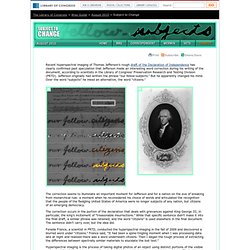
Jefferson originally had written the phrase “our fellow-subjects.” But he apparently changed his mind. Over the word “subjects” he inked an alternative, the word “citizens.” The correction seems to illuminate an important moment for Jefferson and for a nation on the eve of breaking from monarchical rule: a moment when he reconsidered his choice of words and articulated the recognition that the people of the fledgling United States of America were no longer subjects of any nation, but citizens of an emerging democracy.
Fenella France, a scientist in PRTD, conducted the hyperspectral imaging in the fall of 2009 and discovered a blurred word under “citizens.”