

Arts in Education Welcome to New Horizons for Learning - a leading web resource for identifying and communicating successful strategies for educational practice. The Johns Hopkins School of Education does not vet or endorse any information contained on the New Horizons website. Information posted on New Horizons prior to January 1, 2014 can be repurposed as long as the repurposing party provides attribution to the original author of the material being used. Our first journal issues feature articles on neuroscience, creativity, counseling, technology, data-driven decision making, museum education, arts integration, special education, early education, cultural literacy, action research, Universal Design, international exchange programs, higher education, teacher preparation and more: New! Vol.X No. 2, Special Edition: Focus on Autism Vol. It's Here! We just launched an exciting initiative to provide educators with an efficient technology resource database that is teacher-tested. Vision Archives
What is Useful? The paradox of rights in Tania Bruguera’s ‘Useful Art’ Immigrant Movement International. Courtesy CreativeTime If the question for socially engaged art, as the curator Nato Thompson has recently argued, is no longer “Is it art?” but rather “is it useful?”[1] What is the appropriate evaluative framework for art as a social ‘tool’? If we are asked to understand artist practice as undertaking progressive cause, are the traditional analytics of art historians and critics effective in this endeavor? The political theorist Wendy Brown, in her text Suffering the Paradoxes of Rights, asks for a space beyond the judicial which articulates what equality might look like outside of a “progressive historiography,”[6] wherein rights function to achieve the illusion of progress within a still intact and unchanged social order. It is important to note here that as Brown stated in her introduction, she is not against working for rights. Queen’s Dream Team, Immigrant Movement International. To be fair, Bruguera would prefer the project not to end.
The Incredible Art Department 10 Open Education Resources You May Not Know About (But Should) This week, the OCW Consortium is holding its annual meeting, celebrating 10 years of OpenCourseWare. The movement to make university-level content freely and openly available online began a decade ago, when the faculty at MIT agreed to put the materials from all 2,000 of the university’s courses on the Web. With that gesture, MIT OpenCourseWare helped launch an important educational movement, one that MIT President Susan Hockfield described in her opening remarks at yesterday’s meeting as both the child of technology and of a far more ancient academic tradition: “the tradition of the global intellectual commons.” We have looked here before at how OCW has shaped education in the last ten years, but in many ways much of the content that has been posted online remains very much “Web 1.0.” But as open educational resources and OCW increase in popularity and usage, there are a number of new resources out there that do offer just that.
Art Education 2.0 - Using New Technology in Art Classrooms Executive Function, Arts Integration and Joyful Learning (Part 6 of 7) When students know they will have opportunities to use artistic, kinesthetic or manipulative experiences in the course of learning and as part of their learning assessments, their optimism is renewed. Knowing from the start that they will create representations of their learning through visual, musical or movement expressions (ideally with a medium of their choice) is an inoculation against boredom and low effort. When the brain has reasons to expect that something previously pleasurable will soon happen, such as when a creative activity will be part of new learning, that expectation results in increased release of the neurotransmitter dopamine, which increases pleasure and reduces stress. When students have the expectation of pleasure prior to the introduction of new material, the release of this anticipatory dopamine can release students from the hold of self-predicted failure. Fixed Mindset to Growth Mindset Immediate Gratification or Effort Toward Goals Notes
UIC Kicks Off 'Future of Chicago' Lecture Series Sept. 14 The racial transformation of Chicago’s housing market is the subject of the first lecture in the 2011-12 “Future of Chicago” lecture series Sept. 14 at the University of Illinois at Chicago. Janet Smith, associate professor of urban planning and policy and co-director of UIC’s Nathalie P. Voorhees Center for Neighborhood and Community Improvement, will discuss “Race and Politics in Chicago” at the Pierre de Vise Memorial Lecture. The lecture is named in honor of the acclaimed urbanologist and demographer, who was known for declaring Chicago to be America’s most segregated city in the 1967 study, “Chicago’s Widening Color Gap.” de Vise, who died in 2004, taught in the UIC College of Urban Planning and Public Administration, where he earned his doctoral degree. The free-admission “Future of Chicago” series brings civic leaders to campus to examine issues with students and the community. The remaining lecture schedule is below. For more information about UIC, please visit www.uic.edu.
Competent Children As we enter the 21st century it seems we, as a society, have gone even deeper into the morass of institutional education so now we can't even imagine what it is like for a child to discover and own their personal learning. Somewhere, somehow, for any number of reasons, it now seems an adult or one of their programs must lay claim to causing childrens' learning to occur—unless it doesn't, in which case it is the child's fault! As Illich feared, we no longer trust that a child will learn to speak, now we must teach them their mother tongue (Taught Mother Tongue and the Nation State is a fascinating recording of Illich's that goes deep into the political and historical reasons for this). As Holt feared in Instead of Education, the world is no longer considered our birthright to live and grow in, but is increasingly perceived as a global classroom to be managed by others for us. Children Learning On Their Own and Teaching Each Other Why do so many teachers doubt this can occur? GWS 35, p. 22
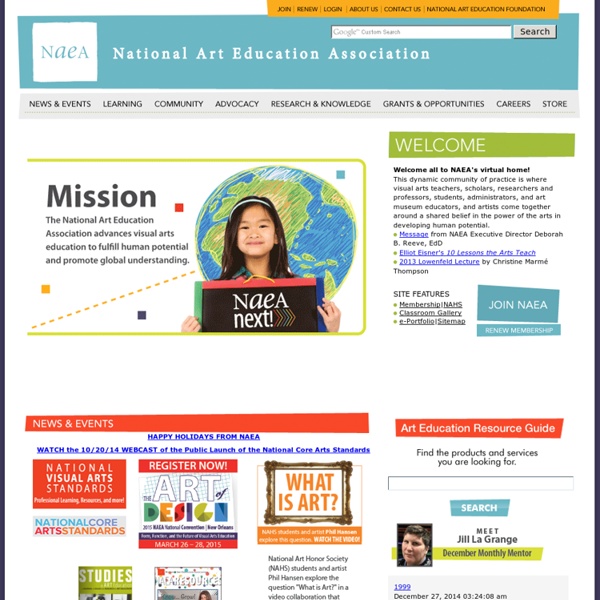
There are just a ton of resources for art educators on this site. They have everything from lesson plans to grants and tips for grant writing. You can become a member as well. I think this is an important resource to remember. by corinnebeans Dec 5