

Half man, half machine: Scientists engineer first 'cyborg' tissue - which uses living human cells and organic polymers Harvard scientists created 'cyborg' skin from neurons, heart cells, and nano-electronic wiringWiring allows scientists to detect and respond to pH changes on the tissue's surface, the same as human skin By Daily Mail Reporter Published: 04:43 GMT, 30 August 2012 | Updated: 16:31 GMT, 30 August 2012 It like it’s something out of a science-fiction movie – genius scientists engineer a synthetic skin that’s part living, part electronics. But scientists at Harvard University have done just that, creating meshes of electronic and biological tissue. The end result is cyborg tissue, which is created from electrodes and wires combined on a Nano-scale. Engineering humanity: Scientists at Harvard have found a way to create cyborg skin, using nano-wires to mesh and human cells High tech: Here, cardiac cells are pictured with a nano-electroic electrode highlighted The results, published in Nature Materials, detail how scientists in the lab embedded electrical nanowires into the lab-grown flesh.
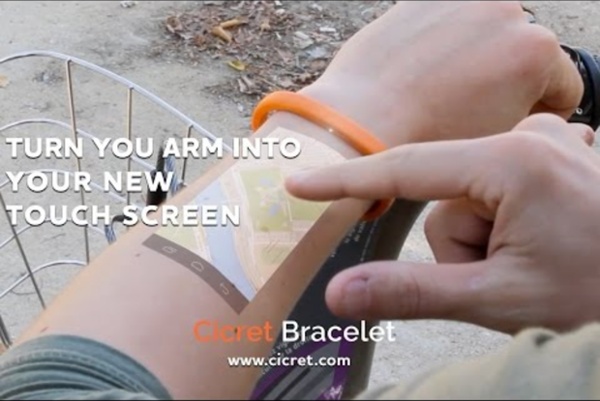
Flexible sensors turn skin into a touch-sensitive interface for mobile devices iSkin is a thin, flexible, stretchable and visually customizable touch sensor that can be worn directly on the skin. Saarland University computer scientists created three novel classes of on-body devices based on iSkin: (a) FingerStrap, exemplified here with a strap on the index finger for fast, one-handed control of incoming calls; (b) Extensions for wearable devices, exemplified here with a rollout keyboard attached to a smart watch; and SkinStickers, exemplified here with (c) an input surface for a music player attached to the forearm, (d) a click wheel on the back of the hand, and (e) a headset control behind the ear. (credit: Martin Weigel et al./CHI ’15) Computer scientists at Saarland University and Carnegie Mellon University are studying the potential use of the human body as a touch sensitive surface for controlling mobile devices. By operating these touch input stickers, users can use their own body to control mobile devices. Give me some skin
Human Genetic Engineering What forms of genetic engineering can be done in human beings? Genetic technology harbors the potential to change the human species forever. The soon to be completed Human Genome Project will empower genetic scientists with a human biological instruction book. The genes in all our cells contain the code for proteins that provide the structure and function to all our tissues and organs. Knowing this complete code will open new horizons for treating and perhaps curing diseases that have remained mysteries for millennia. But along with the commendable and compassionate use of genetic technology comes the specter of both shadowy purposes and malevolent aims. For some, the potential for misuse is reason enough for closing the door completely--the benefits just aren't worth the risks. Since we have introduced foreign genes into the embryos of mice, cows, sheep, and pigs for years, there's no technological reason to suggest that it can't be done in humans too. Edward O. Notes
Bionic Pancreas Promises Big Boost in Health, Quality of Life for Type 1 Diabetics Diabetes, despite affecting nearly 350 million people worldwide, is not really a controlled illness. Those who have the type 1 form of the illness, in which the pancreas fails to produce the insulin that processes glucose in the bloodstream, often face serious eye, kidney and cardiovascular problems. Perhaps the worst outcome is one rarely mentioned in public discourse about the disease: the possibility of dying in the middle of the night due to a miscalculated dose of insulin that can’t be caught when the patient is asleep. The thing is, it’s not easy to dose insulin. When the American Diabetes Association assures patients on its website that, “With the help of insulin therapy and other treatments, even young children can learn to manage their condition and live long, healthy lives,” the claim is more optimistic than realistic. For the study, 20 adults wore the device for five days as they went about their daily lives in the company of a study nurse. Photos: Boston University, DiaTribe
Factory Made Blood Nearing Human Trials There are 30 million blood transfusions every year in the United States; 107 million worldwide. Due to its universal acceptance, Type O negative is the most highly sought-after blood type. Only about 7% of the population has O negative blood, and its rarity makes it a fairly hot commodity. However, it looks like there will soon be a viable alternative, as blood created from stem cells is nearly ready for human clinical trials. The process involves induced pluripotent stem cells (iPSCs), which are adult cells that have been forced back into stem cell state. Human trials are expected to begin in late 2016 or early in 2017. The implications of making this technique commonplace are obviously very important. Of course, nothing is without its challenges, so don’t cancel your appointment to donate blood just yet. Additionally, scaling up the process to make an adequate supply of blood is also proving to be tricky. Image credit: Andrew Mason.
Smart Artificial Skin Could Give Prosthetic Limbs Feeling Scientists have created a smart prosthetic skin that’s stretchy and warm like real skin, and is jammed with tiny sensors that can pick up a variety of environmental cues such as heat, pressure and moisture. Although it’s early days yet, the dream is that with further development, it could transmit sensory information to the brains of amputees to give prosthetic limbs feeling. Artificial limbs have come on in leaps and bounds recently. Scientists have 3D printed prosthetic arms, created artificial limbs that can be controlled by the user’s nerves or brain, and even designed prosthetic skin that is self-healing or 1,000 times more sensitive than human skin. While these are all fantastic, the problem the devices tend to face is that they don’t enable the user to feel if something is dangerously hot, or whether the user is about to drop something because the grip is too soft. Kim et al, via MIT Technology Review [Via MIT Technology Review, Nature Communications PopSci and Live Science]
Human lung made in lab for first time "It's science fiction and we're moving into science fact," says one researcherThe advance won't help patients for many yearsIt could one day help those awaiting a lung transplant (CNN) -- For the first time, scientists have created human lungs in a lab -- an exciting step forward in regenerative medicine, but an advance that likely won't help patients for many years. "It's so darn cool," said Joan Nichols, a researcher at the University of Texas Medical Branch. "It's been science fiction and we're moving into science fact." If the lungs work -- and that's a big if -- they could help the more than 1,600 people awaiting a lung transplant. Lungs are one of many body parts being manufactured in the lab -- some parts, such as tracheas and livers, are even further along. "Whole-organ engineering is going to work as a solution to the organ donor shortage," said Dr. Image A is before new cells were reseeded. New transplant technology keeps organs 'alive' outside body Hope for Womb Transplants
A First: Human Liver Created from Stem Cells Scientists in Japan said they had grown human liver tissue from stem cells in a first that holds promise for alleviating the critical shortage of donor organs. Creating lab-grown tissue to replenish organs damaged by accident or disease is a Holy Grail for the pioneering field of research into the premature cells known as stem cells. Stem Cell 'Ink' Printed Into Living Dots Now Takanori Takebe of the Yokohama City University Graduate School of Medicine and a team reported Wednesday in the journal Nature that they grew tissue "resembling the (human) adult liver" in a lab mouse. They first created induced pluripotent stem (iPS) cells which they mixed with other cell types and coaxed into "liver buds" -- the precursor clusters that develop into a liver. The buds, each about five millimeters (0.2 inches) big, were then transplanted onto a mouse brain, where they were observed transforming into a "functional human liver" complete with blood vessels, the scientists wrote.