

Research on the Go with Mobile Devices Posted by Shelly Terrell on Friday, November 8th 2013 From the Cool Sites Series and Mobile Learning Series “Be regular and orderly in your life, so that you may be violent and original in your work.” – Gustave Flaubert This week I am in beautiful Atlanta, Georgia, presenting at the GAETC conference. I had six sessions which you can read about here, Slides Download these slides! My Favorite Resources Find all these apps and bookmarks in this Pearl Tree, Cultivate your interests with Pearltrees for Android Challenge: Use one of these resources or ideas and share with me how the experience went with your learners.
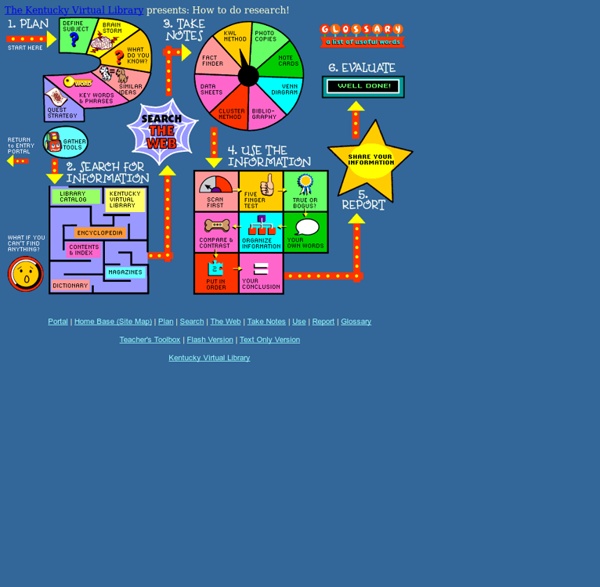
How to Properly Research Online (and Not Embarrass Yourself with the Results) Warning: if you are going to argue a point about politics, medicine, animal care, or gun control, then you better take the time to make your argument legit. Spending 10 seconds with Google and copy-pasting wikipedia links doesn't cut it. The standard for an intelligent argument is Legitimate research is called RE-search for a reason: patient repetition and careful filtering is what will win the day. There are over 86 billion web pages published, and most of those pages are not worth quoting. If you are a student, or if you are seeking serious medical, professional, or historical information, definitely heed these 8 suggested steps to researching online:
NoodleTools : MLA / APA / Chicago Bibliography Composer, Notecards, Outlining July 2013 Free Book Chapter From "Input-Based Incremental Vocabulary Instruction" by Joe Barcroft Chapter 3Checklist for Designing and Implementing Vocabulary Lessons This chapter presents a checklist for designing and implementing effective vocabulary instruction lessons. The rest of this chapter discusses the rationale for attending to each of the seven items in the checklist. 1. With regard to materials, it should be clear from the description of the various steps in the lesson what materials will be needed to implement the lesson. 2. TESOL Community TESOL Community members are constantly connected, discussing topics of importance to you. Recent Discussion Threads from the TESOL Community: Join in the conversation! Have an idea for an online discussion? Discussions in the TESOL Community are open to all TESOL members, regardless of interest section. Nonmembers can participate in selected events with free registration. TESOL Bookstore Looking for Projects to Engage Students and Have Fun?
Help Them Brainstorm! 50+ Tips & Resources Posted by Shelly Terrell on Friday, December 20th 2013 Included in the Digital Tips Advent Calendar and part of the Effective Technology Integration category “An idea, like a ghost, must be spoken to a little before it will explain itself.” – Charles Dickens Brainstorming is an important process that students should do frequently so it becomes a ritual they continue throughout their lives. Storyboarding Storyboards are useful when integrating multimedia projects such as making movies and various digital storytelling projects. Graphic Organizers Graphic organizers help categorize and organize thoughts and ideas to make connections the way the brain does. These are some of my favorite tools and resources: Read Write Think’s Interactive Cube for writing mysteries, biographies, and other storiesLucid Chart is a fantastic tool for web and mobile graphic organizers! Free Brainstorming Mobile Apps More Resources Blog posts related to concept mapping and integrating graphic organizers: Challenge:
Interactive online Google tutorial and references Sweet Search The Fairy Tale Re-Mix AlicePopkorn via photopincc As much as creativity is necessary in learning, it is not realistic to expect learners, who have never had the opportunity to think for themselves, let alone be creative in the classroom, to produce creative work from one day to another. Asking students to write creatively takes time. The three fairy tales which you can see on the left, are well known to many around the world and have become part of childhood references. Working individually or in pairs, learners begin by choosing the fairy tale they want to re-write. After choosing, they can read an example of a "fractured" fairy before developing their own. To help students, there are questions which lead them to think about the characters, the setting, whose point of view is going to be given as well as the plot. When students have completed their new twist of the fairy tale they have chosen, all they need to do is print, and by sticking their stories up around the classroom walls, it can be read by all.