Neurotheology With God In Mind - Neurotheology Article - Clinically Psyched Neurotheology - Hyper-religiosity
Addressing the general meeting for the “Society of Neuroscience” in 1997, Dr. Ramachandran made comment that “there is a neural basis for religious experience.” Ramachandran’s radical statement catapulted neurotheology well into the public eye. The aim of neurotheology is to question and “explore theology from a neurological perspective…helping us to understand the human urge for religion and religious myth” (Newberg, D’Aquili & Rause 2001, p177). Neurotheologians address this through varying scientific methods. Ultimately, can such a movement disprove the existence of God?
Alan Turing
Alan Mathison Turing, OBE, FRS (/ˈtjʊərɪŋ/ TEWR-ing; 23 June 1912 – 7 June 1954) was a British mathematician, logician, cryptanalyst, philosopher, pioneering computer scientist, mathematical biologist, and marathon and ultra distance runner. He was highly influential in the development of computer science, providing a formalisation of the concepts of "algorithm" and "computation" with the Turing machine, which can be considered a model of a general purpose computer.[2][3][4] Turing is widely considered to be the father of theoretical computer science and artificial intelligence.[5] During World War II, Turing worked for the Government Code and Cypher School (GC&CS) at Bletchley Park, Britain's codebreaking centre. For a time he led Hut 8, the section responsible for German naval cryptanalysis. After the war, he worked at the National Physical Laboratory, where he designed the ACE, among the first designs for a stored-program computer. Early life and career[edit]
Theory of relativity
The theory of relativity, or simply relativity in physics, usually encompasses two theories by Albert Einstein: special relativity and general relativity.[1] Concepts introduced by the theories of relativity include: Measurements of various quantities are relative to the velocities of observers. In particular, space contracts and time dilates.Spacetime: space and time should be considered together and in relation to each other.The speed of light is nonetheless invariant, the same for all observers. The term "theory of relativity" was based on the expression "relative theory" (German: Relativtheorie) used in 1906 by Max Planck, who emphasized how the theory uses the principle of relativity.
Can't relax? It's all in your mind: Research shows stopping a thought puts more strain on the brain
(PhysOrg.com) -- Turns out, relaxing is exhausting—which could by why so many people struggle to unplug from work during vacation. According to mathematicians at Case Western Reserve University, stopping a thought burns more energy than thinking-like stopping a truck on a downhill slope. "Maybe this explains why it is so tiring to relax and think about nothing," says Daniela Calvetti, professor of mathematics and one of the authors of a new brain study published in an advanced online publication of the Journal of Cerebral Blood Flow & Metabolism.
Tests of faith
First for some figures. Last year, an ICM poll found 85% of Americans believe that God created the universe. In Nigeria, 98% claimed always to have believed in God, while nine out of 10 Indonesians said they would die for their God or religious beliefs. Last month, a survey by the market research bureau of Ireland found 87% of the population believe in God. Rather than rocking their faith, 19% said tragedies such as the Asian tsunami, which killed 300,000 people, bolstered their belief.
Fullerene
The discovery of fullerenes greatly expanded the number of known carbon allotropes, which until recently were limited to graphite, diamond, and amorphous carbon such as soot and charcoal. Buckyballs and buckytubes have been the subject of intense research, both for their unique chemistry and for their technological applications, especially in materials science, electronics, and nanotechnology. History[edit] The icosahedral fullerene C540, another member of the family of fullerenes. Independently from Henson, in 1973 a group of scientists from the USSR, directed by Prof.
Osho Talks
Osho or Bhagwan Shree Rajneesh was born in 1931 in Central India. He was a charismatic and gifted speaker who became the leader of a worldwide new spiritual movement. It is said that at the age of 21 he attained enlightenment or Samadhi. At the time he was studying philosophy at the University of Saugar.
Brain is not fully mature until 30s and 40s
(PhysOrg.com) -- New research from the UK shows the brain continues to develop after childhood and puberty, and is not fully developed until people are well into their 30s and 40s. The findings contradict current theories that the brain matures much earlier. Professor Sarah-Jayne Blakemore, a neuroscientist with the Institute of Cognitive Neuroscience at University College London, said until around a decade ago many scientists had "pretty much assumed that the human brain stopped developing in early childhood," but recent research has found that many regions of the brain continue to develop for a long time afterwards. The prefrontal cortex is the region at the front of the brain just behind the forehead, and is an area of the brain that undergoes the longest period of development. Prof. Blakemore said brain scans show the prefrontal cortex continues to change shape as people reach their 30s and up to their late 40s.
in the Media: "Tracing the Synapses of Our Spirituality" - Researchers Examine Relationship Between Brain and Religion - By Shankar Vedantam, Washington Post - Sunday, June 17, 2001
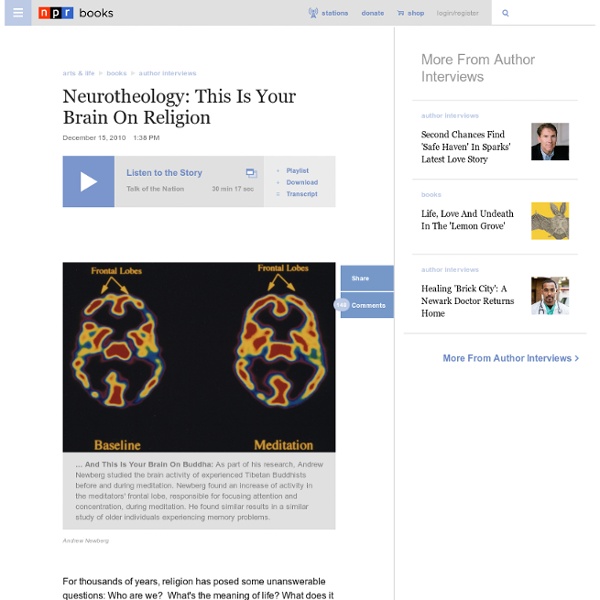
Tracing the Synapses of Our Spirituality Researchers Examine Relationship Between Brain and Religion By Shankar Vedantam, Washington Post Sunday, June 17, 2001 In Philadelphia, a researcher discovers areas of the brain that are activated during meditation. At two other universities in San Diego and North Carolina, doctors study how epilepsy and certain hallucinogenic drugs can produce religious epiphanies. And in Canada, a neuroscientist fits people with magnetized helmets that produce "spiritual" experiences for the secular. The work is part of a broad effort by scientists around the world to better understand religious experiences, measure them, and even reproduce them. Using powerful brain imaging technology, researchers are exploring what mystics call nirvana, and what Christians describe as a state of grace.


If mind is related to consciousness and neurotheology relates to both, insights into human behavior could be revealed. by lennysupak Nov 16
Yes, it is absolutely necessary that progress be made by integrating our knowledge of the brain with that of theology...... spirituality (Man's search for God). Until we are more fully able to understand the relationship between these two basic realms, we will never truly (scientifically, that is) understand what it means to be a human being. by dougsoderstrom Nov 16