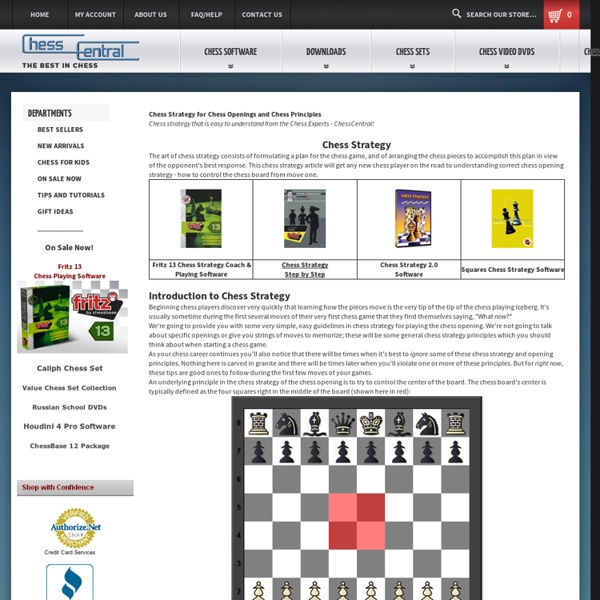
Chess Strategy for Chess Openings and Chess Principles
The Immortal Game: Synopsis
A surprising, charming, and ever-fascinating history of the seemingly simple game that has had a profound effect on societies the world over. Why has one game, alone among the thousands of games invented and played throughout human history, not only survived but thrived within every culture it has touched? What is it about its thirty-two figurative pieces, moving about its sixty-four black and white squares according to very simple rules, that has captivated people for nearly 1,500 years? Why has it driven some of its greatest players into paranoia and madness, and yet is hailed as a remarkably powerful intellectual tool? Nearly everyone has played chess at some point in their lives. In his wide-ranging and ever-fascinating examination of chess, David Shenk gleefully unearths the hidden history of a game that seems so simple yet contains infinity.
22 Manly Ways to Reuse an Altoids Tin
Altoids have been freshening bad breath since the turn of the 19th century. But while they are touted as “Curiously Strong Mints,” perhaps the real curiosity is not the allure of the mints themselves, but the popularity of turning the tin in which they’re packaged into all sorts of truly handy, and just plain fun, creations. The draw of the transformed Altoids tin, like the draw one feels towards, say, a secret book safe, is hard to put your finger on. Part of it is the satisfying challenge of fitting as much as possible into a small space. Part of it is the delight of being able to carry something cool in your pocket. Any way you slice it, beholding the creative uses for an Altoids tin simply brings a smile to your face. First Aid Kit You never know when a bear is going to claw you in the face while you have him in a half-nelson, so it’s best to keep a first aid kit on hand at all times. Full instructions here. Electronics Lab Photo and tin by Nick Ames For tinkering on the go. Photo
SILMAN CHESS
March 2014 If you’re a 1.d4 player, then this book might well be for you A new edition of Dvoretsky’s magnificent work This book, the first of 3, covers the super complex Winawer Variation (sans 7.Qg4) Lakdawala teaches you to play 1.b3, which has been successfully used by Fischer, Larsen, and Nimzowitsch A fine handbook of key positional methods A deep analysis and discussion of Carlsen’s World Championship victory over Anand, in a beautiful hardcover edition. January 2014 Jeremy Silman’s first novel! The first proper translation in English (for iPad, iPhone, and iPod Touch). A simple but effective system for those that want effective but easy-to-learn openings Another instructional masterpiece by Cyrus Lakdawala How Magnus broke Kasparov’s rating record Another magnificent book by grandmaster Ivan Sokolov Aagaard and Ntirlis team up to give you a complete, dynamic answer to 1.e4 November/December 2013 A K-8 educational math learning aid series that teaches you to play chess at the same time! July
Chess History Center - Chess Notes
Learn to Play Chess
Chess Corner Home Learn Play Games Fun World Champions Ecards Book Store Links Learn to Play Chess Want to play chess? Don't know how? Don't worry. Once you know the fundementals, you will need to practise your skills. Why Chess? Elementary Intermediate Copyright © 1997 - 2017 Chess Corner.
Chess Training
GM Igor Smirnov: chess teacher, chess coach, chess trainer
chess variants explained
SchemingMind.com does not only support traditional 'Standard' Chess; several chess variants which use the same board and pieces can also be played. Some of these are very similar to Standard Chess (for example with different starting positions), some are different games in their own right, but all are great fun to play! If you want to learn more about chess variants, we can highly recommend two great books (clicking the links will take you to the Amazon pages where you can purchase the books). Another great resource for information about chess variants is the ChessVariants.org web site. Listed below are the chess variants that you can play on SchemingMind.com - many of these are described in more detail by the resources listed above. Chess960 Many chess masters valued the challenge of playing chess with a non-standard setup as a way to break out of the opening play doldrums. More information on Fischer Random Chess is available on ChessVariants.org Alice Chess 1 Alice Chess 2 All Queens Rules
ChessBomb
Related:
Related:

