

Thésaurus MOTBIS en ligne par SCÉRÉN - CNDP xTooltipElement Vous êtes ici : Accueil <select name="panier" id="panierLab"><option value="panier">Panier des recherches</option></select><input type="submit" name="boutonPanier" value="valider" class="valider" /> <select name="histo" id="histoLab"><option value="Historique">Historique des recherches</option></select><input type="submit" name="boutonHistorique" value="valider" class="valider" /> Site d'informations Motbis Cette zone est une aide à la recherche. Bienvenue sur l'interface de consultation en ligne de MOTBIS 2019 Liste des microthésaurus Pour plus d'efficacité de recherche, veuillez consulter la rubrique aide ci-dessous : © Réseau Canopé Mentions légales
Aarne-Thompson classification system The Aarne–Thompson tale type index is a multivolume listing designed to help folklorists identify recurring plot patterns in the narrative structures of traditional folktales, so that folklorists can organize, classify, and analyze the folktales they research. First developed by Antti Aarne (1867–1925) and published as Verzeichnis der Märchentypen in 1910, the tale type index was later translated, revised, and enlarged by Stith Thompson (1885–1976) in 1928 and again in 1961.[1] The Aarne–Thompson tale type index organizes folktales into broad categories like Animal Tales, Fairy Tales, Religious Tales, etc. Within each category, folktale types are further subdivided by motif patterns until individual types are listed. Use in folkloristics[edit] According to D. Organizing folktale types[edit] The Aarne–Thompson tale type index divides tales into sections with an "AT" number for each entry. Closely related folktales are often grouped within a type. Hans-Jörg Uther[edit] Response[edit]
Qui a peur de Larbre-Dousset ? La fin de l’année approche, et avec elle la perspective des répartitions budgétaires par domaines d’acquisition pour l’année à venir, moment privilégié où le bibliothécaire se pose des questions que le quotidien vient souvent occulter. Il sait bien, pourtant, que dans un contexte de budgets et d’espaces parfois très contraignants, l’évaluation rigoureuse de l’adéquation de l’offre aux usages du public est d’autant plus nécessaire. D’autant plus nécessaire aussi que les proportions documentaires des bibliothèques, façonnées par leur historique, ne prennent pas toujours en compte les évolutions des 10 dernières années (je pense notamment à la place de nos documentaires, fortement dépréciés depuis l’essor du haut débit… :-) ). Prenons par exemple le célèbre taux de rotation. il est peu adapté pour l’analyse des grandes proportions. (Merci à Emmanuel Dousset pour sa disponibilité et sa gentillesse) Like this: J'aime chargement…
Culture numérique - Le référentiel CNIL de formation des élèves à la protection des données personnelles Pourquoi un référentiel international de formation à la protection des données ? À l'ère numérique, l'éducation à un usage citoyen, responsable et éthique des nouvelles technologies constitue une priorité d'action, tout particulièrement auprès des jeunes en âge scolaire.La protection des données et de la vie privée constitue un volet clé de l'éducation au numérique. En ce sens, les personnels éducatifs ont un rôle essentiel à jouer dans cette éducation citoyenne au numérique.Acquérir une connaissance et une compréhension critiques de droits et responsabilités numériques, développer auprès des jeunes une démarche réflexive sur les usages qui sont faits des données personnelles, sensibiliser sur les risques et enseigner les pratiques permettant de se mouvoir dans l'environnement numérique avec confiance, lucidité et dans le respect des droits de chacun : tels sont en effet les objectifs de formation à atteindre. Pourquoi ? À propos du référentiel Les 9 domaines structurants
As of a recent post on Google Books and the research of History, our quiet little blog here on academic history, activism, and spirituality has suddenly gotten more notoriety than it's accustomed to. Hi world! Thanks for stopping by. To carry on with the thread of how information travels for academics, and what the 'net is doing, let's talk about another of my favorite sites for research, del.icio.us. Delicious is the Rome, Jerusalem, and Paris of my existence as an academic these days. It's where I make my friends, how I get the news, and where I go to trade. Why? 1) it sorts things. For two years I've been using Delicious as an information organizer. The result is a navigable taxonomy of my thoughts. After a year of using delicious for my own bookmarks, helping other people find things becomes remarkably easy. Second reason delicious is cool: 2) it makes things public. Not only can you look at your own bookmarks, but you can also look at others'. I don't check in with them.
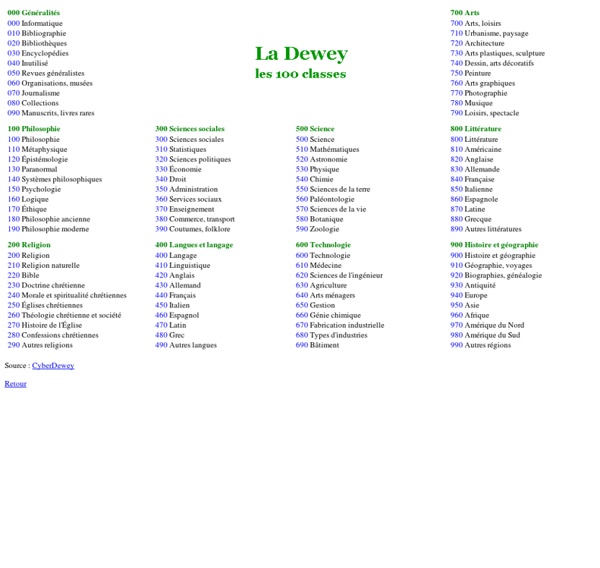
Objectif ATQCPB: Charte des collections Comment définir la charte documentaire d'un établissement ? Comment concevoir et rédiger une charte documentaire ? A quoi sert elle ? Voici quelques unes des questions que je me pose lorsque je consulte, dans les offres d'emploi actuellement diffusées, les postes de responsable de médiathèque existante ou liés à la création d'un établissement, de taille modeste, cela va de soi... Le bibliothécaire est alors seul personnel qualifié dans la structure, et il lui incombe de définir sinon les missions de la bibliothèque, en tout cas la déclinaison de ces missions dans la pratique documentaire de la structure, en particulier dans le domaine des acquisitions. Pour m'éclairer dans cette réflexion et répondre à mes questions, j'ai consulté plusieurs chartes, disponibles sur Internet, de structures de taille moyenne et petite, et tenté de tirer quelques grandes lignes de mes lectures. En résumé, un plan « standard » pourrait donner ceci ; Préambule : objet de la charte des collections
HierarchyVersusFacetsVersusTags See ClassificationPaperOutline2 for a more up-to-date version of this paper. The problem of where to file: Is it possible to construct the perfect classification system? A truly first-rate hierarchy would not only have all of the characteristics of FN's hierarchy [_hey - what's an 'FN'?_], but it would also manage to encode the hierarchy in such a way as to eliminate all ambiguity as to where an item might be found. FN comes pretty close. But you can always imagine that it might be hard to decide where that sock garter really goes? [As a result, Hierarchies are horrible at #3: Targeted search and retrieval of individual items. But as you'll, see this is a problem even in faceted classification systems. How the cookie crumbles: The ways in which hierarchies fail: Nobody builds semantically pure hierarchies, it's just too much work. Look at the Finder screenshot on the HierarchyPapers. [More reasons why hierarchies are bad at #3: Targeted search and retrieval of individual items] 1. 3. 4. 1.
Analyse des chartes de collections des bibliothèques publiques du site Poldoc | Bulletin d'informations de l'ABF, n°189 - 2000 Par Isabelle de Cours, Bibliothécaire Institut nationald'histoire de l'art Le site Poldoc, animé par Bertrand Calenge et hébergé par le serveur de l'Enssib, met à la disposition des lecteurs des politiques d'acquisition et des plans de développement des collections élaborés par des bibliothèques qui consentent à les rendre publics. Quatorze documents émanant de bibliothèques publiques ont été analysés : onze chartes des collections (1) ; un plan de développement des collections (2) ; deux « documents d'orientation (3) ». Quelques précisions en préambule La charte des collections propose les objectifs documentaires généraux de l'établissement, établit les principes de constitution des collections, en apportant un soin particulier aux usages privilégiés qui guideront les bibliothécaires. Les protocoles de sélection établissent en détail les règles d'acquisition et d'élimination d'un domaine considéré du point de vue du contenu (4) . Onze de ces textes ont été rédigés en 1997 et 1998. 1. 2. 3.
Structure and form of folksonomy tags: The road to the public library catalogue Louise F. Spiteri School of Information Management, Dalhousie University, Halifax, Nova Scotia. Canada. Email: Louise.Spiteri (at) dal.ca Received May 8, 2007; Accepted June 5, 2007 Abstract Folksonomies have the potential to add much value to public library catalogues by enabling clients to: store, maintain, and organize items of interest in the catalogue using their own tags. Keywords Collaborative tagging; Controlled vocabularies; Folksonomies; Guidelines Introduction Digital document repositories such as library catalogues normally index the subject of their contents via keywords or subject headings. In order to understand more fully these applications, it is important to examine how folksonomies are structured and used, and the extent to which they reflect user needs not found in existing lists of subject headings. Definitions of Folksonomies Folksonomies have been described as "user created metadata . .. . grassroots community classification of digital assets" (Mathes, 2004). Findings
Folksonomies - Cooperative Classification and Communication Through Shared Metadata The Creation of Metadata: Professionals, Content Creators, Users Metadata is often characterized as “data about data.” Metadata is information, often highly structured, about documents, books, articles, photographs, or other items that is designed to support specific functions. Traditionally metadata is created by dedicated professionals. While professionally created metadata are often considered of high quality, it is costly in terms of time and effort to produce. User created metadata is a third approach, and this paper focuses on grassroots community classification of digital assets. One form of explicit user created metadata was popularized in the late 1990’s with link-focused websites called weblogs (Blood 2000). Tagging Content in Del.icio.us and Flickr Del.icio.us ( henceforth referred to as “Delicious”) is a tool to organize web pages. “a social bookmarks manager. Delicious is not unique or pioneering in its role as bookmarks manager. From Tags to Folksonomy