

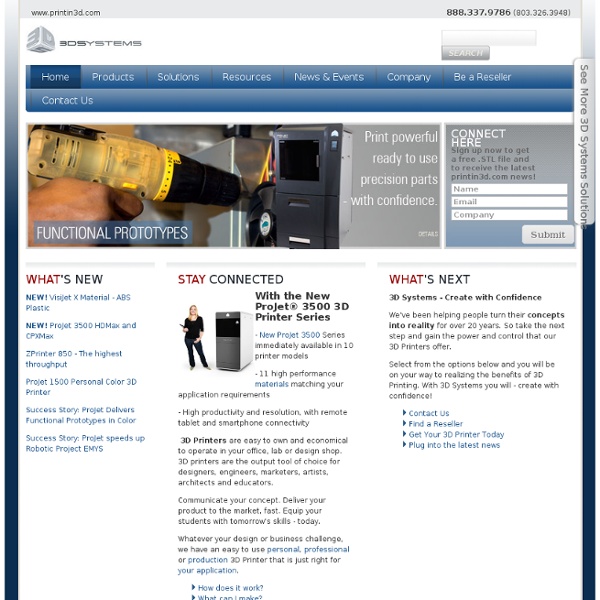
Main Page - partsregistry.org 3D Printers, FDM Prototyping, 3D Models | Dimension Printers Bring Performance Prototyping In-House The Dimension 1200es features the largest build envelope of any Stratasys Design Series performance 3D printer. Running on Fused Deposition Modeling (FDM) Technology, it prints in nine colors of real ABSplus thermoplastic. Image Gallery Dimension 1200es 3D Print Pack The 3D Print Pack is everything you need to start building 3D models. The SST 1200es 3D Printer The SCA-1200 support removal system A startup supply of materials Materials and Bases Dimension 3D printers use ABSplus thermoplastic to build your models. Modeling bases provide a stable platform where your prototype builds. More Design Series Performance 3D Printers Dimension 1200es Printer Specs Model material: ABSplus in nine colors Support material: Soluble (SST 1200es); breakaway (BST 1200es) Build size: 254 x 254 x 305 mm (10 x 10 x 12 in.) Layer thickness: 0.33 mm (0.013 in.) or .254 mm (.010 in.) Workstation compatibility: Windows XP/Windows 7 Power Requirements: Regulatory Compliance:
Reprap RepRap is humanity's first general-purpose self-replicating manufacturing machine. RepRap takes the form of a free desktop 3D printer capable of printing plastic objects. Since many parts of RepRap are made from plastic and RepRap prints those parts, RepRap self-replicates by making a kit of itself - a kit that anyone can assemble given time and materials. RepRap is about making self-replicating machines, and making them freely available for the benefit of everyone. Reprap.org is a community project, which means you are welcome to edit most pages on this site, or better yet, create new pages of your own. RepRap was the first of the low-cost 3D printers, and the RepRap Project started the open-source 3D printer revolution. RepRap was voted the most significant 3D-printed object in 2017. RepRap state-of-the-art when this page was last updated (June 2017) is well represented by the RepRap Snappy, RepRap Dollo and the RepRap Generation 7 Electronics.
Thingiverse - Digital Designs for Physical Objects Lasersaur Lasersaur The Lasersaur is an open source laser cutter. We designed it to fill the need of makers, artist and scientist who wanted a safe and highly-capable machine. Unlike others it comes fully loaded with knowledge to run, maintain, and modify. Since its conception, Nortd Labs and the Lasersaur community has generated knowledge to develop a comprehensive system. We have specifically focused on laser cutting, software, and making the building process repeatable. How can you Contribute? Unlike software, hardware RD is costly even when living off of Ramen. Short on cash? $32 Beta Access: Support the project and get full access to design documents, community (mailing list), and software before the project goes fully open source. $(any) Project Support: Simply want to support the project? We Accept Bitcoin! Credits Mad props to reprap.org, www.cnczone.com, arduino.cc, grbl, buildlog.org, and their giants' shoulders.
3D Printers & 3D Production Systems | Stratasys Products The Stratasys Idea Series levels the playing field by bringing professional 3D printers to individuals and small teams, accelerating creativity. Making the leap to world-class 3D printing at such a low cost is a revolution on its own. If you’ve ever taken a 3D prototype for a test spin before production, you already know its impact. Cut turnaround time and increase quality by building prototypes right under your own roof with Stratasys Design Series 3D printers. Rethink the factory from the floor up. The Stratasys Production Series is built to streamline manufacturing while maximizing your possibilities — handling the largest prototypes and accurate low-volume parts with agility. Because Stratasys believes the future of dentistry is digital, we’ve designed a 3D printing solution for almost every dental need. Learn about 3D Printing 3D printing is a way to create physical objects directly from digital files. Technologies
Protei >> 2013/04/25, 08:00 : Barcelona, Spain>> 2013/04/18, 08:00 - April 21, 20:00 : Casablanca, Morroco>> 2012/04/06, 08:00 - April 10, 20:00 Tema (Accra), Ghana>> 2013/03/25, 08:00 - March 30, 20:00 : CAPE TOWN, SOUTH AFRICA>> 2013/03/08, 08:00 - March 18, 20:00 : Port Louis, Mauritanie>> 2013/03/06 08:00 - March 11, 20:00 : Cochin, India>> 2013/03/01, 20:00 - Feb 25, 08:00 : Rangoon, Burma>> 2013/02/20, 08:00 - Feb 21, 20:00 : Singapore>> 2013/02/12, 08:00 - February 18, 16:00 : Ho Chi Minh, Vietnam>> 2013/02/07, 08:00 - Feb 8, 20:00 : Hong Kong>> 2013/02/03 : 08:00 - Feb 4, 20:00 : Shanghai, China>> 2013/01/30, 08:00 - Jan 31, 20:00 : Kobe, Japan>> 2013/01/27, 08:00 - Jan 28, 23:00 : Yokohama, Japan >> 2013/01/15, 08:00 - 16, 20:00 : Hilo, Hawaii, USA>> 2013/01/9, 17:00 : departure from San Diego, CA, USA >> 2012/11/29 : TEDxVilaMada "Nosso Planeta Agua" Sao Paolo, Brasil >> 2012/10/18 - 28 : Protei at Lodz Design Festival, Poland. Blog Origin of the name & Biomimicry Protei Community
Generation FAB by Matthew Gardiner on Prezi DIYLILCNC OpenCola (drink) OpenCola is a brand of open-source cola, where the instructions for making it are freely available and modifiable. Anybody can make the drink, and anyone can modify and improve on the recipe as long as they, too, license their recipe under the GNU General Public License. Since recipes are, by themselves, not copyrightable, the legal basis for this is untested.[1] The flavouring formula for OpenCola is:[2][3] Ingredients of OpenCola 2.36 kg plain granulated white table sugar2.28 L water30.0 mL caramel color17.5 mL (3.50 tsp.) 75% phosphoric acid or citric acid10.0 mL (2.00 tsp.) flavouring formula2.50 mL (0.50 tsp.) caffeine (optional)[2][3] After mixing up the concentrate to the prescribed recipe (including all recommended safety precautions – see links), the syrup is diluted 5:1 with ("preferably sodium-free") soda water to make the finished drink; at this dilution, the above combination of ingredients will yield approximately 24 litres of OpenCola.
How to Make OpenCola Steps Part 1 of 4: Making The Flavoring 1Mix the oils together.Ad 2Add gum arabic and mix.3Add water and mix well. For this step, use a hand mixer or blender to mix thoroughly. The flavoring can be made in advance and stored for use later. Part 2 of 4: Making The Acid Solution from Powder You can make a larger batch for future use or just what is needed, either way you want 75% of the total weight to be the powder and 25% water. 1Measure 13 grams of the acid powder and place in a small glass jar.2Boil a small amount of water (you can microwave 10-20 ml water for about a minute)3Add 4.5 ml of hot water to the powdered acid (enough to bring the total weight up to 17.5 g).4Swirl the solution carefully until the powder is dissolved. Part 3 of 4: Making The Concentrate Part 4 of 4: Making The Soda 1Mix 1 part concentrate with five parts water. Tips Ad Warnings Gum arabic is available in two forms: art grade and food grade.
FREE BEER Gear template generator This free online gear template generator is designed for making scale accurate paper gear templates which you can glue onto wood and then cut out with a bandsaw. I recommend printing the gears with an ink jet printer. Even cheap ink jet printers print very scale accurate but Not all laser printers are accurate. You can still access the old (pre 2015) Flash based gear geberator Getting the printout to scale correctly, avoiding cropping Different browsers print at different scales depending on browser type and printer configuration. Use an ink jet printer I recommend using an ink jet printer. Printing the gear templates To print the gear template, use the 'Print' button, instead of printing the web page from the browser. The gear generator program that I created and sell doesn't need the scale calibration, and can paginate across many pages for larger gears. Some notes about gear design and this gear template generator This gear template generator generates shapes for involute spur gears.