

Jetstrap, créateur d'interfaces Bootstrap en ligne Vous avez besoin de créer un prototype de site web fonctionnel en quelques minutes ? Jetstrap peux vous sauver la mise en proposant un service en ligne plutôt bien pensé… Jetstrap est un outil en ligne qui vous permet de créer gratuitement une interface web basée sur le Bootstrap Twitter. (Vous ne savez pas ce qu’est le Bootstrap Twitter ? Destiné aux designers, développeurs et chefs de projets web, Jetstrap se compose d’une interface 100% web avec des fonctionnalités de création rapide de mise en page. Pour gagner en productivité le fonctionnement en drag and drop vous permet de placer les éléments de la page en quelques secondes. Gros plus non négligeable, Jetstrap vous permet de créer un prototype avec une mise en page adaptative. Pour conclure : Jetstrap se présente comme un outil vraiment rapide et facile d’utilisation pour créer rapidement un prototype de site web. Autre avantage, pour l’instant l’application web propose son service gratuitement ! jetstrap.com
Entries about Personas Whew. That was close. As every year, there’s a risk that we’ll be overrun with with zombies, werewolves, vampires, sasquatch(es), and mummies before the veil that separates the world seals tight for another year. But a quick tally around the Cooper offices shows that here, at least, we all made it. Hope all our readers are yet un-undead as well. While we’re taking this breather, we’re called to reflect a bit on this year’s interaction design for monsters. Monsters are extreme personas One of the power of personas is that they encourage designers to be more extrospective, to stop designing for themselves. But then again… Some of the constraints of the monsters are human constraints writ large (or writ strangely). Juan wasn’t a useful person in and of himself, but his users exercised flash mob requirements of real-time activation and coordination.
La matrice Swot un outil précieux Qui n’est pas resté songeur face à une problématique car il ne savait pas par quoi commercer ? Aujourd’hui, je vais vous parler d’un outil précieux, la matrice SWOT, qui ne va pas résoudre le problème mais permettre de le poser et d’analyser les différents environnements. L’intérêt de cette méthode est qu’on peut l’appliquer pour un bon nombre de sujets… Dans un premier temps, je vais définir la matrice SWOT, puis aborder comment se construit une matrice SWOT pour finir par les stratégies associées. La matrice SWOT La matrice SWOT est un outil d’analyse stratégique née en 1960 par Albert S. S pour Strenght : forces W pour Weakness : faiblesses O pour Opportunities : opportunités T pour Threats : menaces Comment réussir sa matrice SWOT ? Pour réaliser la matrice, il est recommandé de réunir les différentes personnes concernées par le projet, pour qu’aucun point ne soit oublié dans les 4 facteurs. La première étape Elle consiste à lister l’ensemble des points en les regroupant ainsi :
CRM segmentation | Have Personas Become Chic Again? Best Buy brought personas into the mainstream in 2005 when it started designing its stores around customer segments. Jill, the soccer-mom type with an aversion to electronics who is the main shopper in the family, became famous after Best Buy designed specific stores with pink balloons and Hello Kitty merchandise to cater to this segment. While Best Buy still accommodates Jill, she has slipped from the limelight. Personas themselves haven't received much press either…until recently. Lately companies like AOL, BMW, and USAA, have discussed how they're taking their persona initiatives to the next level by integrating them with other company data and layering them with behavioral characteristics to conduct everything from customer acquisition to product development. Vidya L.
Using Personas in Web Design | AdPearance Blog The most valuable lesson I’ve learned in growing as a web designer was to stop designing for myself. Some of you may scoff and say “No duh,” but honestly, to embrace this mentality is a tough job. A personal philosophy has been to avoid assumptions and base my designs on real data. Harder still was to stop my addiction to “Best of” gallery sites and to stop designing the “coolest” site. Cool won’t sell. Enter in user centered web design. User Personas: a Definition In 1998, Alan Cooper made mention of “personas” in his book The Inmates Are Running the Asylum based on the emerging user-centric method of designing software. “A persona is a fictitious, specific and concrete representation of target users.” Personas act as stand-ins for real users and help guide decisions about functionality, design and ultimately marketing. Personas first and foremost force designers and shareholders to maintain focus. A persona is a concrete, deliverable item. Who is this person? How to Create a Persona
Reconciling Market Segments and Personas Market segmentation and personas are two different techniques that are often perceived as conflicting methods, but they are actually complementary tools that organizations can use to design and sell successful products. The value of market segmentation The marketing profession has taken much of the guesswork out of determining what motivates people to buy. One of the most powerful tools for doing so is market segmentation, which groups people by their distinct needs to determine what types of consumers will be most receptive to a particular product or marketing message. To develop these models, marketers classify consumers according to a set of demographics and geographic variables such as age, race, education, and location. However, understanding why somebody wants to buy something is not the same thing as actually defining the product—what it is, how it will work, and how it will be used. The value of personas How do you select the right personas? An example Example survey chart
Les organismes de recherche face aux réseaux sociaux Entre juin et octobre 2012, j’ai réalisé une étude visant à mieux comprendre les stratégies de communication digitale des organismes français de recherche. Les objectifs étaient les suivants : Quelles sont les stratégies de communication digitale des organismes de recherche français ? Quels sont les enjeux et les problématiques propres à ces acteurs ? Éclairer les pratiques et susciter des échanges entre les acteurs. Sommaire : Une étude en trois phases Cette étude se basait tout d’abord sur une analyse de la présence et de l’activité de ces organismes sur les réseaux sociaux. Ensuite, l’étude portait sur l’analyse d’entretiens semi-directifs réalisés en face à face ou par téléphone avec les acteurs afin de comprendre comment cela se passe « derrière » les comptes : qui est en charge de l’animation des réseaux sociaux ? Voici les personnes ayant accepté de participer à cette étude et nous tenons à les remercier : La présentation de l’ensemble des résultats Une présence incontournable
Improving Hiring for User Experience I had a recent engagement in the heartland of the United States which involved a room full clients who labeled themselves user experience professionals. One of the UX pros was a darling lady with cats on her sweatshirt whose sole responsibility was emailing basic summative data on a system’s users count once a month. She indicated that she was on the verge of ending her career to continue developing her poultry farm. LinkedIn shows that the number of self-identified UX Designers has grown 12% in the past year. This article does not attempt to establish a concrete definition of what the proper definition of user experience is—there are several excellent examples already out there (Smashing Web, N/N Group). To begin, I’ll examine this road to discovery from the perspective of the interviewee—the aspiring professional wanting to develop their career and expand or refine their skill set. The Applicant If you’re approaching a speaker after a talk, get in, get your point across, and get out.
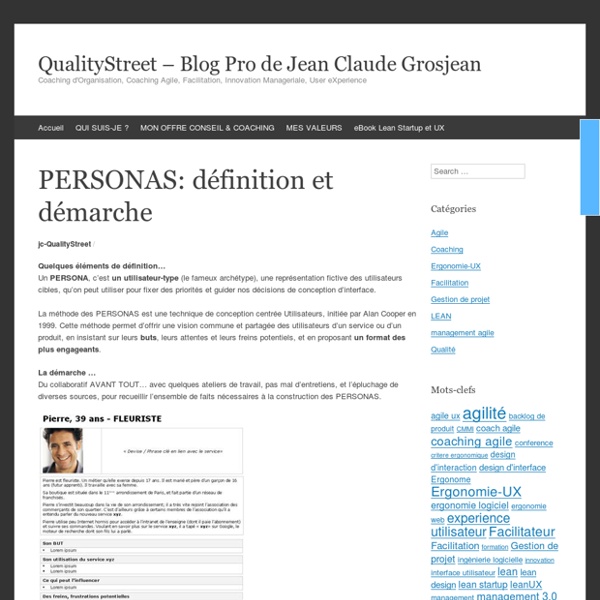
Les personas, ces utilisateurs presque pas virtuels qui sauvent vos projets Immortalisés par Josiane Michu, les personas sont des avatars des utilisateurs futurs ou existants auxquels est destiné votre produit. En créant de véritables références tangibles utilisables par joute l’équipe, ils permettent de mettre en place les différents scénarios d’utilisations et de mieux appréhender le public ciblé. Mes parents disent que c’est juste un ami imaginaire. Vous l’aurez compris, on ne va pas parler du dernier gadget à la mode pour rendre Firefox encore plus lourd, mais bien d’expérience utilisateur, et plus particulièrement des débuts d’un projet. Au delà du caractère sympathique porté par ces représentations, les personas permettent de répondre à deux questions : Qui sont mes clients, et comment utilisent-ils mon produit ? Les différents avatars vous permettront de construire les principaux scénarios d’utilisation du produit. D’une manière très large, les personas vous permettront d’élaborer : En bref : 95% de votre produit. Élaboration de vos personas