

Crystal Skulls -- National Geographic By Richard A. Lovett and Scot Hoffman Crystal skulls are not uncommon or terribly mysterious. Thousands are produced every year in Brazil, China, and Germany. There are perhaps a dozen of these rare crystal skulls in private and public collections. Many believe these skulls were carved thousands or even tens of thousands of years ago by an ancient Mesoamerican civilization. Supernatural Fascination Stories about the skulls focus heavily on their perceived supernatural powers. Joshua Shapiro, coauthor of Mysteries of the Crystal Skulls Revealed, on his Web site cites claims of healings and expanded psychic abilities from people who have been in the presence of such skulls. "We believe the Crystal Skulls are a form of computer which are able to record energy and vibration that occur around them," he writes. " The skull will pictorially replay all events or images of the people who have come into contact with them (i.e. they contain the history of our world)." All Fakes?
Ancient underwater cities being found that are 10,000 years old Lost city 'could rewrite history' By BBC News Online's Tom Housden The remains of what has been described as a huge lost city may force historians and archaeologists to radically reconsider their view of ancient human history. Marine scientists say archaeological remains discovered 36 meters (120 feet) underwater in the Gulf of Cambay off the western coast of India could be over 9,000 years old. The vast city - which is five miles long and two miles wide - is believed to predate the oldest known remains in the subcontinent by more than 5,000 years. The site was discovered by chance last year by oceanographers from India's National Institute of Ocean Technology conducting a survey of pollution. Using sidescan sonar - which sends a beam of sound waves down to the bottom of the ocean they identified huge geometrical structures at a depth of 120ft. Lost civilization The city is believed to be even older than the ancient Harappan civilization, which dates back around 4,000 years. Continued...
Caricature Map of Europe 1914 The Clanker Powers: Germany is a massive military machine with weapons aimed outwards to all surrounding countries. It points threateningly at Britain, not so much as a sign of direct aggression, but more as an indicator that it was now Germany’s turn to start a grand global Empire to challenge the world’s current one. Austria Hungary is an aggressive armoured giant, teetering on shoddy foundations. The Ottoman empire is a teetering automaton, collapsing under the weight of a paranoid and ungainly spying network that gazes at Europe through many lenses and spy glasses. The Swiss watch ticks away the time, comfortable to wait it all out. The Darwinist Powers: Britain is an militaristic lion with a Roman Imperial italic-type helmet. France’s elephant beast (wearing the French kepi they started the war with before adapting their firefighter helmets) is influenced by the Elephantine Collossus built for the Universal Exhibition of 1889 in Paris (later it ended up going to the Moulin Rouge.)
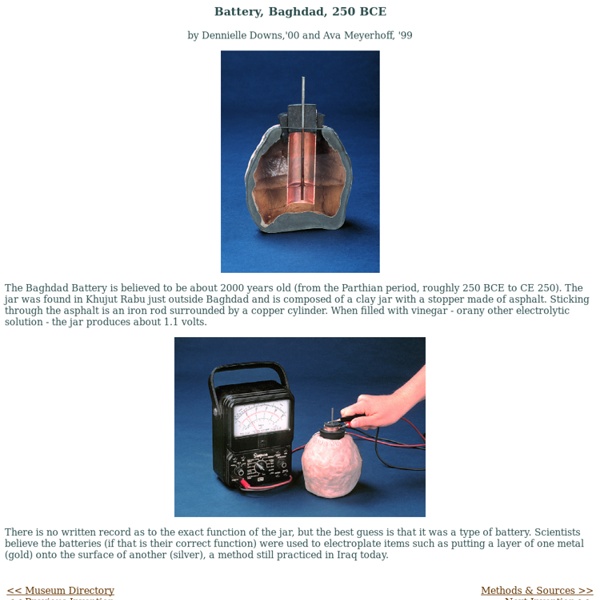
The 10 Most Puzzling Ancient Artifacts The Bible tells us that God created Adam and Eve just a few thousand years ago, by some fundamentalist interpretations. Science informs us that this is mere fiction and that man is a few million years old, and that civilization just tens of thousands of years old. Could it be, however, that conventional science is just as mistaken as the Bible stories? The Grooved Spheres Over the last few decades, miners in South Africa have been digging up mysterious metal spheres. The Dropa Stones In 1938, an archeological expedition led by Dr. The Ica StonesBeginning in the 1930s, the father of Dr. The Antikythera MechanismA perplexing artifact was recovered by sponge-divers from a shipwreck in 1900 off the coast of Antikythera, a small island that lies northwest of Crete. The Baghdad BatteryToday batteries can be found in any grocery, drug, convenience and department store you come across. Ancient Model Aircraft Impossible Fossils Out-of-Place Metal Objects What are we to make of these finds?
Home | Project Mosul Top 10 Myths About the Romans History For many, the only exposure to Ancient Rome comes from what they have seen in the movies or on television. Unfortunately, films like Gladiator, Spartacus, Barabbas, and Demetrius and the Gladiators don’t present a very accurate depiction of life in Rome and the arena. Considering the fact that the Roman Empire existed for so long, and so much of our own Western society has derived from it, it is no surprise that we all have at least one or two misconceptions about the Empire and its people. For this reason, we have put together a list of the most misconceptions people hold about the Ancient Roman society and customs. Fortunately most are easily proven wrong as you will see when you read on: Contrary to popular belief, the emperor did not give a thumbs up or down for a gladiator as a signal to kill his enemy. HBO/BBC created an excellent series called “Rome” which covers a number of years of the Roman Empire. When we think of Romans, we almost always imagine men in togas.
100 Very Cool Facts About The Human Body The Brain The human brain is the most complex and least understood part of the human anatomy. There may be a lot we don’t know, but here are a few interesting facts that we’ve got covered. Nerve impulses to and from the brain travel as fast as 170 miles per hour. Ever wonder how you can react so fast to things around you or why that stubbed toe hurts right away? It’s due to the super-speedy movement of nerve impulses from your brain to the rest of your body and vice versa, bringing reactions at the speed of a high powered luxury sports car.The brain operates on the same amount of power as 10-watt light bulb. Hair and Nails While they’re not a living part of your body, most people spend a good amount of time caring for their hair and nails. Facial hair grows faster than any other hair on the body. Internal Organs Though we may not give them much thought unless they’re bothering us, our internal organs are what allow us to go on eating, breathing and walking around. Bodily Functions Senses
23 Bizarre Products Trending On Amazon That Are Actually Genius AF There are a lot of things on the internet that make you go "WTF?" Most of that stuff is just straight up bizarre, but some of it is actually useful — and when it comes to the world of online shopping, sometimes the most bizarre products trending are actually brilliant lifesavers. If you want to see what I'm talking about, head right on over to Amazon. Over the last few years, they've really upped their game when it comes to finding innovative and unusual products. So, if you're looking for the perfect pair of food scissors or you just want to peruse the odd offerings Amazon has on display, look no further.
Walter Hunt Invented the Safety Pin and a Sewing Machine By Mary Bellis The modern safety pin was the invention of Walter Hunt. For those of you who don't know what a safety pin is; it is an object commonly used to fasten clothing (i.e. cloth diapers) together. The very first pins used for clothing date back to the Mycenaeans during the 14th century BCE and were called fibulae. Walter Hunt (1796 – 1859) Born in upstate New York, Walter Hunt earned a degree in masonry. Walter Hunt's other inventions included: a forerunner of the Winchester repeating rifle, a successful flax spinner, knife sharpener, streetcar bell, hard-coal-burning stove, artificial stone, road sweeping machinery, velocipedes, ice ploughs and mail making machinery. continue reading below our video Play Video Walter Hunt - Safety Pin The safety pin was invented while Walter Hunt was twisting a piece of wire, trying to think of something that would help him pay off a fifteen dollar debt. On April 10, 1849, Walter Hunt was granted US patent #6,281 for his safety pin.
The World before 1000 BCE 100 Websites You Should Know and Use In the spring of 2007, Julius Wiedemann, editor in charge at Taschen GmbH, gave a legendary TED University talk: an ultra-fast-moving ride through the “100 websites you should know and use.” Six years later, it remains one of the most viewed TED blog posts ever. Time for an update? We think so. To see the original list, click here. And now, the original list from 2007, created by Julius Wiedemann, editor in charge at Taschen GmbH. In the spring of 2007, Julius Wiedemann, editor in charge at Taschen GmbH, gave a legendary TED University talk: an ultra-fast-moving ride through the “100 websites you should know and use.” To see the original list, click here. And now, the original list from 2007, created by Julius Wiedemann, editor in charge at Taschen GmbH.
Self-made millionaire invented Bug-A-Salt gun, shoots salt at flies If killing a fly bothers you, stop reading. If, however, flies are your nemesis, if they make your life miserable when you’re trying to picnic at the park, barbecue in the backyard, sleep at night but can’t because some stupid fly got in the house and is buzzing around... If you hate them, then Lorenzo Maggiore is your patron saint. “I was a weird kid, I didn’t like flies,” says the 57-year-old from Los Angeles. “I used to put them in my Hot Wheels cars and send them down the track. Maggiore is the artistic madman behind Bug-A-Salt, a $40 “gun” which uses table salt as buckshot to stun or kill bugs, especially flies. Last year, Bug-A-Salt sold one million units. BUG-A-SALT shooters Mary Stevens Lorenzo Maggiore never graduated high school. But he always had this idea to make a gun to kill flies. He tried to make and market one in the ’90s, but it didn’t go anywhere. Maggiore maxed out his credit cards and went to China to spend two months working with a prototype toy maker. Like this story?
Jon Mooallem: How the teddy bear taught us compassion History of Roman swords | Sword history Roman swords History of Roman swords. Roman gladius sword, Roman spatha sword and gladiator swords. Roman pugio dagger. Sword history. Roman legionaries The Romans used all the knowledge they gained from other cultures such as the Greeks and Celts in order to forge these great swords it also allowed them to create a sword for any military situation, examples of this are mountainous regions would require a shorter sword that allowed greater slashing and stabbing, one such sword was the Pompeii Gladius. The Roman sword that really conquered all was the short sword. Roman gladius was the primary sword of Ancient Roman foot soldiers. Gladius was adopted by Romans in 4-3 century BC. Roman gladius sword Common gladius meassurements: Weight: 1.2–1.6 kg (2.6–3.5 lb) Length: 64–81 cm (25–32 in) Blade length: 60–68 cm (2.0–2.23 ft) Width: 4–8 cm (1.6–3.1 in) Gladius sword subtypes:Hispaniensis gladius – the orgiginal gladius imported from today Spain.Mainz gladius-gladius made for northern wars.