

No known hominin is common ancestor of Neanderthals and modern humans, study suggests -- ScienceDaily The search for a common ancestor linking modern humans with the Neanderthals who lived in Europe thousands of years ago has been a compelling subject for research. But a new study suggests the quest isn't nearly complete. The researchers, using quantitative methods focused on the shape of dental fossils, find that none of the usual suspects fits the expected profile of an ancestor of Neanderthals and modern humans. The study, which will be published online this week by the Proceedings of the National Academy of Sciences, was carried out by an international team of scholars from The George Washington University, Konrad Lorenz Institute for Evolution and Cognition Research in Austria, Indiana University and Atapuerca Research Team in Spain. P. The researchers use techniques of morphometric analysis and phylogenetic statistics to reconstruct the dental morphology of the last common ancestor of Neanderthals and modern humans. What comes next?
DNA from the Beginning - An animated primer of 75 experiments that made modern genetics. DNA from the Beginning is organized around key concepts. The science behind each concept is explained by: animation, image gallery, video interviews, problem, biographies, and links. DNAftb blog: It's the season of hibernation, something I've always wished I could do. Feature: We have relaunched the Weed to Wonder site as a flexible "e-book" that can be viewed as a website, an app, or a printable PDF. Mailing List Gene News - ‘Alien’ DNA makes proteins in living cells for the first time Find the DNALC on: Language options:
Making a Genealogy Map Using the Google Maps API Introduction I wanted to try out using the Google Maps API for a project, so I decided I’d try to use it in conjunction with some genealogy data to see what I could come up with. The result is a family tree which is mapped out spatially rather than chronologically; once rendered, the following visual data is revealed: Migration paths - see where particular people suddenly moved a large distance Geographical density/immobility - see which areas the most family members were from Most popular places - see which villages or cities successive generations lived in Example Click on the image below to view a live example of the project (using real data from my family tree) and then read on for an explanation of how the program works: Features Google Maps features: Pan and zoom around the map using AJAX technology Switch to vector mapping, satellite mapping or hybrid maps Program features: By way of compromise, it is possible to adjust the zoom level via a variable at the top of the program though. Code
Synthesis of DNA There is a major difference between DNA polymerase and RNA polymerase: the RNA polymerase can synthesize a new strand whereas the DNA polymerase can only extend an existing strand. Therefore, to synthesize a DNA molecule, a short RNA molecule (~ 5 - 12 nucleotides) must be synthesize first by a special enzyme. The initiating RNA molecule is known as a primer, and the enzyme is called primase. In addition to DNA polymerase and primase, DNA replication requires helicase and single strand binding protein (SSB protein). The role of helicase is to unwind the duplex DNA. The replication mechanisms in both bacteria and eukaryotes are similar. Figure 7-B-2. DNA polymerases can extend nucleic acid strands only in the 5' to 3' direction. Figure 7-B-3. The whole lagging strand is synthesized by repeating steps (b) to (e).
European Neanderthals were on the verge of extinction even before the arrival of modern humans New findings from an international team of researchers show that most Neanderthals in Europe died off around 50,000 years ago. The previously held view of a Europe populated by a stable Neanderthal population for hundreds of thousands of years up until modern humans arrived must therefore be revised. This new perspective on the Neanderthals comes from a study of ancient DNA published February 25 in Molecular Biology and Evolution. The results indicate that most Neanderthals in Europe died off as early as 50,000 years ago. After that, a small group of Neanderthals recolonised central and western Europe, where they survived for another 10,000 years before modern humans entered the picture. The study is the result of an international project led by Swedish and Spanish researchers in Uppsala, Stockholm and Madrid. The results presented in the study are based entirely on severely degraded DNA, and the analyses have therefore required both advanced laboratory and computational methods.
Train with Marsec Neanderthals died out earlier than previously thought, new evidence suggests Direct dating of a fossil of a Neanderthal infant suggests that Neanderthals probably died out earlier than previously thought. Researchers have dated a Neanderthal fossil discovered in a significant cave site in Russia in the northern Caucasus, and found it to be 10,000 years older than previous research had suggested. This new evidence throws into doubt the theory that Neanderthals and modern humans interacted for thousands of years. Instead, the researchers believe any co-existence between Neanderthals and modern humans is likely to have been much more restricted, perhaps a few hundred years. The research, directed by the University of Oxford and University College Cork in collaboration with the Laboratory of Prehistory at St Petersburg, Russia, and funded by Science Foundation Ireland was recently published in PNAS Online Early Edition. The new dating evidence throws new light on when the Neanderthals became extinct and why.
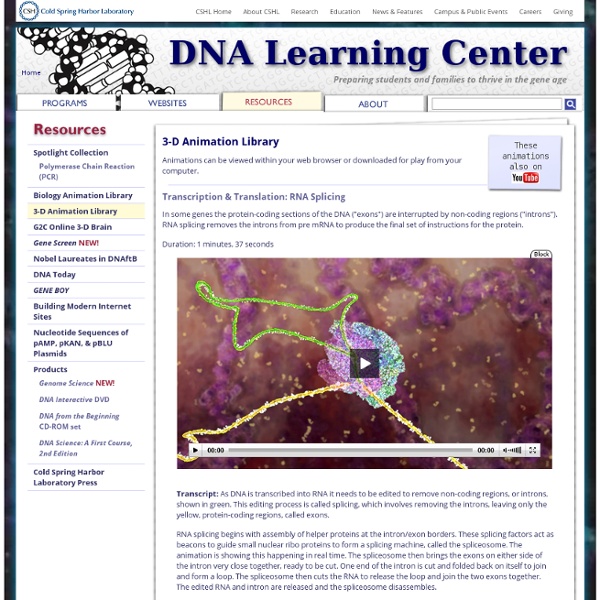
DNA Molecule: How DNA is Packaged (Advanced) DNA Molecule: How DNA is Packaged (Advanced) Each chromosome consists of one continuous thread-like molecule of DNA coiled tightly around proteins, and contains a portion of the 6,400,000,000 basepairs (DNA building blocks) that make up your DNA. Duration: 1 minutes, 42 seconds Transcript: In this animation we'll see the remarkable way our DNA is tightly packed up to fit into the nucleus of every cell. Choose a 3-D animation by name: Bunnies implicated in the demise of Neanderthals - 27 February 2013 BLAME it on the bunnies. The debate over what Neanderthals ate, and how it may have led to their demise, has turned to rabbits. Which, it is now claimed, they did not feast on. Signs that our extinct cousins hunted dolphins and seals were presented in 2008 as evidence of their sophistication. Now, John Fa of the Durrell Wildlife Conservation Trust in Trinity, Jersey, says the remains in caves around Europe became dominated by rabbits rather than large game around the time Neanderthals went extinct (Journal of Human Evolution, doi.org/kkn). It's not clear why they would have had more trouble changing prey, says Fa.
History - British History in depth: 1066