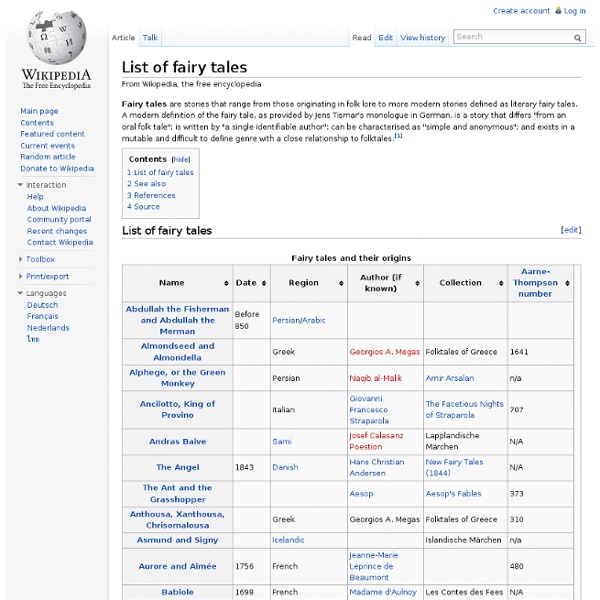
List of fairy tales
A modern definition of the fairy tale, as provided by Jens Tismar's monologue in German, is a story that differs "from an oral folk tale"; is written by "a single identifiable author"; can be characterised as "simple and anonymous"; and exists in a mutable and difficult to define genre with a close relationship to folktales.[1] Jump up ^ Zipes, xvJump up ^ Laura Gibbs (July 12, 2003). "Don Giovanni de la Fortuna". Mythfolklore.net. Retrieved 26 September 2010. Jump up ^ Hans Christian Andersen.
Magical Fairytales - Eugenio Recuenco (10 photos)
Eugenio Recuenco is an award-winning fashion photographer from Spain. His unique style has been referred to as "cinematographic" and "pictorial" and his work has been featured in magazines such as Vogue and Twill. Eugenio Recuenco
Aarne–Thompson classification system
The Aarne–Thompson tale type index is a multivolume listing designed to help folklorists identify recurring plot patterns in the narrative structures of traditional folktales, so that folklorists can organize, classify, and analyze the folktales they research. First developed by Antti Aarne (1867–1925) and published as Verzeichnis der Märchentypen in 1910, the tale type index was later translated, revised, and enlarged by Stith Thompson (1885–1976) in 1928 and again in 1961.[1] The Aarne–Thompson tale type index organizes folktales into broad categories like Animal Tales, Fairy Tales, Religious Tales, etc. Within each category, folktale types are further subdivided by motif patterns until individual types are listed. Use in folkloristics[edit] According to D. Organizing folktale types[edit] The Aarne–Thompson tale type index divides tales into sections with an "AT" number for each entry. Closely related folktales are often grouped within a type. Hans-Jörg Uther[edit] Response[edit]
Annotated Fairy Tales, Fairy Tale Books and Illustrations
Nederlandse Volksverhalenbank
Hans Christian Andersen: Fairy Tales and Stories
Liste typologique de contes
Liste typologique Classification Aarne-Thompson-Üther – des contes populaires de la Collection – Merveilleux des éditions Corti Afin de faciliter le travail des chercheurs et de satisfaire les curieux, voici la liste des contes-types que l’on peut trouver dans les recueils de collectes de contes de la collection Merveilleux des éditions Corti. Cette liste est conforme à la classification internationale de Anti Aarne et Stith Thompson, The Types of the folktales, Helsinki, 1973, (liste dite AT) révisée, dans sa troisième édition par Hans-Jörg Üther (ATU) en 2000. Le titre du conte-type est celui choisi par les deux folkloristes ou celui donné par Paul Delarue et Marie-Louise Tenèze dans leur catalogue raisonné de toutes les variantes françaises des contes : Le Conte populaire français, Maisonneuve et Larose, 1997.
mondo immaginario
Da Wikipedia, l'enciclopedia libera. Spesso un mondo immaginario è costruito in maniera coesa e fa da ambientazione o sfondo ad una o più opere di letteratura come una serie di romanzi, di film, di videogiochi (talvolta in questo senso impropriamente si parla di universo immaginario, che invece implica concetti astronomici e fisici o teorie scientifiche). Elementi[modifica | modifica sorgente] Ambientazioni[modifica | modifica sorgente] Le ambientazioni immaginarie non devono necessariamente riflettere o riprodurre il mondo naturale, e logica, leggi della fisica e plausibilità sono spesso ignorate o violate. Luoghi[modifica | modifica sorgente] I luoghi immaginari sono meglio conosciuti nella mitologia e nelle opere di narrativa, dove sono creati come parte di un universo immaginario, con informazioni sulla loro storia passata ed attuale. Città immaginariaPaese immaginario (inteso come area geografica) Eventi o scenari[modifica | modifica sorgente] Bibliografia[modifica | modifica sorgente]
carte d'Oz et environnement
Related:
Related: